
There are some foods that are simply meant to be eaten in a specific place, at a specific time, under a specific set of circumstances. A fresh oyster on the coast of Brittany, a piping hot slice of pizza in Naples, or a perfectly chilled glass of white wine on a summer evening in the Douro Valley. But perhaps no dish is more inextricably linked to its environment than the Swiss fondue, and the simple truth is this: the fondue only makes sense in the Alps.
I learned this truth on a particularly cold, clear evening high in the Swiss Alps, after a day of hiking that had left my muscles aching and my spirit exhilarated. We had taken a small, rattling gondola up to a tiny, wooden chalet perched precariously on the side of a mountain. The air outside was sharp and thin, the stars impossibly bright, and the only sound was the gentle creak of the wind against the wooden beams. Inside, the atmosphere was a warm, golden embrace—a sanctuary of wood, fire, and the rich, intoxicating aroma of melted cheese and white wine.

I had eaten fondue before, of course. In city restaurants, in cozy homes, even at a few novelty pop-ups. But those experiences were pale imitations, mere theatrical performances of the real thing. Here, in the heart of the mountains, the fondue was not a novelty; it was a necessity. It was a cultural anchor, a dish born of survival and community, and in that moment, surrounded by the very landscape that had birthed it, I finally understood its soul.
A Dish Born of Necessity and Isolation
The history of fondue is a story of the Alps themselves. It is a tale of long, harsh winters when the mountain passes were closed, and the local communities were cut off from the rest of the world. Fresh food was a luxury, and the resourceful Swiss had to rely on what they had stored: aged cheese, stale bread, and local wine.
The word “fondue” comes from the French verb fondre, meaning “to melt.” It was a brilliant, simple solution to a very real problem: how to make hard, aged cheese palatable and how to soften day-old bread. The peasants and shepherds of the Alpine regions would gather around a communal pot, or caquelon, sharing the warm, nourishing meal. It was a dish of the people, a symbol of resourcefulness, and a powerful act of communal sharing.
The traditional fondue is a blend of local cheeses, often Gruyère and Emmentaler, melted with white wine, a touch of cornstarch, and a hint of garlic. The wine is crucial; its acidity keeps the cheese smooth and prevents it from becoming stringy. This is not a dish of complex flavors, but of perfect harmony between a few, high-quality, local ingredients.

The Ritual of the Caquelon
The fondue is a ritual, and the rules are as important as the ingredients. The communal pot, the caquelon, is the centerpiece, and it dictates the pace of the meal. There is no rushing a fondue. The cheese must be kept at a gentle simmer, and the dipping must be a slow, deliberate process.
The most famous rule, of course, is the penalty for losing your piece of bread in the pot. Tradition dictates that a man who loses his bread must buy a round of drinks, and a woman must kiss her neighbors. This is not about punishment; it is about reinforcing the communal nature of the meal. It’s a gentle, playful way of ensuring everyone is present, paying attention, and participating in the shared experience.
The act of dipping the bread is a sensory experience. The crusty bread is plunged into the molten cheese, swirled a few times to coat it thoroughly, and then brought out, steaming and dripping. The heat of the cheese, the crunch of the bread, the rich, earthy flavor—it is a moment of pure, unadulterated comfort.
If you are interested in other ways that local food traditions reflect the history and culture of a place, you might enjoy reading my article on What Street Food Says About a City: A Deep Dive into Urban Culture and History. It explores how the most accessible foods often tell the deepest stories of a community.
The Alpine Connection: Terroir and Atmosphere
The reason fondue only makes sense in the Alps is rooted in two concepts: terroir and atmosphere.
Terroir: The cheese used in a true Swiss fondue is a product of the Alpine environment. The cows graze on high-altitude pastures, eating a diet of wildflowers and fresh grasses that gives the milk, and consequently the cheese, a unique, complex flavor profile. When you eat fondue in the Alps, you are tasting the mountain air, the soil, and the centuries of tradition that have gone into its making. Eating it elsewhere is like listening to a symphony on a tinny speaker—you get the notes, but you lose the soul.
Atmosphere: Fondue is a winter dish, a defense against the cold. It is meant to be eaten in a cozy, dimly lit space, with the wind howling outside and the snow falling softly. The warmth of the cheese, the heat of the small flame beneath the caquelon, and the warmth of the company are all essential elements. The atmosphere of a city restaurant, no matter how well-decorated, can never replicate the genuine, rustic coziness of an Alpine chalet. The fondue is a communal hug, and it is best received when you genuinely need that warmth and connection.
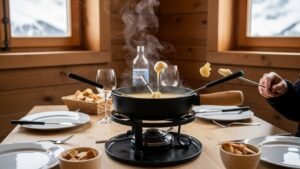
I remember looking out the window of that chalet, the snow-covered peaks looming in the darkness, and realizing that the fondue was a perfect mirror of the Swiss spirit: practical, resourceful, and deeply committed to quality and community. It was a meal that forced you to slow down, to connect with the people around you, and to appreciate the simple, profound comfort of being warm and well-fed in a harsh environment.
Beyond the Cheese: The Cultural Experience
The fondue experience is also a lesson in the Swiss approach to life. It is a rejection of the individualistic, fast-paced culture of the modern world. It is a meal that cannot be rushed, cannot be eaten alone, and cannot be done without a certain level of shared responsibility. Everyone must participate, everyone must be careful not to lose their bread, and everyone must contribute to the conversation.
This communal aspect is what makes it so special. It is a social lubricant, a conversation starter, and a powerful tool for bonding. The shared pot creates an immediate intimacy, breaking down barriers and fostering a sense of shared experience. It is a perfect reflection of the close-knit communities that thrive in the isolation of the high mountains.
If you are planning a trip to the Swiss Alps and are looking for other authentic, off-the-beaten-path experiences, you might find my article on 3-Day Trip in Switzerland: Lakes, Alps, and Hidden Villages helpful. It focuses on finding the quieter, more cultural corners of this stunning country.
A Final Dip
The fondue is not just a meal; it is a memory. It is the taste of the Alps, the warmth of the chalet, the laughter of friends, and the quiet satisfaction of a simple, perfect tradition. It is a reminder that the best things in life are often the simplest, and that the true flavor of a dish is inseparable from the place where it was born.
So, if you find yourself craving fondue, I urge you to wait. Wait until you are high in the mountains, surrounded by snow and good company. Wait until you can taste the Alpine air in the cheese and feel the history in the wooden walls of the chalet. Because that is when the fondue will finally make sense. That is when it will taste like home, like history, and like the very soul of Switzerland.

Taylor Smith is a passionate traveler since the age of 19 and currently lives in the United States. At 40 years old, Taylor loves exploring new cultures, experiencing local cuisine, and discovering authentic places around the world. He is also a dedicated writer, sharing his travel experiences and tips on this blog to help others make the most of their journeys in a thoughtful and inspiring way.