
There are moments in travel that distill the entire experience into a single, perfect sensory memory. For me, one of those moments involved a dessert in a small, sun-dappled *pâtisserie* in Brittany, a region of France known for its rugged coastline and fiercely independent spirit. It was a dessert I couldn’t pronounce, couldn’t quite describe, but which, with a single bite, taught me more about French culinary philosophy than any textbook ever could.
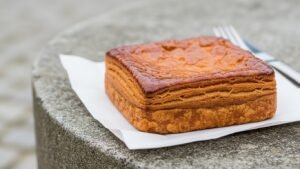
I had spent the morning wandering the cobbled streets of Saint-Malo, the air thick with the smell of salt and butter. My French is passable for ordering coffee and asking for directions, but when faced with the ornate, handwritten labels in the bakery window, I was utterly lost. Everything looked divine, but one pastry, in particular, called to me. It was a golden, layered square, glistening with caramelized sugar, looking both rustic and impossibly elegant.
When the baker, a woman with flour perpetually dusted on her apron, asked me what I wanted, I simply pointed. “That one,” I mumbled, feeling foolish. She smiled, a knowing, gentle smile that seemed to say, “Ah, the traveler’s choice.” When I asked her the name, she pronounced it with a soft, rolling R and a final, clipped sound that my tongue simply refused to replicate. It sounded something like “Kween Ah-mahn.” I tried, failed, and simply nodded, accepting my fate as a culinary tourist. The name, I would later learn, was **Kouign-Amann**.
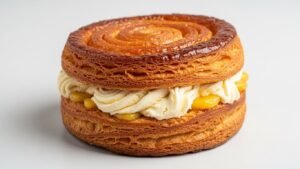
The Kouign-Amann is a masterpiece of simplicity and excess. It is, quite literally, “butter cake” in the Breton language. It is made from bread dough, folded with layers of butter and sugar, much like a croissant, but with a crucial difference: the sugar caramelizes during baking, creating a crisp, almost brittle exterior that shatters with a satisfying crunch. Inside, the layers remain soft, buttery, and slightly chewy. It is a caloric bomb that is worth every single, glorious calorie. It is a testament to the Breton spirit—unapologetically rich, honest, and deeply rooted in local ingredients.
The History of a Happy Accident: Brittany’s Golden Secret
The story of the Kouign-Amann is a beautiful example of culinary necessity being the mother of invention. It originated in the town of Douarnenez in the mid-19th century. Legend has it that a baker, facing a shortage of flour but an abundance of butter, decided to improvise. He took the remaining bread dough and folded in copious amounts of the local, high-quality salted butter and sugar.
The result was a happy accident. The high fat and sugar content, combined with the folding technique, created a pastry unlike any other. It was a way to use up ingredients that might otherwise have gone to waste, transforming them into a regional delicacy. The Kouign-Amann is not a delicate, airy Parisian pastry; it is a hearty, substantial treat, reflecting the rugged, seafaring culture of Brittany. It is a food that sustains, a food that celebrates the richness of the land and the sea.
The use of **salted butter** is non-negotiable. Brittany is famous for its butter, often made with sea salt harvested from the local salt marshes. This saltiness is what cuts through the intense sweetness of the caramelized sugar, creating a perfect balance that is the hallmark of the authentic Kouign-Amann. Without the salt, it would be merely sweet; with it, it becomes a complex, unforgettable experience.
IMAGEM2
This focus on regional ingredients and historical context is what makes French food so fascinating. It’s not just about the recipe; it’s about the story of the place. If you are interested in how local ingredients and traditions shape a country’s cuisine, you might enjoy reading my article on **The Italian Lasagna That Doesn’t Look Like Lasagna**. It delves into how regional variations completely change a classic dish.
The Art of the Fold: Why Technique Matters
The creation of a perfect Kouign-Amann is a masterclass in lamination, the process of folding fat into dough to create layers. While similar to the process for croissants, the proportions are different, and the goal is a denser, more caramelized result.
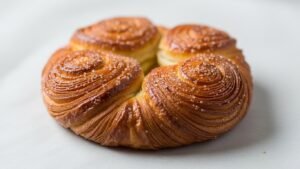
The dough is repeatedly rolled out, spread with a mixture of butter and sugar, and folded back on itself. This creates hundreds of thin layers. During baking, the butter melts, the water in the butter turns to steam, and the sugar caramelizes, essentially frying the layers of dough in butter and sugar. This is what gives the pastry its signature golden-brown, crackling crust.
A true Kouign-Amann should be served warm, ideally fresh from the oven. When it cools, the caramel hardens, and the pastry loses some of its delicate, buttery softness. Eating it warm is a race against time, a fleeting moment of perfection that must be savored immediately. It is a dessert that demands your full attention, a small ritual of indulgence.
Beyond the Pastry: The Culture of the French *Pâtisserie*
The experience of eating the Kouign-Amann was not just about the taste; it was about the atmosphere of the *pâtisserie*. In France, the bakery is a cultural institution, a place where art and sustenance meet. It is a place of ritual, where people line up patiently for their daily baguette and their weekend treats.
The baker, or *pâtissier*, is a respected artisan, a master of a demanding craft. There is a quiet pride in their work, a dedication to quality that is evident in every perfectly formed pastry. They are not just selling food; they are selling a piece of French heritage.
I remember watching a young couple enter the shop. They didn’t point; they spoke the name of their chosen pastry with confidence and a shared understanding with the baker. It was a small moment, but it highlighted the connection between language, food, and culture. My inability to pronounce the name was a small barrier, a reminder that I was an outsider, but the shared joy of the taste was a universal language that instantly broke it down.
If you are planning a trip to France and want to explore the culinary scene beyond the well-trodden paths, you might find my article on **The Simple Paris Sandwich That Tasted Better Than a Fancy Dinner** interesting. It explores how the simplest French foods can often be the most profound and memorable.
The Lesson of the Unpronounceable Name
The Kouign-Amann taught me that the best travel experiences often lie just beyond the edge of what is familiar. It was a reminder to be brave, to point when I couldn’t speak, and to trust that the quality of the experience would transcend the language barrier.
The name itself, “Kouign-Amann,” remains a delightful challenge, a secret password to a world of caramelized butter and sugar. It is a word that is meant to be spoken with a Breton accent, a sound that is part of the local landscape. And while I may never pronounce it perfectly, I will always remember the taste of that golden square, the sound of the shattering crust, and the kind smile of the baker who sold me a piece of her culture.
It is a dessert that is best enjoyed with a strong cup of coffee, sitting on a stone bench, watching the world go by. It is a moment of pure, unhurried pleasure, a small act of rebellion against the fast pace of modern life. It is a taste of *la douceur de vivre*—the sweetness of living—found in the most unexpected of places.

Taylor Smith is a passionate traveler since the age of 19 and currently lives in the United States. At 40 years old, Taylor loves exploring new cultures, experiencing local cuisine, and discovering authentic places around the world. He is also a dedicated writer, sharing his travel experiences and tips on this blog to help others make the most of their journeys in a thoughtful and inspiring way.