
Every traveler arrives in Athens with a mental checklist: the Acropolis, the Parthenon, and, inevitably, a warm, satisfying Gyros. And while the Gyros is a delicious, essential part of the Greek street food experience, to stop there is to miss the true, complex, and deeply historical heart of Athenian cuisine. Athens is a city that has been continuously inhabited for over 3,400 years, and its food is a living, breathing history book, a delicious narrative of empires, migrations, and the resilient spirit of the Greek people.
My own culinary awakening in Athens happened not in a bustling tourist square, but down a quiet, sun-drenched side street in the Psiri neighborhood. I was searching for a quick lunch, and the smell of roasting meat and spices was everywhere. I almost defaulted to a Gyros, but a small, unassuming sign in Greek caught my eye. It led me to a tiny *taverna* where the menu was handwritten and the only English spoken was a friendly “Welcome.”
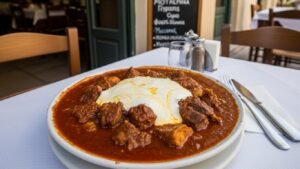
I pointed to a dish I saw on a neighboring table: a deep, rich stew with chunks of tender lamb and a thick, creamy topping. It looked like a hearty, comforting meal, far removed from the fast-food pace of the street. The waiter, a man with a magnificent mustache and an even more magnificent laugh, simply said, “Moussaka.” I thought I knew Moussaka—the layered casserole with eggplant and béchamel. But this, this was different. It was a revelation, a dish that spoke of slow cooking, family tradition, and the deep, earthy flavors of the Mediterranean.

The Moussaka I ate that day was a perfect example of how the best Greek food is often found when you venture just one street away from the main drag. It was a reminder that the most authentic culinary experiences are those that are shared, unhurried, and rooted in the local way of life. It was a dish that demanded I sit down, slow down, and savor the moment, a stark contrast to the grab-and-go nature of the Gyros.
The Unsung Heroes of Athenian Street Food
While the Gyros reigns supreme in the tourist imagination, the true street food scene in Athens is a vibrant tapestry of quick, delicious, and deeply traditional bites. These are the foods that fuel the city’s workers, students, and families, the ones that tell the story of a city always on the move.
One of the first things you should seek out is the **Koulouri**. Imagine a sesame seed bagel, but lighter, crispier, and often sold from a cart by a vendor who has been doing the same route for decades. It is the quintessential Athenian breakfast, a simple, cheap, and satisfying ring of bread that is perfect for eating on the go as you head to the metro or the ancient sites. The best ones are still warm, with a generous coating of toasted sesame seeds that leave a delightful, nutty residue on your fingers.
Another must-try is **Spanakopita**, the savory spinach and feta pie. But again, you must seek out the authentic version. The best Spanakopita is made with thin, delicate layers of phyllo pastry, brushed with olive oil and baked until golden and flaky. The filling is a creamy, tangy mix of spinach, feta cheese, and sometimes leeks or herbs. It is a perfect balance of textures and flavors, a portable piece of comfort food that can be found in almost any bakery (*fournos*) in the city.
The true beauty of Athenian street food is its honesty. It is food that is meant to be eaten quickly, but not carelessly. It is a nod to the Mediterranean diet’s emphasis on fresh, simple ingredients. If you’re interested in how street food reflects the soul of a city, you might enjoy my article on **What Street Food Says About a City**. It explores how these quick bites are often the best storytellers of a place’s history and culture.
Beyond the Grill: The Magic of *Mezedes*
To truly understand Greek cuisine, you must embrace the concept of *Mezedes*—small plates, similar to Spanish tapas, meant to be shared and savored over long, leisurely conversations. This is where the true culinary creativity of Athens shines, far from the simplicity of the Gyros.
One of my favorite *Mezedes* is **Dolmades**, the stuffed vine leaves. Forget the canned, vinegary versions you might have tried. The authentic Athenian Dolmades are tiny, delicate parcels, often stuffed with a mixture of rice, fresh herbs (like dill and mint), and sometimes minced meat. They are served cold, often with a dollop of thick, tangy Greek yogurt, and they are a burst of fresh, herbaceous flavor. They require patience to make, and that patience is rewarded in every bite.
Another essential *Mezedes* is **Keftedes**, the Greek meatballs. These are not the heavy, dense meatballs you might be used to. Keftedes are light, airy, and packed with flavor from herbs like oregano and mint. They are often fried until golden brown and served with a squeeze of lemon. They are the perfect accompaniment to a glass of *ouzo* or *tsipouro*, the traditional Greek spirits.
IMAGEM3
The experience of sharing *Mezedes* is a cultural one. It is about slowing down, connecting with your companions, and letting the food be the backdrop to the conversation. It is the antithesis of the fast-paced, individualistic meal. It is a reflection of the Greek philosophy of *kefi*—the spirit of joy, passion, and enthusiasm—that permeates their social life.
The Sweet Side of Athens: Desserts That Tell a Story
Greek desserts are often overlooked, but they are a vital part of the culinary landscape, telling tales of the country’s history and its connection to the Middle East.
The most famous, of course, is **Baklava**, the rich, sweet pastry made of layers of phyllo, chopped nuts, and a sweet syrup. But in Athens, you can find variations that are far more interesting than the standard tourist fare. Look for Baklava made with pistachios or walnuts, and pay attention to the syrup—the best ones are flavored with honey, cinnamon, and sometimes a hint of lemon or orange zest.
Another dessert that is a must-try is **Loukoumades**, the Greek doughnuts. These are small, fluffy balls of fried dough, soaked in honey syrup and sprinkled with cinnamon and sometimes chopped nuts. They are served warm, and they are incredibly addictive. They are a simple, comforting dessert, often sold by street vendors and in specialized shops.
And finally, there is **Galaktoboureko**, the custard pie. This is a creamy, semolina-based custard baked in phyllo pastry and drenched in a light, citrus-flavored syrup. It is a dessert that is both rich and refreshing, a perfect end to a heavy meal.
If you are a traveler who appreciates how food connects to a destination’s history, you might enjoy reading my article on **The Greek Yogurt That Has Nothing to Do With the Supermarket’s**. It explores how a seemingly simple food can be a profound cultural experience.
Conclusion: The Athenian Culinary Journey
To eat in Athens is to embark on a culinary journey that goes far beyond the familiar. It is about seeking out the hidden *tavernas*, embracing the slow ritual of *Mezedes*, and discovering the unsung heroes of the street food scene. It is about understanding that the best food is often the food that is made with patience, tradition, and a deep respect for the ingredients.
So, yes, have your Gyros. It is a rite of passage. But then, venture out. Find the small bakery selling warm Koulouri. Sit down for a plate of Dolmades. And most importantly, find a *taverna* where a man with a magnificent mustache will serve you a Moussaka that will redefine everything you thought you knew about Greek food. That is when you will truly taste Athens.


Taylor Smith is a passionate traveler since the age of 19 and currently lives in the United States. At 40 years old, Taylor loves exploring new cultures, experiencing local cuisine, and discovering authentic places around the world. He is also a dedicated writer, sharing his travel experiences and tips on this blog to help others make the most of their journeys in a thoughtful and inspiring way.