
The Coastal Charm of the Amalfi Coast: Beyond the Postcard Views
There is a specific shade of blue that only exists along the Tyrrhenian Sea. It’s not quite navy, and it’s certainly not turquoise; it’s a deep, shimmering cobalt that seems to hold the weight of a thousand summers. When you first catch a glimpse of it from the winding turns of the Statale 163—the famous Amalfi Drive—it takes your breath away. But as I’ve learned over decades of wandering through Europe, the true beauty of a place like the Amalfi Coast isn’t found in the panoramic views that everyone captures on their phones. It’s found in the scent of the lemon groves that clings to your clothes and the sound of the waves hitting the rocks while the rest of the world is still asleep.
[imagem1]
The Amalfi Coast is often described as a “playground for the rich,” a place of luxury yachts and expensive linen shirts. While that version of it certainly exists, it’s only the surface. If you look closer, you see a landscape that was carved out of necessity by farmers and fishermen long before the first tourist ever arrived. It is a vertical world, where life happens on staircases and terraces. To truly experience it, you have to be willing to leave the main squares behind and climb. You have to be willing to get a little bit lost.
This philosophy of looking deeper is something I carry with me on every trip. Whether I’m figuring out what to eat in Rome to truly understand Italian culture or exploring a quiet village in the Alps, I’ve realized that the most authentic experiences are the ones that require a bit of effort. In Amalfi, that effort usually involves several hundred stone steps, but the reward is always worth the sweat.
The Vertical Life of Positano
Positano is the most photographed town on the coast, and for good reason. From a distance, the colorful houses look like they are tumbling down the mountain into the sea. It’s a masterpiece of architecture and gravity. However, many visitors spend their entire time on the main beach or in the luxury boutiques.
I decided to spend my third morning there doing something different. I woke up at dawn—which, as I’ve discussed before, is the only way is it worth waking up early to photograph tourist cities?—and headed for the “upper” Positano. Away from the designer sandals and the expensive gelato, the town feels entirely different. I watched an old woman hanging her laundry across a narrow alleyway, her movements slow and rhythmic. I heard the sound of a radio playing Italian opera from an open kitchen window.
In these higher reaches, the “glamour” of the Amalfi Coast fades into the “reality” of Campania. You see the vegetable gardens tucked into tiny corners of soil and the small shrines built into the stone walls. It’s a reminder that even in the most famous places on earth, there is a quiet, everyday life that continues regardless of the tourist season.
The Lemon Groves of Minori and Maiori
If Positano is the face of the coast, the towns of Minori and Maiori are its soul. These towns are less vertical and a bit more lived-in. They are also the heart of the region’s lemon production. The Sfusato Amalfitano lemon isn’t just a fruit here; it’s a cultural icon. These lemons are massive, with a thick, sweet pith that you can eat like an apple.
I spent an afternoon walking the “Path of the Lemons,” an ancient trail that connects the two towns. The path takes you through rows of lemon terraces, shaded by traditional chestnut wood pergolas. The smell is intoxicating—a mix of citrus, wild herbs, and salt air. As I walked, I encountered a farmer carrying a heavy crate of lemons on his shoulder. He stopped to catch his breath and offered me a slice of lemon sprinkled with a bit of sugar.
That simple gesture, and that explosion of flavor, told me more about the Amalfi Coast than any five-star dinner could. It’s a region defined by its produce and its people’s resilience in farming such difficult terrain. It’s about taking something rugged and turning it into something sweet.
The Silence of Ravello
While the coastal towns can feel chaotic, especially when the ferries arrive, Ravello sits high above the fray. Perched on a cliff 350 meters above the sea, Ravello is where you go for silence. It has long been a retreat for artists, writers, and musicians. Wagner found inspiration here, and so did Virginia Woolf.
I spent hours sitting in the gardens of Villa Cimbrone, looking out from the “Terrace of Infinity.” The view is so vast that the horizon line disappears, and the blue of the sea blends perfectly with the blue of the sky. It’s a place that forces you to be still.
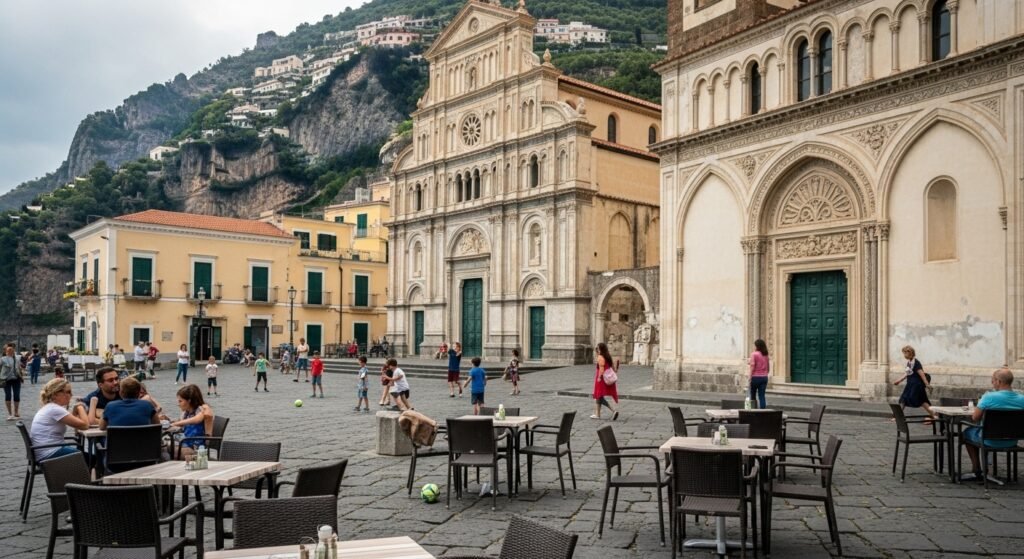
In Ravello, the luxury isn’t about what you can buy; it’s about the space you have to think. I found a small cafe in the main piazza where I sat for hours with a single espresso. I watched the local children playing soccer against the side of the 11th-century cathedral. There was no rush. Nobody was checking their watch. It was a masterclass in the art of doing nothing.
The Flavor of the Sea: Cetara
No journey through this region is complete without visiting Cetara, a tiny fishing village that remains largely untouched by the mass tourism that has transformed Positano. Cetara is famous for one thing: Colatura di Alici, a pungent, amber-colored fermented anchovy sauce that dates back to Roman times.
Eating in Cetara is a raw, honest experience. I sat at a small plastic table near the harbor and had a simple plate of spaghetti tossed with olive oil, garlic, chili, and a few drops of that precious anchovy essence. It was incredibly salty, intensely savory, and tasted exactly like the ocean.
Watching the blue fishing boats (called lampare) bobbing in the harbor, I realized that Cetara is the anchor of the coast. It’s the place that keeps the region connected to its maritime roots. While the other towns have pivoted toward hospitality, Cetara still smells of salt and scales. It’s a place where the “postcard view” is of a man mending a net, not a celebrity on a yacht.
Navigating the Amalfi Drive
I have to mention the drive itself. The Amalfi Drive is legendary for its beauty and notorious for its difficulty. It’s a narrow ribbon of asphalt that clings to the cliffs, with sheer drops on one side and towering rocks on the other.
Many people are terrified of driving it, and I understand why. The local bus drivers are artists; they navigate these turns with inches to spare, honking their horns before every blind curve. But there is a thrill to it. It’s a road that demands your total presence. You can’t daydream on the Amalfi Drive. You have to be engaged with every turn, every gear shift, and every breathtaking vista that appears around the corner.
However, if you want to enjoy the view without the white-knuckle stress, take the ferry. Seeing the coast from the water gives you a completely different perspective on the scale of the mountains. You see the tiny caves, the hidden beaches accessible only by boat, and the way the towns look like they were carved directly out of the limestone.
The Hidden Beaches and Secret Coves
Beyond the main docks, the Amalfi Coast is dotted with “secret” beaches. One of my favorites is Furore, often called “the fjord of Italy.” It’s a deep crack in the rocks where the sea rushes in to meet a tiny patch of sand. A high bridge spans the opening, and if you arrive early enough, you can have the entire place to yourself.
Swimming in these coves is a sensory overload. The water is cold and incredibly clear. You can see the silver flash of fish darting between the rocks feet below you. There’s a sense of privacy and discovery here that you don’t get at the beach clubs with their rows of identical umbrellas. It’s a reminder that even in a place as famous as this, there are still corners that feel like they belong only to you.
Why We Always Come Back
The Amalfi Coast is a place of contradictions. It is crowded yet lonely, expensive yet simple, ancient yet constantly changing. People often ask me if it’s “worth the hype,” especially during the summer months when the crowds are at their peak.
My answer is always yes, but with a caveat: you have to look beyond the postcard. If you only see what the influencers see, you’ll leave feeling like you’ve watched a beautiful movie but didn’t understand the plot. But if you take the time to talk to the lemon farmer, to climb the stairs to the quiet neighborhoods, and to eat the anchovies in a fishing village, you’ll find a region that is deeply human and incredibly resilient.

The charm of the Amalfi Coast isn’t in its perfection; it’s in its ruggedness. It’s in the way the stone feels under your hands as you climb a staircase that has been there for five hundred years. It’s in the bitter-sweet taste of a handmade limoncello. It’s a place that challenges you physically and rewards you spiritually.
As I drove away from the coast for the last time, watching the lights of Positano flicker like stars against the dark mountain, I realized that I wasn’t just leaving a destination. I was leaving a feeling. The Amalfi Coast teaches you that beauty is something you have to work for, and that the best views aren’t the ones you see with your eyes, but the ones you feel with your heart.

Taylor Smith is a passionate traveler since the age of 19 and currently lives in the United States. At 40 years old, Taylor loves exploring new cultures, experiencing local cuisine, and discovering authentic places around the world. He is also a dedicated writer, sharing his travel experiences and tips on this blog to help others make the most of their journeys in a thoughtful and inspiring way.