
There is a moment of pure, delightful confusion that every seasoned traveler eventually experiences: the moment when a dish you thought you knew intimately reveals a completely different identity. For me, that moment happened not in a remote, exotic land, but in the heart of Italy, with a plate of lasagna. I had come to Italy with the image of lasagna firmly fixed in my mind: thin, green pasta sheets layered with a rich, slow-cooked Bolognese ragù, creamy béchamel, and a dusting of Parmesan. It was a masterpiece of Emilia-Romagna, a culinary icon of the North.
But in Naples, I encountered a lasagna that defied everything I thought I knew. It was a towering, dense, almost architectural creation, bursting with ingredients that seemed to have no business being there: tiny, savory meatballs, slices of hard-boiled egg, chunks of cured sausage, and a generous, fluffy layer of ricotta cheese. It was a vibrant, messy, and utterly delicious rebellion against the Northern classic. It was the Lasagna di Carnevale, or Neapolitan Lasagna, and it was the moment I realized that in Italy, the word “lasagna” is not a recipe; it is a philosophy.
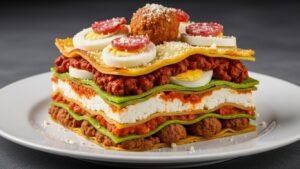
This realization is the key to understanding Italian cuisine. The country is a patchwork of fiercely independent regions, each with its own history, dialect, and, most importantly, its own kitchen. The lasagna I knew from Bologna was a product of its environment—the rich, fertile plains of Emilia-Romagna, famous for its dairy and its slow-cooked meats. The lasagna I found in Naples was a product of a different world: the vibrant, chaotic, and deeply religious culture of the South, where every dish is a celebration, and abundance is the highest form of hospitality.
The Neapolitan Rebellion: Lasagna di Carnevale
The Lasagna di Carnevale is the perfect example of the lasagna that doesn’t look like lasagna. It is traditionally made for the Carnival season, a time of feasting and excess before the austerity of Lent. This is why it is so rich, so heavy, and so unapologetically maximalist. It is a dish designed to use up all the rich ingredients before the fasting begins.
Instead of the delicate, meat-only ragù of Bologna, the Neapolitan version uses a ragù napoletano, a sauce that is slow-cooked for hours with large pieces of meat (often pork ribs, sausage, and beef) that are later removed and served as a separate secondo. The sauce itself is deep, dark, and intensely flavored. The layers are not just pasta and sauce; they are a cross-section of Neapolitan life. The ricotta adds a lightness and creaminess that contrasts beautifully with the dense meat and pasta. The hard-boiled eggs are a symbol of fertility and renewal, a nod to the coming spring.
The visual difference is striking. The Bolognese lasagna is often a neat, rectangular slice with a smooth, golden-brown top. The Neapolitan version is a glorious, messy mountain, often baked in a round or oval dish, with the fillings spilling out and the top bubbling with a mix of mozzarella and Parmesan. It is a dish that announces its presence, a true reflection of the Neapolitan spirit.
The Ligurian Green: Lasagna al Pesto
Traveling north along the coast, the lasagna transforms again. In Liguria, the region famous for its basil and its proximity to the sea, the meat disappears entirely, and the ragù is replaced by the vibrant green of pesto. This is the Lasagna al Pesto, a dish that is so visually and texturally different from the traditional version that it might as well be a different food entirely.
The pasta sheets are often thin and delicate, sometimes made with a touch of spinach for an even deeper green hue. The layers are simple: pasta, a generous spread of fresh pesto (made with local basil, pine nuts, garlic, and Parmesan), and a light coating of béchamel or ricotta to bind it all together. The flavor is bright, herbaceous, and utterly refreshing. It is a dish of the summer, a celebration of the Ligurian sun and the bounty of the coast.
This variation perfectly illustrates the Italian principle of cucina povera (peasant cooking), where the dish is dictated by the best local ingredients available. In Liguria, the best ingredient is basil, and the lasagna is simply the vehicle for its perfect expression.
If you are planning a trip to Italy and want to ensure you are experiencing the true, regional flavors, you might enjoy reading my article on What to Eat in Rome to Truly Understand Italian Culture. It delves into how the food of a city is the best guide to its history and soul.
The Sicilian Twist: Lasagna with Eggplant and Seafood
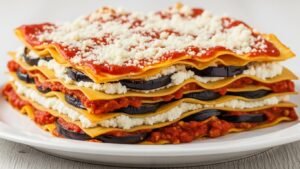
In Sicily, the lasagna takes on a Mediterranean flair. The most famous Sicilian variation is the Lasagna alla Norma, which is a celebration of the island’s most iconic vegetable: the eggplant. Here, the layers are interspersed with slices of fried eggplant, a rich tomato sauce, and a generous grating of ricotta salata (a salted, aged ricotta cheese) instead of the creamy béchamel.
The Lasagna alla Norma is a dish of the sun, a reflection of the island’s history and its strong connection to the land. The eggplant adds a smoky, meaty texture that makes the dish incredibly satisfying, even without traditional meat ragù.
But the Sicilian variations don’t stop there. Given the island’s coastal location, seafood lasagnas are also common, featuring layers of fresh fish, shrimp, and shellfish. Imagine a lasagna where the rich, meaty sauce is replaced by a delicate, briny seafood broth. It is a complete re-imagining of the dish, proving that the concept of “lasagna” is simply a framework for layering flavors, not a rigid set of rules.

The Philosophy of Lasagne: A Framework, Not a Formula
The true beauty of lasagne (the plural, and the correct Italian term for the dish) is its adaptability. It is a canvas upon which every region, every family, and every season can paint its own culinary portrait. The core idea is simple: pasta, filling, and a binder. Everything else is open to interpretation.
This regional diversity is a testament to the Italian spirit of preserving local traditions. In a country that was only unified in the mid-19th century, the kitchen remains the last bastion of regional pride. A Bolognese person will defend their ragù, a Neapolitan their ricotta and eggs, and a Ligurian their pesto, all with equal passion. This is why the lasagna you encounter in Italy will often not look like the one you expected—it will look like the region it comes from.
The key to appreciating this is to let go of your preconceptions. Don’t look for the “authentic” lasagna; look for the lasagna that is authentic to the place you are in. Each variation is a historical document, a reflection of the local economy, the climate, and the cultural influences that have shaped the region over centuries.
If you are planning a trip to Rome, a city that is a crossroads of Italian history and cuisine, you might find my article on What to Do in 2 Days in Rome: Experiences Beyond the Obvious helpful. It focuses on how to explore the city’s hidden gems and authentic experiences, which often includes finding the best local food spots.
The Lasagna That Unites
Despite all the regional differences, there is one thing that unites all lasagnas: they are dishes of celebration, comfort, and family. Whether it is the rich, celebratory Lasagna di Carnevale or the simple, comforting Lasagna al Pesto, it is a dish that is rarely made for one. It is a dish that requires time, patience, and a gathering of people to be truly appreciated.
The act of making lasagna is a labor of love, a slow, deliberate process that fills the house with the aroma of simmering sauce and baking cheese. It is a dish that forces you to slow down, to be present, and to share. And in a world that is constantly rushing, the lasagna, in all its forms, is a powerful reminder of the value of tradition, community, and the simple, profound pleasure of a meal shared with loved ones.
So, the next time you are in Italy, don’t just order “lasagna.” Ask about the local specialty. Ask why they use that particular cheese or that specific vegetable. Let the dish tell you the story of the region. You might find that the lasagna that doesn’t look like lasagna is the one that tastes the most authentic.

Taylor Smith is a passionate traveler since the age of 19 and currently lives in the United States. At 40 years old, Taylor loves exploring new cultures, experiencing local cuisine, and discovering authentic places around the world. He is also a dedicated writer, sharing his travel experiences and tips on this blog to help others make the most of their journeys in a thoughtful and inspiring way.