
New York City. It’s a place of towering skyscrapers and bustling avenues, but its true heart beats on the sidewalks, fueled by the incredible, chaotic, and utterly delicious world of street food. This isn’t just fast food; it’s a living, breathing history book, a culinary map drawn by generations of immigrants who brought their flavors, their traditions, and their dreams to the five boroughs. To eat street food in New York is to taste the story of the city itself.

The narrative begins with the pushcart vendors of the late 19th and early 20th centuries. As waves of immigrants—Irish, Italian, Jewish, and German—poured into the city, they found a way to survive and thrive by selling familiar, affordable foods from their homelands. The simple hot dog, for instance, was popularized by German immigrants, becoming the quintessential “dirty water dog” that still anchors countless street corners. It’s a symbol of American assimilation, a humble sausage that became a New York icon.
But the story quickly diversifies. Jewish immigrants from Eastern Europe introduced the bagel and the knish. The bagel, boiled and then baked, became the perfect portable breakfast, a dense, chewy ring of comfort. The knish, a baked or fried dough pocket filled with mashed potatoes or kasha, was the ultimate working-class snack. These foods weren’t just sustenance; they were cultural anchors, a taste of home in a bewildering new world.
The evolution of New York’s street food is a direct reflection of its ever-changing demographics. In the mid-20th century, the city saw an influx of Latin American and Caribbean immigrants, bringing with them the vibrant flavors of the south. Suddenly, the streets were filled with the aroma of empanadas, arepas, and cuchifritos (fried pork parts), adding new textures and spices to the urban palate.
If you are a traveler who loves to explore the cultural side of a city through its food, you might enjoy reading my guide on What to Eat in Rome to Truly Understand Italian Culture. It’s all about seeking out those authentic, local culinary experiences that tell a deeper story.
The Modern Melting Pot: From Halal Carts to Korean BBQ
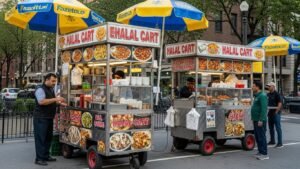
Today, the street food scene is a global bazaar. The ubiquitous Halal Cart is perhaps the most famous modern addition. Started by Egyptian immigrants, these carts, serving chicken or lamb over rice with their signature white and hot sauces, have become a culinary phenomenon. They represent the more recent waves of immigration from the Middle East and South Asia, providing a delicious, filling, and affordable meal that has transcended its origins to become a true New York staple.
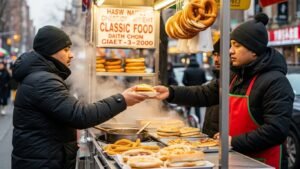
Another fascinating chapter is the rise of the specialized food truck. You can now find everything from gourmet Korean BBQ tacos to artisanal grilled cheese sandwiches. These trucks often start as culinary experiments, testing new concepts on the demanding New York public before moving into brick-and-mortar restaurants. They are the cutting edge of the city’s food scene, a testament to the entrepreneurial spirit that defines New York.
The beauty of New York street food is its accessibility. It democratizes the culinary experience. You can stand next to a Wall Street executive, a construction worker, and a tourist, all sharing the same $5 meal from a cart. It’s a great equalizer, a place where social barriers dissolve over a shared love of a perfectly seasoned falafel or a steaming bowl of ramen.
Finding the best street food requires a bit of insider knowledge. It’s not always the flashiest cart or the longest line. Sometimes, the best finds are the small, unassuming vendors tucked away in neighborhoods like Jackson Heights or Sunset Park, serving up incredible, authentic dishes from their home countries. If you’re looking for tips on how to find these hidden culinary gems, you might want to check out my article on How to Choose Restaurants That Locals Really Frequent. The same principles apply to finding the best street food.
The Sweet Side of the Street
The street food story isn’t complete without dessert. The classic New York soft pretzel, often sold by vendors alongside hot dogs, is a simple, salty, and satisfying treat. But the sweet side has also evolved with immigration. From the churros sold by Latin American vendors to the incredible array of Asian desserts found in Flushing, Queens, the street offers a world of sweet endings.
The most important thing about New York street food is the human connection. It’s the quick, friendly exchange with the vendor, the shared moment of warmth on a cold day, the feeling of being part of the city’s constant, vibrant motion. Each bite is a reminder that New York is a city built by people from every corner of the globe, and their food is the most delicious, enduring legacy they have left behind.
It’s a story told in spices, in dough, and in the steam rising from a thousand carts—a story that is still being written, one delicious meal at a time.

Taylor Smith is a passionate traveler since the age of 19 and currently lives in the United States. At 40 years old, Taylor loves exploring new cultures, experiencing local cuisine, and discovering authentic places around the world. He is also a dedicated writer, sharing his travel experiences and tips on this blog to help others make the most of their journeys in a thoughtful and inspiring way.