
Viennese Coffee House Culture: The Art of Doing Absolutely Nothing
There is a specific, golden weight to the air inside a traditional Viennese coffee house. It’s the smell of roasted beans, the faint scent of old newspapers, and the soft clink of a silver spoon against a porcelain cup. When I first stepped into Café Central in Vienna, I was a typical American traveler: I had my phone in my hand, my itinerary pulled up, and I was looking for the quickest way to get my caffeine fix so I could rush off to see the Hofburg Palace. But as the waiter—dressed in a formal black tuxedo—slowly approached my table, I realized that my pace was an insult to the room. In Vienna, coffee isn’t a beverage; it’s a destination. It is one of the few places left on earth where “doing nothing” is not only accepted but celebrated as a high art form.
The UNESCO-listed Viennese Coffee House culture is built on a beautiful, counter-intuitive philosophy: you pay for the chair, not the coffee. Once you order your Melange or Einspänner, the table is yours for as long as you wish. You are not a customer to be cycled through for profit; you are a guest in a public living room. This concept of lingering is something I’ve come to cherish over the years, much like the Paris cafe that taught me the art of sitting still. While the Parisians have their outdoor terraces and people-watching, the Viennese have their velvet booths and intellectual solitude. It is a sanctuary for the mind in an increasingly frantic world.
The Living Room of the Soul
To understand Vienna, you have to understand the history of these spaces. In the late 19th and early 20th centuries, the coffee house was the center of intellectual life. Writers like Stefan Zweig and Peter Altenberg practically lived in them; they had their mail delivered there, they conducted their business there, and they argued about philosophy until the early hours of the morning. Altenberg even had “Café Central” printed on his business card as his home address.
As I sat in that same cafe, I looked around and saw that the tradition hadn’t changed much. At one table, a student was buried in a thick textbook. At another, a couple was sharing a slice of Sachertorte in complete silence, simply enjoying the atmosphere. There is no pressure to “perform” or to be productive. In a world that demands we be constantly connected, the coffee house offers a rare moment of disconnect. It reminded me of why every trip starts long before boarding; we travel to find these pockets of peace that allow our thoughts to catch up with our bodies.
The Anatomy of the Order
Ordering coffee in Vienna is a ritual in itself. If you ask for a “regular coffee,” you’ll likely receive a confused look from the waiter. You have to speak the language. A Wiener Melange is the classic—similar to a cappuccino but often milder, topped with steamed milk and a bit of foam. Then there is the Einspänner, a strong black coffee served in a glass and topped with a thick, cold dollop of whipped cream.
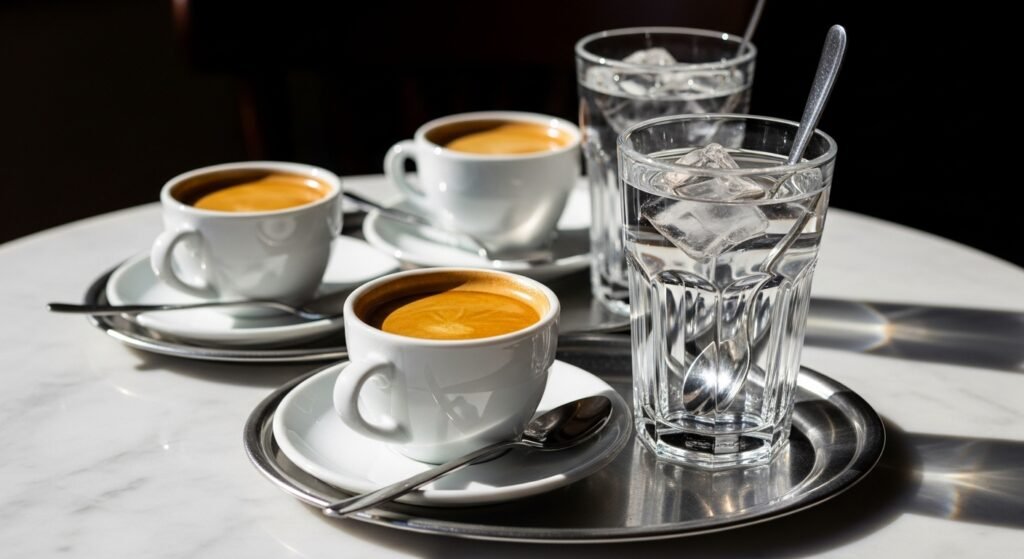
Every coffee is served on a small silver tray, accompanied by a tall glass of cold water with a silver spoon balanced upside down across the rim. This spoon isn’t just for show; it’s a signal from the house that the water is fresh. The water is meant to cleanse your palate between sips of coffee, ensuring that every taste is as vibrant as the first. It is a level of detail that makes you slow down. You find yourself noticing the way the sunlight catches the silverware and the way the marble table feels cool under your palms.
The Newspaper and the Marble Table
One of the most iconic sights in a Viennese coffee house is the Zeitungshalter—the wooden newspaper holders. In an era where everyone is staring at a glowing screen, seeing a row of international newspapers mounted on bentwood frames feels like a time-traveling experience. There is something tactile and grounding about the rustle of paper.
I spent an entire afternoon at Café Sperl, one of the most authentic spots in the city, doing nothing but reading and thinking. I didn’t check my emails. I didn’t look at my GPS. I just sat. At first, my brain felt itchy—that modern anxiety that tells us we are “wasting time.” But after the second glass of water, that feeling vanished. I started to notice the architecture of the room: the high ceilings, the worn parquet floors, and the billiards tables in the back. I realized that by doing “nothing,” I was actually absorbing the city far more deeply than I would have by running through ten different museums.
The Sweet Side of Silence: Cakes and Tortes
Of course, we cannot talk about Vienna without talking about the Konditorei (the pastry shop). The rivalry between the Hotel Sacher and Café Demel over the “original” Sachertorte recipe is the stuff of legends—a legal battle that lasted decades. But beyond the chocolate-and-apricot cake, there is a world of strudels, plum tarts, and cream puffs.
Eating a pastry in a Viennese coffee house is not a quick snack. It is an event. The Apfelstrudel here is served with a thin, flaky crust and just the right amount of tartness from the apples. As I watched a waiter expertly slice a cake at a side table, I thought about the craftsmanship involved. Much like the Italian gelato that doesn’t burn the tongue, the Viennese have turned their sweets into a cultural pillar. You don’t eat it because you are hungry; you eat it because it is a celebration of the present moment.
The Waiter: A Master of Discretion
The Viennese waiter is a character unto himself. Often characterized as “grumpy” by tourists, the reality is that they are masters of discretion. They understand that their job is to provide you with space. They will not hover. They will not ask you if “everything is okay” every five minutes. They leave you alone because they respect your solitude.
When you finally want the bill, you have to catch their eye. This might take a few minutes, but that is part of the game. It’s a subtle reminder that you are in no rush, and neither are they. In our “instant gratification” culture, this can be frustrating, but if you lean into it, it’s incredibly liberating. You realize that the world won’t end if it takes ten minutes to pay for a cup of coffee.
The Philosophy of the “Stammtisch”
In many cafes, you’ll see a table marked Stammtisch. This is the reserved table for the regulars—the people who have been coming to the same spot at the same time for thirty years. To see a group of elderly Viennese men playing cards or debating politics at their Stammtisch is to see the social fabric of the city in action.
The coffee house is the great equalizer. Whether you are a billionaire, a struggling artist, or a curious traveler, the price of admission is the same. Everyone is entitled to their small piece of marble and their silver tray. It is a democratic space where the only requirement is a respect for the quietude of others. It made me think about how we design our cities; we need more places that aren’t just for “moving through,” but for “being in.”

As the sun began to set over the Ringstraße, casting long shadows across the cafe floor, I realized that I had spent four hours in one spot. I hadn’t crossed anything off my “must-see” list. I hadn’t taken a single photo for social media. But I felt more connected to the spirit of Vienna than I ever had before. I understood that the city isn’t just its palaces and its music; it’s the quiet space between them.
The art of doing absolutely nothing is the hardest skill for a modern traveler to learn, but it is the most rewarding. It’s the secret to not just seeing a city, but feeling it. As I finally stood up to leave, folding my newspaper and nodding to the waiter, I felt a strange sense of clarity. I walked out into the cool evening air, not rushing, but moving at the slow, deliberate pace of a man who had finally learned how to drink his coffee.
Vienna teaches us that our time is our own. It reminds us that productivity is not the same as living. And sometimes, the most important thing you can do on your trip is to sit down, order a Melange, and wait for the world to come to you.
Taylor Smith is a passionate traveler since the age of 19 and currently lives in the United States. At 40 years old, Taylor loves exploring new cultures, experiencing local cuisine, and discovering authentic places around the world. He is also a dedicated writer, sharing his travel experiences and tips on this blog to help others make the most of their journeys in a thoughtful and inspiring way.