
Street food is the raw, unfiltered autobiography of a city. It is the culinary equivalent of a whispered secret, passed down through generations of vendors, immigrants, and hungry locals. Forget the Michelin-starred restaurants and the white tablecloths; if you truly want to understand the soul of an urban center—its history, its struggles, its triumphs, and its cultural melting pot—you must eat where the pavement meets the palate. Street food is fast, it is cheap, and it is democratic. It is the great equalizer, a shared experience that cuts across social strata, uniting the banker in a suit and the construction worker in a hard hat over a steaming, perfect bite.
My journey to understanding this began not in a bustling Asian market, but on a cold, rainy corner in London. I was rushing, trying to find a quick, forgettable lunch, when I stumbled upon a tiny cart selling the most incredible, spiced lamb wrap I had ever tasted. The vendor, a man with a kind smile and hands stained with turmeric, told me his family had brought the recipe from a small village in the Middle East decades ago. In that moment, the wrap was more than just food; it was a passport to another world, a piece of history preserved in a simple flatbread. It made me realize that every city’s street food scene is a living, breathing museum of its past.

The history of street food is as old as the city itself. In ancient Rome, the thermopolia (hot food stands) served the working class who lacked the means to cook at home. In the bustling markets of ancient China, vendors offered noodles and dumplings to travelers and merchants. Street food has always been a necessity born of urban density and the need for quick, accessible sustenance. It is a mirror reflecting the city’s economic reality, its population density, and its architectural layout. Where there are people on the move, there is street food.
The evolution of a city’s street food is a direct narrative of its immigration patterns. Think of New York City. The hot dog, the quintessential American street food, was popularized by German immigrants in the late 19th century. The pretzel, another staple, came from German and Austrian bakers. Later, the influx of Eastern European Jews brought the bagel and the knish. Today, the city’s carts and trucks serve everything from Korean BBQ tacos to Halal chicken and rice, each dish a delicious testament to the waves of people who have shaped the city’s identity. It is a constant, edible dialogue between the old and the new, the native and the newcomer.
The Culinary Archaeology of the Pavement
To truly appreciate street food, you must approach it with the mindset of a culinary archaeologist. Each ingredient, each spice, and each cooking technique is a clue to the city’s past. Consider the use of spices in a dish. In a city like Singapore, the blend of Chinese, Malay, and Indian spices in a simple laksa tells a story of trade routes, colonial history, and cultural exchange. The food is a palimpsest, with layers of history baked into every bite.
The simplicity of street food is its genius. It often relies on a few high-quality, locally sourced ingredients, prepared with a technique that has been perfected over decades. This focus on simplicity is often a reflection of the economic conditions that gave birth to the dish. It was food for the masses, designed to be filling, flavorful, and affordable. This is why street food often remains stubbornly authentic, resisting the pressures of gentrification and gourmet trends. It is a cuisine of necessity, not pretense.
The sheer variety of street food in a single city can be overwhelming, but it is also a beautiful expression of its diversity. In Mexico City, you can find tacos al pastor (a Lebanese-Mexican fusion), tlayudas (a Oaxacan specialty), and quesadillas (a central Mexican staple), all within a few blocks. This culinary geography is a map of the country’s internal migration, a demonstration of how people carry their regional identities with them when they move to the capital.
If you are fascinated by how local food reveals a city’s history, you might find my article on The Street Food of New York That Tells the City’s Story to be a compelling read. It goes into detail about the specific dishes that define the Big Apple’s cultural evolution.
Street Food as a Social and Economic Engine
Beyond its cultural significance, street food is a vital economic engine for many cities. It provides low-barrier entrepreneurship opportunities for immigrants and low-income residents, allowing them to start a business with minimal capital. The street vendor is often the first rung on the ladder of economic mobility, a small business owner who is contributing to the local economy one perfect empanada or bao at a time.
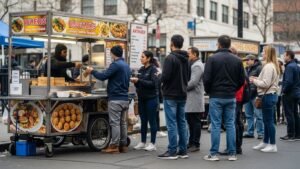
The social role of street food is equally important. It creates public spaces where people from all walks of life interact. The queue for a popular food cart is a temporary community, a place where strangers share a common anticipation. It is a space of social mixing that is increasingly rare in modern, segmented urban life. The street food scene is a vibrant, chaotic, and utterly human ecosystem.

The rise of the “gourmet” food truck has brought a new dimension to the street food scene. While some purists lament the gentrification of the pavement, the gourmet movement has also brought innovation and a new level of culinary artistry to the streets. It has shown that street food is not just about tradition; it is also about experimentation and pushing culinary boundaries. This evolution is a sign of a healthy, dynamic food culture that is constantly adapting to new tastes and trends.
However, the heart of street food remains in the traditional, often family-run stalls. These are the places where recipes are guarded secrets, passed down from mother to daughter, father to son. These vendors are the true custodians of the city’s culinary heritage, preserving flavors and techniques that might otherwise be lost to time. They are the ones who remind us that the best food is often the simplest, made with love and a deep respect for tradition.
The global spread of street food is also a fascinating phenomenon. Dishes like the taco, the kebab, and the ramen bowl have traveled the world, adapting to local ingredients and tastes while still retaining their core identity. This culinary globalization is a testament to the universal appeal of street food: its convenience, its flavor, and its ability to tell a compelling story.
If you are interested in how food can be a window into a country’s soul, you might also enjoy my article on The Pastel de Nata in Portuguese Culture: More Than Just a Custard Tart. It explores how a simple pastry can embody centuries of history and tradition.
The Future of the Pavement Plate
The future of street food is bright, but it is not without its challenges. Issues like regulation, sanitation, and competition from fast-food chains constantly threaten the livelihood of street vendors. Yet, the enduring appeal of street food—its authenticity, its affordability, and its connection to local culture—suggests that it will continue to thrive.
As travelers, we have a responsibility to support this vital part of the urban ecosystem. Seek out the local stalls, talk to the vendors, and be open to trying something new. Every bite is an investment in the city’s culture and a chance to connect with its people on a deeply human level. Street food is not just a meal; it is an experience, a lesson in history, and a celebration of the human spirit. It is the taste of the city, and it is waiting for you on the next corner.

Taylor Smith is a passionate traveler since the age of 19 and currently lives in the United States. At 40 years old, Taylor loves exploring new cultures, experiencing local cuisine, and discovering authentic places around the world. He is also a dedicated writer, sharing his travel experiences and tips on this blog to help others make the most of their journeys in a thoughtful and inspiring way.