
The first time I arrived in Paris, I had a very specific, almost cinematic, culinary goal: to sit at a tiny café table, sip a *café au lait*, and bite into the perfect, flaky, buttery croissant. I achieved it, of course. It was everything the movies promised—a golden, crescent-shaped piece of heaven that shattered into a thousand crumbs with the first bite. But after the third perfect croissant, I realized something profound: if I only ate the famous things, I would only experience the Paris that everyone else experiences. I would miss the city’s true, complex, and deeply personal culinary soul.
Parisian food is a language, and the croissant is just the first, most famous word. To truly understand the city, you have to learn the rest of the vocabulary—the savory, the hearty, the simple, and the unexpected. You have to venture beyond the glass cases of the *boulangeries* and into the cozy, often noisy, world of the *bistros* and the local markets.
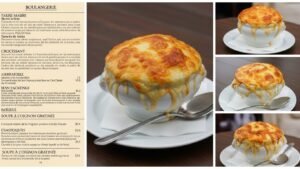
My journey to discover the “other” Paris began with a simple, yet life-changing, mistake. I was trying to find a famous *boulangerie* near the Marais, got completely turned around, and ended up in a small, unpretentious *bistro* where the menu was entirely in French and the only other patrons were elderly couples speaking in rapid-fire Parisian slang. I pointed to a dish on the menu that I vaguely recognized: *Soupe à l’Oignon Gratinée*.
I thought I was ordering a simple onion soup. What arrived was a bowl of deep, caramelized flavor, topped with a thick, golden crust of melted Gruyère cheese that sealed the bowl like a lid. It was a dish of peasant origins, born from necessity, transforming humble onions and stale bread into something luxurious and deeply comforting. It was a hug in a bowl, a taste of a Paris that was warm, grounded, and utterly unconcerned with being fashionable.

That soup was my first lesson: the best Parisian food is often the food that doesn’t try to impress the tourists. It simply exists to nourish the soul. It was a moment of quiet, authentic connection that made me realize I needed to adjust my entire approach to eating in the city.
The Savory Staples: Comfort Food of the Parisian Soul
While the croissant is the star of the morning, the true heart of Parisian cuisine lies in its savory, comforting staples. These are the dishes that have sustained the city through centuries, and they are the ones you must seek out to truly eat like a local.
One of the most ubiquitous and satisfying is the **Croque Monsieur**. Forget the sad, pale versions you might find elsewhere. The authentic Parisian Croque Monsieur is a masterpiece of simplicity: two slices of brioche-like bread, filled with high-quality ham and Gruyère cheese, slathered with a creamy Béchamel sauce, and baked until the cheese is bubbling and golden brown. It is often served with a side of crisp, lightly dressed greens to cut through the richness. It is the perfect lunch, a testament to the French ability to elevate even the simplest ingredients.
Then there is the **Steak Frites**. This might seem obvious, but the Parisian version is about the quality of the ingredients and the precision of the execution. A perfectly seared cut of beef, often a *bavette* or *entrecôte*, served with a mountain of thin, crispy, golden fries. The key is the sauce—often a simple butter-herb concoction that melts over the hot steak. It is a dish that speaks of the French reverence for quality meat and the simple joy of a perfectly cooked meal.
If you are interested in finding the places where these authentic, non-touristy dishes are served, you might find my article on **How to Choose Restaurants That Locals Really Frequent** helpful. It offers practical tips for navigating the culinary landscape of any major city to find the true local gems.
The Regional Deep Cuts: Beyond the Bistro Menu
To truly go beyond the basics, you need to look for the regional specialties that have found a home in Paris. These dishes tell the story of France’s diverse geography and culinary traditions.
The most famous of these is **Cassoulet**, a hearty, slow-cooked stew originating from the Languedoc region. It is a dish of white beans, duck confit, sausages, and sometimes pork skin, cooked for hours until the flavors meld into a rich, unctuous masterpiece. Finding a good Cassoulet in Paris is like finding a hidden treasure—it is a sign that the *bistro* takes its culinary heritage seriously. It is a dish that demands a cold day, a glass of robust red wine, and a long, unhurried afternoon.
Another fascinating dish is **Pot-au-feu**, a classic French boiled dinner. It is a simple, yet elegant, dish of beef, root vegetables (carrots, turnips, leeks), and spices, simmered in a broth until the meat is falling apart. The broth is served first as a soup, and then the meat and vegetables follow, often with a side of coarse salt and mustard. It is the ultimate comfort food, a dish that embodies the French philosophy of using every part of the animal and celebrating the natural flavors of simple ingredients.
IMAGEM3
These dishes are not just food; they are cultural artifacts. They are the flavors of French history, brought to the capital by generations of migrants and cooks. They are a reminder that the French culinary tradition is not just about fancy sauces and complex techniques, but about honoring the ingredients and the slow, deliberate process of cooking.
The Sweet Surprises: Desserts That Aren’t Macarons
While macarons and crêpes are delightful, the Parisian dessert scene offers so much more. These are the sweets that locals crave, the ones that are often found in the smaller, neighborhood *pâtisseries*.
The **Paris-Brest** is a must-try. Created in 1910 to commemorate the Paris-Brest-Paris bicycle race, it is a ring of *choux* pastry, filled with a praline-flavored cream and dusted with sliced almonds. The circular shape is meant to resemble a bicycle wheel. It is a light, airy, and intensely nutty dessert that is a perfect example of French *pâtisserie* artistry.
Another classic is the **Tarte Tatin**. This is an upside-down caramelized apple tart, where the apples are cooked in butter and sugar until they are soft and deeply caramelized, and then covered with a layer of puff pastry before being baked. It is served warm, often with a dollop of *crème fraîche*. The story goes that it was created by accident by the Tatin sisters in their hotel in Lamotte-Beuvron, and it is a perfect example of how a simple mistake can lead to a culinary legend.
If you are exploring the hidden corners of the city in search of these culinary gems, you might also be interested in my article on **2-Day Trip in Paris: Hidden Cafés and Secret Streets**. It offers a guide to the less-traveled paths where you can find these authentic experiences.
The Parisian Ritual: More Than Just Eating
The final, and perhaps most important, thing to eat in Paris is not a dish at all, but the **ritual of the meal**. It is the unhurried pace, the focus on conversation, and the deep respect for the food on the plate.
The French approach to dining is a cultural lesson in itself. Lunch is not a quick desk-side affair; it is a moment to step away, sit down, and savor. Dinner is a long, multi-course event, where the wine flows and the conversation is the main course. This is the true Parisian experience—the art of *savoir-vivre*, or the art of living well.
To truly eat in Paris is to embrace this ritual. It means ordering a glass of wine with your lunch, even on a Tuesday. It means taking the time to appreciate the quality of the bread, the sharpness of the cheese, and the simple perfection of a perfectly ripe tomato. It means putting down your phone and engaging with the people around you.
Conclusion: The Taste of a Thousand Stories
The croissant is a beautiful introduction to Paris, but it is only the beginning. To truly taste the city, you must venture into the world of savory stews, comforting sandwiches, and regional specialties. You must seek out the *bistros* where the menu is in French and the only English spoken is a friendly “Welcome.”
It is in these places, far from the tourist crowds, that you will find the true heart of Parisian cuisine. You will find the food that tells the story of the city’s history, its regions, and its people. And in doing so, you will not just eat in Paris; you will live it.


Taylor Smith is a passionate traveler since the age of 19 and currently lives in the United States. At 40 years old, Taylor loves exploring new cultures, experiencing local cuisine, and discovering authentic places around the world. He is also a dedicated writer, sharing his travel experiences and tips on this blog to help others make the most of their journeys in a thoughtful and inspiring way.