
Early explorations in coffee often emphasized tangible factors like water quality and grind precision. These elements remain essential, but the world of coffee is evolving. Today, the craft is increasingly informed by high-tech, data-driven approaches.
Modern laboratories are combining molecular biology with machine learning to understand coffee at a deeper level. These innovations aim not only to safeguard the industry against climate change but also to enhance the aromatic complexity and flavor potential of every bean. The future of coffee is becoming as much about science and technology as it is about traditional barista skills.
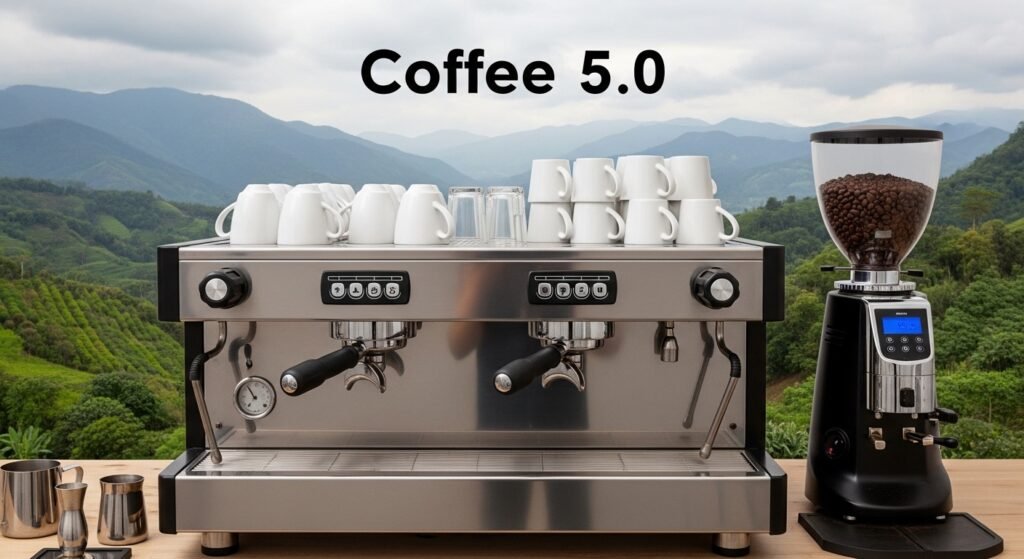
The concept of “Coffee 5.0” represents the integration of the physical, digital, and biological worlds. We are moving beyond just calibrating an espresso machine; we are now calibrating the genetics of the bean and the neural response of the consumer. This article serves as a manifesto for the next century of coffee science.
AI and Terroir Prediction: The End of Geographic Guesswork
One of the most revolutionary shifts in the “Sensory Laboratory” is the use of Artificial Intelligence (AI) to map and predict terroir. Historically, finding a “Grand Cru” coffee farm was a matter of luck and generations of trial and error in high-altitude regions.
-
Predictive Modeling: By feeding decades of climate data, satellite soil analysis, and cupping scores into neural networks, AI can now identify “future terroirs.” As the planet warms, AI helps us find new regions—perhaps in currently dormant African highlands—that will have the perfect conditions for specialty Arabica in 2040.
-
Real-Time Crop Monitoring: “Smart Farms” now use drone-mounted multispectral cameras to detect “flavor stress.” Before a human eye can see a nutrient deficiency, the AI detects changes in leaf reflectance, allowing for precision maintenance that ensures the mouthfeel and body of the final cup remain consistent.
CRISPR and the Genetic Future of Flavor
As we explored in our study of High-Altitude Secrets, altitude provides the thermal stress necessary for complex acid development. However, climate change is removing those cold nights.
-
CRISPR-Cas9 Editing: Scientists are now using gene-editing tools to “switch on” the stress-response genes that produce fruity esters and citric acids, even at lower temperatures. This could allow farmers to produce “High-Altitude Quality” coffee at lower, more resilient elevations.
-
Caffeine Tuning: We are moving toward “Precision Caffeine.” In the future, the “Sensory Laboratory” won’t just offer decaf or regular. Through genetic selection, we will have beans with specific caffeine “half-lives,” allowing for a cup that provides focus without interfering with sleep cycles, all while maintaining the aftertaste clarity of a specialty bean.
Molecular Gastronomy 2.0: Beyond Spherification
In the “Drink Laboratory,” we have mastered spherification and nitro-infusion. The next step is Flavor Printing and Acoustic Aging.
-
Sonic Maturation: By subjecting green coffee or cold brew to specific ultrasonic frequencies (beyond what we use for equipment cleaning), we can accelerate the breakdown of complex lipids into smaller, more aromatic molecules. This mimics the effects of “aged” coffee in a matter of hours.
-
3D Printed Foams: We are seeing the rise of structured foams where the viscosity is engineered at a microscopic level to release different aromas at different temperatures. As you drink, the foam structure changes, shifting the profile from “Citrus” to “Chocolate” as the cup cools.
The Digital Twin: Real-Time Extraction Simulation
On the barista’s bench, the future is the “Digital Twin.” Every espresso machine will be connected to a cloud-based simulation of the specific coffee being used.
-
Dynamic Calibration: Instead of the barista guessing the dial-in process, the machine will use sensors to analyze the density and moisture of the beans in the hopper. It then runs a thousand simulations to find the “Ideal Extraction Curve” for that specific millisecond of the day, adjusting for water quality and barometric pressure.
-
Biometric Feedback: We are entering the era of “Neuro-Feedback Cupping.” In the “Sensory Laboratory,” we can now use wearable EEG devices to measure a taster’s brain response to a specific aftertaste. This removes the subjectivity of human language and provides a pure data point on “Pleasure” and “Intensity.”

Sustainability: The Circular Coffee Economy
The future of coffee science is also the science of waste. The 100th article marks our commitment to a “Zero-Loss” system.
-
Cascara Refinement: We are moving beyond simple cascara tea. The “Sensory Laboratory” is developing ways to extract polyphenols from coffee cherry waste to create natural preservatives and flavor enhancers for the Drink Laboratory.
-
Carbon-Negative Roasting: Future roasters will use green hydrogen and carbon-capture technology to ensure that the aromatic profile we love doesn’t come at a cost to the atmosphere.

Conclusion: The Journey to Article 1,000
We have reached 100 articles, but in the world of science, we have only just cleared the portafilter. The “Sensory Laboratory” has evolved from a simple brewing guide into a multidisciplinary hub of physics, chemistry, and biology.
The future of coffee is not about replacing the human element, but about empowering it. Whether we are using AI to protect a Kenyan hillside or using molecular physics to engineer a better mouthfeel, the goal remains the same: the perfect cup.
Respect the water, trust the grind, maintain your equipment with religious fervor, and never stop questioning the aftertaste. Here is to the next 100 articles, and to the endless pursuit of the bean’s hidden soul.

Kevin Smith is deeply interested in the craft and culture of coffee, with practical experience exploring specialty beans, brewing techniques, and flavor development. Over the years, he has spent time studying preparation methods, observing extraction processes, and understanding how small details influence the final cup.
Through NovaWeHub, Kevin shares clear, practical, and research-based insights designed to make coffee knowledge approachable for everyone — from beginners to enthusiasts. His focus is on simplifying complex concepts and encouraging readers to explore coffee with curiosity, confidence, and a more refined sensory awareness.