
If you ask any professional barista what the most important piece of equipment is for making great coffee at home, they won’t say the espresso machine or the pour-over dripper. They will almost certainly say the grinder. In the world of specialty coffee, the grinder is the heartbeat of your kitchen laboratory. You can buy the most expensive, award-winning beans in the world, but if you grind them with a poor-quality tool, you will destroy their potential before the water even touches them. Choosing a grinder is the single most significant investment you can make to elevate your daily ritual.
The reason for this is simple: consistency. When you brew coffee, you are performing a chemical extraction. You want the water to pull flavor out of every coffee particle at exactly the same rate. If your grinder produces a mix of large chunks and fine dust, the dust will over-extract and become bitter, while the chunks will under-extract and stay sour. This guide is designed to help you navigate the complex market of burrs, motors, and adjustments to find the perfect tool for your specific coffee needs.
Blade vs. Burr: The Great Divide
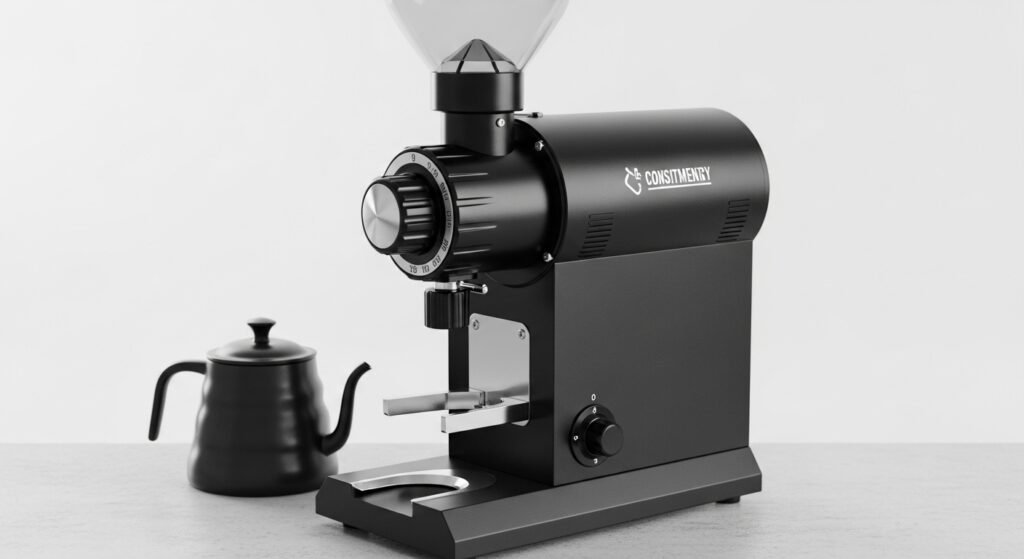
The first lesson in coffee grinding is understanding the difference between blade grinders and burr grinders. Blade grinders, often found in general appliance stores, work like a blender. A metal blade spins at high speeds, smashing the beans into uneven fragments. There is no control over the size of the particles, and the friction often generates heat that can “re-roast” the beans, altering their flavor profile. For specialty coffee, blade grinders are generally avoided because they make it impossible to achieve a balanced extraction.
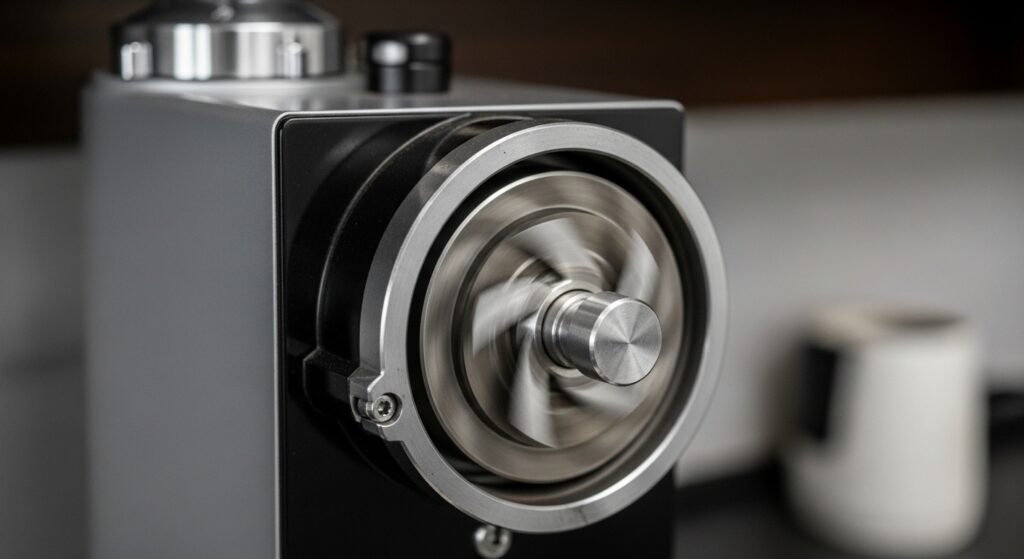
Burr grinders, on the other hand, use two revolving abrasive surfaces (the burrs). The beans are crushed between them rather than sliced. The distance between these two surfaces determines the grind size, allowing for incredible precision. Whether you need a coarse grind for a French Press or a powder-fine grind for Espresso, a burr grinder ensures that every particle is nearly identical in size. This consistency is what allows you to repeat a great recipe day after day. Within the world of burr grinders, you will encounter two main types: flat burrs and conical burrs. Flat burrs are known for producing a very uniform grind that highlights clarity and bright notes, while conical burrs are often preferred for their ability to produce a “bimodal” grind that adds texture and body to the coffee.
Manual vs. Electric: Which Journey are You On?
Once you decide on a burr grinder, the next big question is: do you want to use your muscles or electricity? Manual (hand) grinders have come a long way in the last decade. High-end manual grinders now use stainless steel burrs and ball bearings that make grinding a pleasure rather than a chore. They are perfect for those who only brew one or two cups at a time, or for people who travel frequently. The main advantage of a manual grinder is the price-to-performance ratio; you can get a professional-level grind quality for a fraction of the cost of an electric model because you aren’t paying for a motor or electronics.
However, if you find yourself making coffee for a family or if you are focused on espresso, an electric grinder is a necessity. Espresso requires a very fine grind, which can take over a minute of intense cranking by hand. Electric grinders offer convenience and speed, allowing you to go from whole bean to ground coffee in seconds at the push of a button. For those seeking the ultimate home experience, electric “single-dose” grinders are currently the biggest trend. These machines are designed to have “zero retention,” meaning that every gram of coffee you put in is exactly what comes out, ensuring maximum freshness for every cup.
Understanding Grind Adjustment: Stepped vs. Stepless
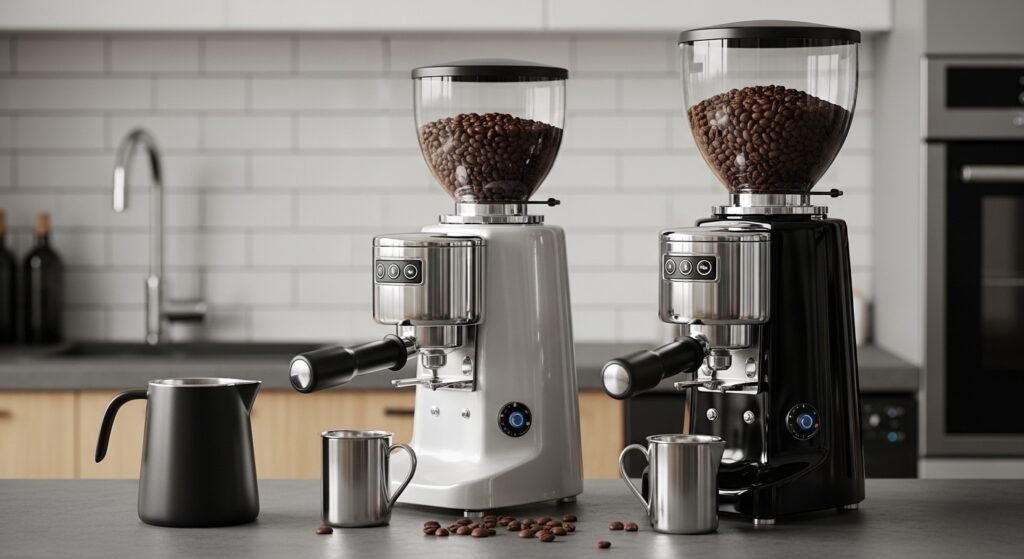
As you dive deeper into the specifications of various grinders, you will see the terms “stepped” and “stepless” adjustments. This refers to how you change the grind size. A stepped grinder has pre-set “clicks” or notches. These are great for beginners because they are easy to navigate and allow you to switch back and forth between different brew methods (like going from a coarse French Press setting to a medium V60 setting) with ease. Most high-quality home grinders use a stepped system with enough clicks to satisfy most brewing needs.
Stepless grinders, however, are the gold standard for espresso enthusiasts. They have no notches, allowing you to make infinite, microscopic adjustments to the grind size. In the world of espresso, a change of just a few microns can be the difference between a shot that flows too fast and one that is perfect. Stepless grinders allow you to “dial in” your coffee with surgical precision. The downside is that they are harder to move between different brew methods. If you primarily drink espresso, go stepless. If you like to experiment with various methods like AeroPress, Chemex, and Moka Pot, a stepped grinder will likely be much more user-friendly.
Build Quality and Heat Management
A grinder is a mechanical tool, and like any tool, the materials matter. Cheap grinders often use ceramic burrs. While ceramic is durable and doesn’t get hot, it tends to produce more “fines” (micro-dust) than stainless steel. Stainless steel burrs are sharper and more precise, making them the preferred choice for those who want a “clean” cup of coffee where individual flavor notes like berries or jasmine can shine. Furthermore, the build quality of the housing—whether it is plastic or heavy-duty aluminum—affects the noise level and the stability of the machine.
Heat is another enemy of fresh coffee. When burrs spin at very high speeds for a long time, they generate heat. This heat can cause the volatile aromatic oils in the coffee to evaporate before they ever reach your cup. High-end home grinders are designed with powerful motors that spin at lower RPMs (revolutions per minute) or use larger burrs to dissipate heat more effectively. This ensures that the complex chemical profile developed by the roaster is preserved during the grinding process.
Conclusion: Investing in Your Palate
Choosing the right grinder is about matching the tool to your lifestyle. If you are a minimalist who loves a morning pour-over, a high-quality manual grinder might be your best friend for life. If you are an aspiring home barista dreaming of the perfect latte art, you should prioritize an electric, espresso-focused burr grinder. Whatever you choose, remember that the grinder is not an “accessory” to your coffee machine—it is the most vital component of the system.
When you invest in a great grinder, you aren’t just buying a kitchen appliance; you are buying the ability to taste the world. You are enabling yourself to distinguish between a citrusy Ethiopian Yirgacheffe and a nutty Brazilian Cerrado. You are taking control of the extraction process and ensuring that every morning begins with the best possible version of your favorite beverage. In the long run, a good grinder pays for itself by reducing wasted beans and providing a level of satisfaction that no pre-ground coffee could ever achieve. Stop looking at the coffee machine and start looking at the burrs; that is where the magic truly happens.

Kevin Smith is deeply interested in the craft and culture of coffee, with practical experience exploring specialty beans, brewing techniques, and flavor development. Over the years, he has spent time studying preparation methods, observing extraction processes, and understanding how small details influence the final cup.
Through NovaWeHub, Kevin shares clear, practical, and research-based insights designed to make coffee knowledge approachable for everyone — from beginners to enthusiasts. His focus is on simplifying complex concepts and encouraging readers to explore coffee with curiosity, confidence, and a more refined sensory awareness.