
When many specialty enthusiasts think of “premium coffee,” their minds often drift toward the high-altitude peaks of Colombia or the floral gardens of Ethiopia. However, to ignore the Asian continent is to ignore a massive and increasingly sophisticated pillar of the coffee world. Asia is a land of extremes. In Vietnam, you find the world’s powerhouse of Robusta production, driving the global industry. In Indonesia, you find some of the most unique and labor-intensive processing methods ever devised by human ingenuity.
The “Spirit of Asia” in coffee is defined by its wildness. It doesn’t offer the clean, sparkling acidity of a V60 pour-over made with Central American beans. Instead, it offers a deep, brooding body and mouthfeel characterized by notes of tobacco, cedar, dark chocolate, and forest floor. In this exploration of “Origin and Earth,” we will travel through the misty archipelagos of Indonesia and the vast highlands of Vietnam to understand how these environments shape the boldest cups of coffee on the planet.
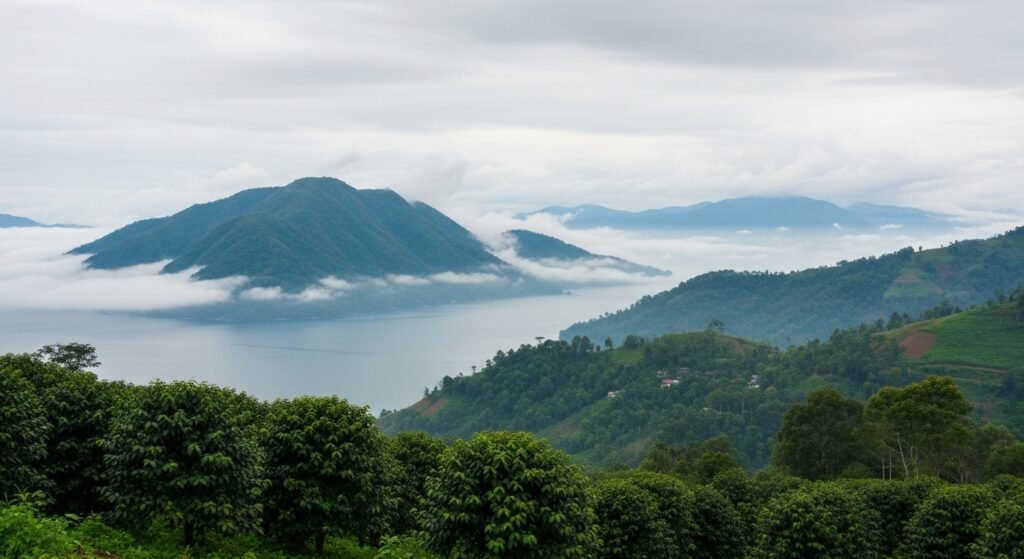
Indonesia: The Magic of “Giling Basah”
Indonesia is an archipelago of over 17,000 islands, and its coffee is as diverse as its geography. From Sumatra and Java to Sulawesi and Bali, each island offers a distinct terroir. However, what truly defines Indonesian coffee—particularly from Sumatra—is a unique processing method called Giling Basah, or “Wet Hulling.“
Because of the high humidity and constant tropical rainfall in Indonesia, farmers cannot dry coffee in the traditional way used in Brazilian coffee regions. In the Giling Basah method, the coffee is de-pulped but the parchment is removed while the bean is still at a high moisture content (around 30-50%). Most other origins wait until the bean is at 11% moisture. This “wet” processing gives the beans a signature deep bluish-green color and reduces the acid vs. bitter balance toward a low-acid, heavy-bodied profile. When you identify flavor notes in a Sumatran Mandheling, you are tasting the direct result of this intense environmental struggle against moisture.
Vietnam: The Robusta Revolution and Beyond
Vietnam is the second-largest coffee producer in the world. For decades, it has been the backbone of the global instant coffee and commercial espresso market, primarily growing Coffea Canephora (Robusta). However, a revolution is happening on the barista’s bench. Vietnamese farmers are beginning to apply “specialty” standards to their Robusta, focusing on water quality during processing and precise maintenance of their equipment.
Robusta contains nearly double the caffeine and antioxidants of Arabica. While it has a reputation for being harsh, a high-quality “Fine Robusta” from the Central Highlands of Vietnam can offer incredible notes of roasted grains, dark cocoa, and even savory spices. It provides a thick crema and a powerful aftertaste that makes it an essential component for many traditional European espresso blends. Furthermore, Vietnam is increasingly growing Arabica (like the Catimor variety) in regions like Da Lat, proving that its high-altitude potential is just as viable as its lowland power.
The Volcanic Soil of the Ring of Fire
The entire Southeast Asian coffee belt sits on the “Pacific Ring of Fire.” This means the soil is almost exclusively volcanic. As we discussed in our study of mountain coffee, volcanic soil is rich in minerals that contribute to a coffee’s structural complexity.
In Indonesia, the soil’s iron and phosphorus content, combined with the Giling Basah process, creates a very distinct “earthy” sweetness. It is a flavor that is polarizing; some drinkers find it too heavy, while others find it to be the most comforting and satisfying profile in the world. It is the perfect base for drinks that require a strong backbone, such as the classic Irish coffee or even a modern Carajillo, where the coffee’s earthiness can stand up to the sugars of the spirits.
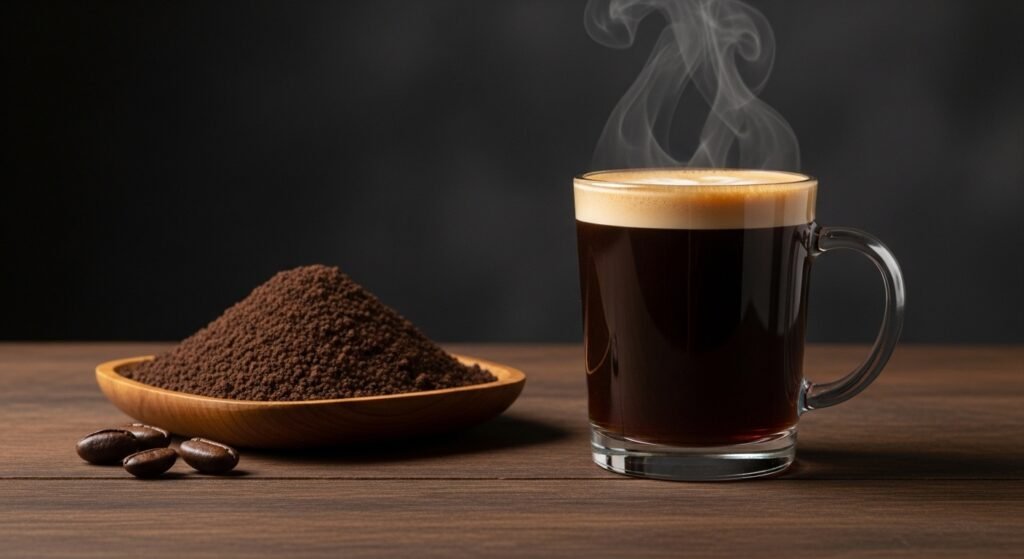
Sensory Evaluation: Conducting an Asian Cupping
If you were to host a coffee cupping at home featuring Asian coffees, the experience would be vastly different from a standard Latin American session. While a Costa Rican coffee might taste like honey and berries, an Indonesian coffee will often taste like “wild herbs” and “baker’s chocolate.“
Pay close attention to the body and mouthfeel. Asian coffees are generally the “heaviest” in the sensory laboratory. They coat the tongue in a way that feels like syrup or heavy cream. This makes them excellent candidates for cold brew experiments, where the long immersion time extracts even more of those deep, resonant woodsy notes. The aftertaste is another highlight—instead of a clean, disappearing finish, Asian coffees linger with a savory, spicy presence that stays with you long after the cup is empty.
The Challenge of Climate and Logistics
The journey of a bean from seed to export in Asia is fraught with challenges. The heavy monsoon rains make drying a constant battle. The logistics of moving coffee from remote islands like Sulawesi to the global market involve multiple steps that require extreme calibration of quality control.
Despite these hurdles, the innovation coming out of Asia is relentless. From the “Elephant Dung” or “Kopi Luwak” (civet coffee) of Indonesia—which, while controversial, highlights the extreme search for unique flavor notes—to the sophisticated anaerobic fermentations now appearing in Vietnam, Asia is a continent that refuses to be defined by just one style. It is a region that rewards the curious barista who is willing to look past the “Robusta vs. Arabica” debate and appreciate the soul of the land.
Conclusion: Respecting the Earthy Giant
The “Spirit of Asia” is a reminder that coffee is a global tapestry. It doesn’t always have to be delicate and floral to be “specialty.” Sometimes, we crave a coffee that feels like the earth itself—bold, spicy, and unbreakable. By understanding the unique processing of Indonesia and the production might of Vietnam, we gain a more holistic view of the journey of the bean.
Whether you are seeking a powerful espresso shot or a soul-warming cold brew, Asian coffees provide a foundation of flavor that is unmatched. They are the “bass notes” of the coffee world’s orchestra. So, the next time you see a bag from Sumatra or Vietnam on the shelf, don’t hesitate. Dive into the deep, dark, and spicy world of Asian coffee and experience the spirit of the archipelago.

Kevin Smith is deeply interested in the craft and culture of coffee, with practical experience exploring specialty beans, brewing techniques, and flavor development. Over the years, he has spent time studying preparation methods, observing extraction processes, and understanding how small details influence the final cup.
Through NovaWeHub, Kevin shares clear, practical, and research-based insights designed to make coffee knowledge approachable for everyone — from beginners to enthusiasts. His focus is on simplifying complex concepts and encouraging readers to explore coffee with curiosity, confidence, and a more refined sensory awareness.