
When we describe a coffee as having notes of “blueberries,” “jasmine,” or “toasted almonds,” we aren’t suggesting that these ingredients were added to the beans. Instead, we are identifying specific volatile organic compounds (VOCs) that are naturally created during the journey of the bean. In our “sensory laboratory,” the Flavor Wheel is our map. It is a scientific tool designed to standardize the way we communicate the sensory experience of coffee across the globe.
Understanding the flavor wheel is about more than just vocabulary; it is about training your brain to decouple “taste” (perceived by the tongue) from “aroma” (perceived by the nose). While the tongue identifies the acid vs. bitter balance, it is the olfactory system that detects the nuanced flavor notes that make a high-altitude Colombian taste fundamentally different from a Brazilian Cerrado.

The Biology of Flavor: Retronasal Olfaction
To navigate the flavor wheel, you must first understand how you “taste” aroma. When you sip coffee, volatile compounds travel from the back of your mouth up into your nasal cavity. This is called retronasal olfaction. It is the reason why coffee tastes like nothing when you have a cold; your tongue can still feel the body and mouthfeel, but the “flavor” is gone.
In the laboratory, we use the “slurp” technique during home cupping sessions to aerosolize the coffee. This sends a concentrated burst of VOCs to the olfactory bulb, making it easier to pinpoint where on the flavor wheel a coffee sits. Whether you are detecting the enzymatic “fruity” notes of an African coffee or the sugar-browning “nutty” notes of a Sul de Minas bean, your brain is essentially acting as a gas chromatograph.
How to Read the Wheel: From General to Specific
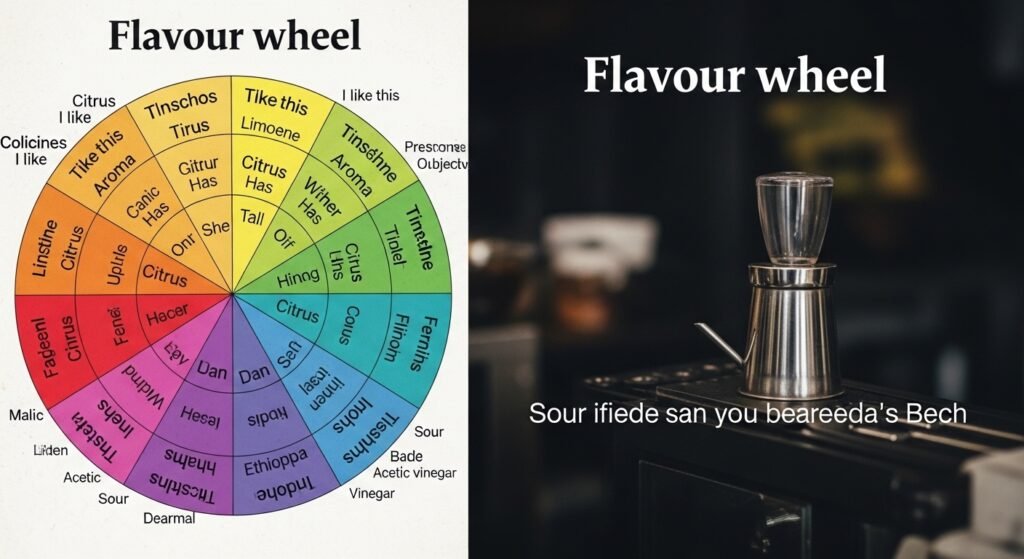
The SCA Flavor Wheel is designed to be read from the center outward.
-
The Center (General): Start here. Is the coffee fruity, roasted, or floral? This helps you narrow down the terroir.
-
The Middle (Intermediate): If it’s fruity, is it a citrus fruit or a berry?
-
The Outer Ring (Specific): This is the ultimate goal. Is that citrus note more like a lemon or a grapefruit?
For example, a calibrated espresso made with beans from Ethiopia might start in the “Floral” center, move to “Black Tea” in the middle, and end at “Bergamot” on the edge. Conversely, a darker roast might sit firmly in the “Roasted” and “Cereal/Nutty” sections, highlighting the aftertaste of dark chocolate and malt.
The Chemistry of the Wheel: Enzymatic vs. Sugar Browning
The flavors on the wheel aren’t random; they are grouped by the chemical reactions that created them.
-
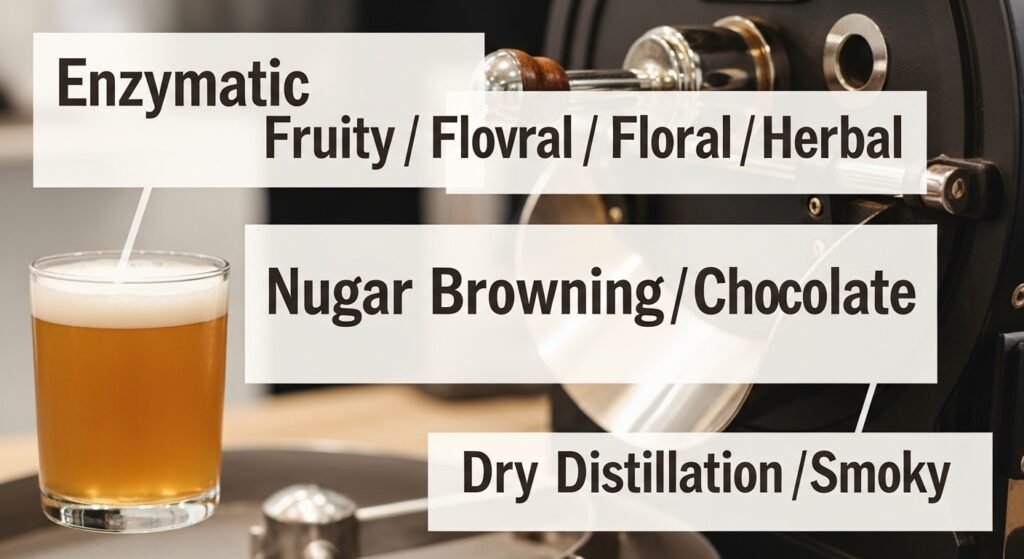
Enzymatic (Fruity/Floral/Herbal): These are the compounds inherent to the journey of the bean and the plant’s biology. They are most prominent in light roasts and high-altitude coffees.
-
Sugar Browning (Nutty/Caramel/Chocolate): These are created during the roasting process via the Maillard reaction. This is the hallmark of Brazilian regions and is what provides the base for drinks like the Modern Carajillo.
-
Dry Distillation (Spicy/Smoky): These occur during the later stages of roasting, where the fiber of the bean begins to burn. If not managed with precision equipment, these can lead to an unpleasantly bitter aftertaste.
Calibrating Your Palate: Sensory Training
Just as you would calibrate your grinder, you must calibrate your palate. In the “sensory laboratory,” we use “reference standards.” To understand the “Stone Fruit” section of the wheel, eat a peach and a plum side-by-side. Pay attention to the acid vs. bitter balance and the specific sweetness.
Water quality is also a major factor in how these aromas are perceived. Distilled water will make the flavors on the wheel appear “muted” or one-dimensional, while properly mineralized water acts as a magnifying glass for the flavor notes.
Overcoming the “Subjectivity” Trap
A common critique of the flavor wheel is that taste is subjective. While personal preference is subjective, the presence of chemical compounds is objective. If a coffee contains limonene, it objectively has a citrus aroma. The flavor wheel helps us move past “I like this” and into “This coffee has the chemical markers of a washed Ethiopian heirloom.”
This objective approach is vital on the barista’s bench. If you are calibrating an espresso and it tastes “sour,” the wheel helps you identify if it’s a “good” sour (like malic apple) or a “bad” sour (like acetic vinegar). This distinction is what separates a professional from a hobbyist.
Conclusion: Mastering the Map
The Flavor Wheel is not a set of rules; it is a language. It allows us to share the story of the farmer, the roaster, and the terroir with every person who drinks our coffee. By learning to navigate the wheel, you unlock a deeper level of the sensory experience.
The next time you brew a cup using the golden ratio, don’t just drink it. Smell it. Slurp it. Consult the map. Whether you find yourself in the “Fruit” forest or the “Chocolate” valley, the journey is the most rewarding part of the psychology of coffee. Welcome to the laboratory of aroma.

Kevin Smith is deeply interested in the craft and culture of coffee, with practical experience exploring specialty beans, brewing techniques, and flavor development. Over the years, he has spent time studying preparation methods, observing extraction processes, and understanding how small details influence the final cup.
Through NovaWeHub, Kevin shares clear, practical, and research-based insights designed to make coffee knowledge approachable for everyone — from beginners to enthusiasts. His focus is on simplifying complex concepts and encouraging readers to explore coffee with curiosity, confidence, and a more refined sensory awareness.