
Coffee brewing methods are commonly grouped into two primary approaches: percolation and immersion. Each technique influences how water interacts with coffee grounds, ultimately shaping flavor, body, and overall balance in the cup. While pour-over methods are often associated with clarity and precision, immersion brewing stands out for delivering richness and fuller texture.
Among immersion techniques, the French Press remains one of the most widely appreciated methods. Its simplicity allows greater control over extraction time, making grind consistency and patience essential factors for achieving a balanced and satisfying result.
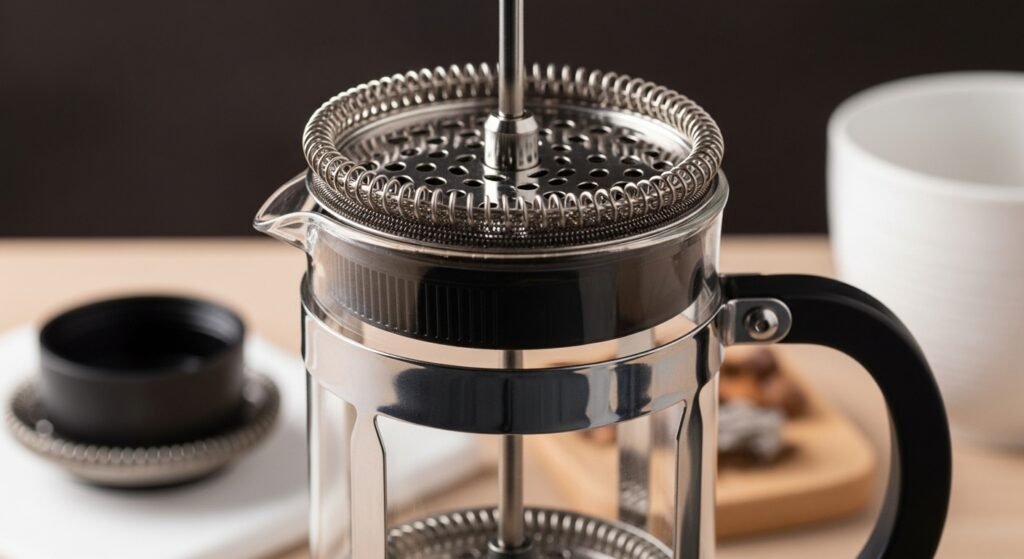
The beauty of the French Press lies in its honesty. Because it uses a metal mesh filter rather than paper, it allows the coffee’s natural oils (lipids) and micro-fine particles to pass into the final cup. This creates a texture that is “weighty” and “velvety.” However, this same lack of filtration makes the method prone to over-extraction and muddiness. To master the French Press, we must look past the “push and pour” folklore and apply the science of extraction.
The Physics of Immersion: Saturation vs. Flow
In a percolation method, fresh water constantly passes through the grounds, washing away solutes. In the French Press, the grounds sit in the same water for the entire duration of the brew. This creates a “saturation gradient.” As the water becomes more concentrated with coffee solids, its ability to extract more flavor slows down.
This is a built-in safety mechanism. Immersion is much more “forgiving” than percolation because the extraction rate naturally plateaus. However, if your water quality is poor or your temperature is unstable, this plateau can happen too late, leading to a bitter, hollow profile. In the laboratory, we use a longer steep time—often 6 to 8 minutes—combined with a coarser grind to ensure that we extract the heavy sweetness without the dry tannins.
The Metal Mesh: Why Texture is King
The defining characteristic of the French Press is the metal filter. Paper filters are excellent at trapping diterpenes (oils like cafestol and kahweol), which contributes to the “clean” aftertaste of a Chemex. In a French Press, these oils are preserved.
These lipids do more than just add flavor; they change how your tongue perceives the coffee. Oils act as a lubricant, coating the palate and “softening” the impact of acidity. This is why a Brazilian Sul de Minas coffee tastes so rich in a press—the natural nutty and chocolatey oils are allowed to fully coat the sensory receptors. If you are looking for “body,” the metal mesh is your greatest ally.
The Protocol: Beyond the Four-Minute Myth
The most common mistake in French Press history is the “four-minute rule.” In our laboratory experiments, four minutes is rarely enough time for a coarse grind to reach its full potential. We recommend the “Advanced Immersion Protocol”:
-
The Ratio: 1:15 (30g of coffee to 450ml of water).
-
The Grind: Very coarse, similar to breadcrumbs or sea salt.
-
The Initial Steep (4 minutes): Pour all the water ($94^\circ C – 96^\circ C$) and let it sit. A “crust” of grounds will form at the top.
-
The Break: At the 4-minute mark, take a spoon and gently stir the top crust. Most of the grounds will sink to the bottom.
-
The Cleanup: Use two spoons to scoop off any remaining floating foam and light-colored silt. This foam contains bitter lipids and trapped gases that can ruin the sensory experience.
-
The Second Steep (4 to 5 minutes): Put the lid on, but do not plunge yet. Let the coffee sit undisturbed. This allows the “fines” to settle to the bottom of the beaker, resulting in a much cleaner cup.

Plunging: A Gentle Sieve, Not a Press
Despite the name “French Press,” you should never actually “press” the coffee with force. If you push the plunger down aggressively, you create turbulence at the bottom of the beaker, kicking up all the sediment you just worked so hard to settle.
In the laboratory, we treat the plunger as a simple sieve. Lower the mesh until it is just below the surface of the liquid. When you pour, do so slowly. This ensures that the “bed” of spent grounds at the bottom remains undisturbed, acting as its own secondary filter.
Sediment Management and the Decanter
Even with a perfect technique, a French Press will continue to extract as long as the water is in contact with the grounds. If you leave the coffee in the press after brewing, the final cup will be bitter and “ashy.“
The final step of the masterclass is the Decant. As soon as the brew is finished, pour the entire contents into a separate carafe or directly into your cups. This “stops the clock” on extraction and ensures that the acid vs. bitter balance you achieved remains stable.
Maintenance: The Hidden Bacteria Trap
Because the French Press uses a multi-layered metal mesh, it is a magnet for old coffee oils. If you only rinse your press with water, those oils will eventually turn rancid, imparting a fishy or metallic taste to your high-altitude beans.
Every few brews, you must disassemble the plunger entirely. Clean each screen and the metal spring with a specialized coffee detergent. In our “Sensory Laboratory,” we have found that 50% of “bad” French Press experiences are caused by poor maintenance rather than poor brewing.
Conclusion: The Soul of the Bean
The French Press is the most “intimate” way to brew coffee. There are no papers or high-pressure pumps between you and the bean. It is a method that celebrates the raw terroir and the natural fats of the coffee fruit.
By applying the principles of slow immersion, sediment management, and meticulous cleaning, you transform a “muddy” morning cup into a sophisticated, full-bodied masterpiece. The laboratory teaches us that patience is a variable just as important as temperature. Take your time, let the grounds settle, and enjoy the deepest body that the coffee world has to offer.

Kevin Smith is deeply interested in the craft and culture of coffee, with practical experience exploring specialty beans, brewing techniques, and flavor development. Over the years, he has spent time studying preparation methods, observing extraction processes, and understanding how small details influence the final cup.
Through NovaWeHub, Kevin shares clear, practical, and research-based insights designed to make coffee knowledge approachable for everyone — from beginners to enthusiasts. His focus is on simplifying complex concepts and encouraging readers to explore coffee with curiosity, confidence, and a more refined sensory awareness.