
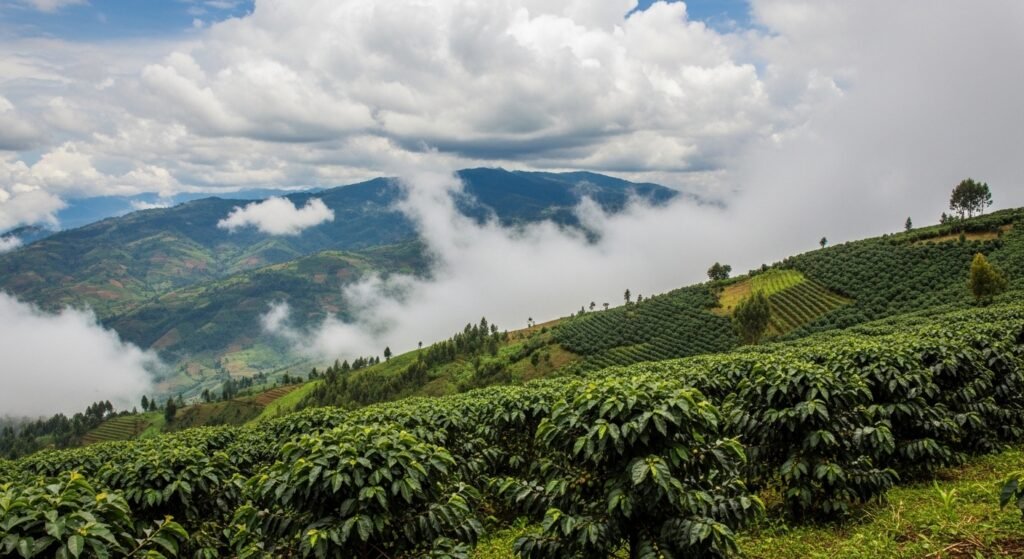
Some coffee origins are especially valued for delivering a remarkably clear and expressive sensory profile. Rwanda and Burundi, two neighboring landlocked countries in East Africa, are widely recognized for producing coffees with this level of distinction. Often referred to as the “Land of a Thousand Hills,” the region offers environmental conditions that strongly support the cultivation of high-quality specialty coffee.
Coffee farms in these countries are typically located at elevations ranging from 1,700 to over 2,000 meters above sea level. Combined with nutrient-rich volcanic soils and reliable seasonal rainfall, these conditions allow coffee cherries to mature slowly, encouraging the development of complex flavors, vibrant acidity, and refined balance in the final cup.
While they share a similar high-altitude environment with Ethiopia and Kenya, Rwandan and Burundian coffees have a personality all their own. They are often defined by a “sparkling” acidity and a complex sweetness that ranges from floral honey to dark red berries. However, the journey of the bean in these regions is also a story of social resilience and scientific overcoming, particularly regarding the unique challenges of the African “Cloud Forest” environment.
Rwanda: The Renaissance of Quality
Rwanda’s coffee history is one of transformation. Following the tragedy of the 1994 genocide, the coffee industry was rebuilt as a tool for national reconciliation and economic growth. Today, Rwanda is one of the most organized and quality-focused origins in the world.
Most Rwandan coffee is of the Bourbon variety, which is known in our lab for its deep sweetness and balanced body. Because the country is so mountainous, most coffee is grown by smallholders who bring their cherries to central washing stations. This centralized processing is the key to Rwanda’s consistency.
-
The Profile: Expect notes of black tea, red currant, and orange blossom.
-
The Texture: Rwandan coffees often have a “crisp” mouthfeel, which makes them exceptional when brewed with the V60 protocol.
Burundi: The Wild and Intense Neighbor
If Rwanda is organized and refined, Burundi is often seen as its “wilder” sibling. Burundi’s coffee industry is also dominated by smallholders, but the flavor profiles can be more intense and “boozy.” This is partly due to the widespread use of “Natural” and “Honey” processing in recent years, which contrasts with Rwanda’s traditional focus on “Washed” coffees.
In Burundi, the Kayanza and Ngozi regions are the high-altitude leaders. The coffees from these areas are famous for their “heavier” body and an acidity that leans toward stone fruits like apricot and nectarine. In the “Sensory Laboratory,” we often use Burundian coffees to demonstrate how water quality can either highlight or hide the delicate “sparkle” of a high-altitude bean.
The Science of PTD: The Potato Taste Defect
We cannot discuss Rwanda and Burundi without addressing a specific biological challenge: the Potato Taste Defect (PTD). Occasionally, a single bean in a bag can smell and taste exactly like a raw potato.
For a long time, this was a mystery. Today, we know it is caused by a specific bacteria introduced by the Antestia bug. When the bug punctures the coffee cherry, the bacteria enters and produces a chemical compound called Pyrazine. Even one affected bean can ruin an entire pot of coffee.
-
In the Lab: We have found that PTD is not harmful to health, but it is a major “sensory” defect.
-
The Solution: Rwandan and Burundian washing stations have implemented rigorous “hand-sorting” and “floating” protocols. By using ultraviolet light and meticulous visual inspection, they have reduced the occurrence of PTD to nearly zero in specialty lots. This level of maintenance and quality control is what allows these “African Pearls” to compete on the world stage.
Sensory Breakdown: The Sparkling Acidity
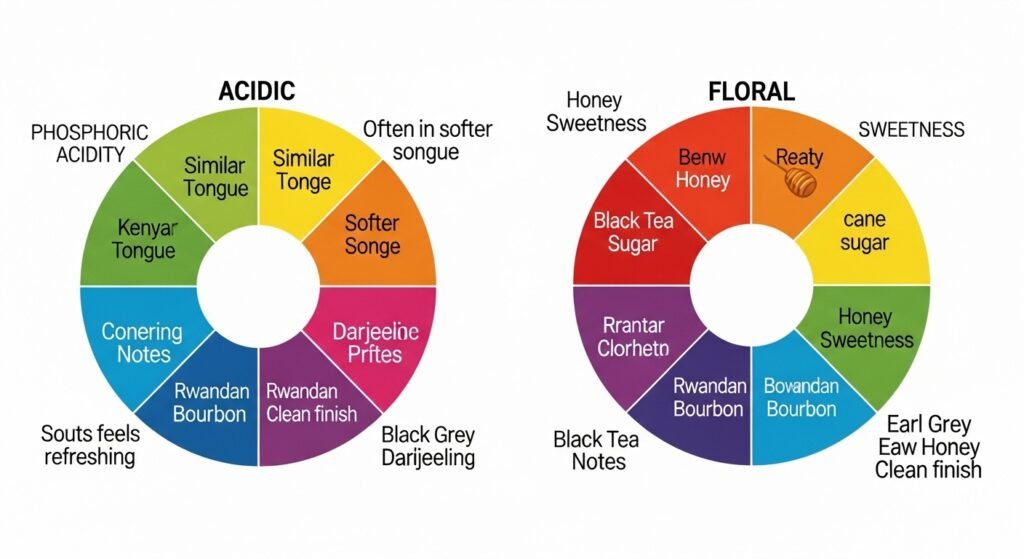
When we use the flavor wheel to evaluate these origins, we focus on the “Acidic” and “Floral” quadrants:
-
Phosphoric Acidity: Similar to Kenya, but often softer. It creates a “zing” on the tongue that feels refreshing.
-
Black Tea Notes: A common descriptor for Rwandan Bourbon is “Earl Grey” or “Darjeeling,” referring to the combination of citrus and a slightly tannic, clean finish.
-
Honey Sweetness: Both origins excel at producing a “raw honey” or “cane sugar” sweetness that lingers in the aftertaste.
Brewing the Pearls: Barista’s Bench Recommendations
To preserve the delicate volcanic profiles of Rwanda and Burundi, we recommend a “Clarity-First” approach:
-
The Brewer: The Chemex or V60. These methods use paper filters to strip away the heavy oils, allowing the bright, tea-like acidity to shine.
-
The Water: Use a temperature between $93^\circ C$ and $95^\circ C$. These are very dense, high-altitude beans that require significant heat to extract their complex sugars.
-
The Grind: Medium-fine. A consistent grind is essential; if you have too many “fines,” the cup will become “muddy,” and you will lose the sparkling character that makes these origins special.

Conclusion: A Lesson in Resilience
Rwanda and Burundi are more than just coffee origins; they are proof that quality can be a catalyst for change. By mastering the science of extraction and overcoming the biological hurdles of their environment, these nations have earned their place in the “Sensory Laboratory.“
Whether you are tasting the refined, orange-blossom elegance of a Rwandan washing station or the wild, stone-fruit intensity of a Burundian smallholder, you are experiencing the “Spirit of the Thousand Hills.” These coffees challenge our palates and remind us that the most beautiful flavors often come from the most challenging landscapes. Respect the acidity, manage your grind, and enjoy the sparkling journey of the African Pearl.

Kevin Smith is deeply interested in the craft and culture of coffee, with practical experience exploring specialty beans, brewing techniques, and flavor development. Over the years, he has spent time studying preparation methods, observing extraction processes, and understanding how small details influence the final cup.
Through NovaWeHub, Kevin shares clear, practical, and research-based insights designed to make coffee knowledge approachable for everyone — from beginners to enthusiasts. His focus is on simplifying complex concepts and encouraging readers to explore coffee with curiosity, confidence, and a more refined sensory awareness.