
While modern coffee preparation often emphasizes advanced tools—precision filters, digital scales, and perfectly aligned grinders—the oldest brewing techniques still hold remarkable complexity. Among them, the Turkish Cezve (or Ibrik) stands out as a method that combines tradition with scientific nuance.
This technique relies on Decocción, the process of boiling coffee to extract its full chemical profile. Despite its simplicity in appearance, mastering the Cezve requires attention to temperature, timing, and stirring, as each variable influences aroma, body, and flavor intensity, making it one of the most intricate brewing methods still widely practiced today.
While many specialty baristas avoid boiling coffee due to the risk of “ashy” flavors, the Turkish protocol, when executed with modern precision, produces a sensory experience that is unparalleled in body and aromatic concentration. To master the Cezve, one must understand the physics of “impalpable” grind consistency and the thermal conductivity of copper.

The Physics of the “Impalpable” Grind
The first variable in the Turkish lab is the particle size. Turkish coffee requires a grind that is finer than espresso—it must be like flour or talcum powder (around 50 to 100 microns).
-
Surface Area: This ultra-fine grind creates a massive surface area, allowing for an almost instantaneous extraction of sugars and aromas.
-
Suspension: Because the particles are so small, they do not settle immediately. They remain in suspension, contributing to the famous “viscous” mouthfeel.
-
The Gas Barrier: The fine powder traps CO2 more effectively than coarser grinds. When heated, this gas expands to create the Kaimaki (the thick foam) that protects the delicate volatiles from escaping.
The Thermal Engine: Why Copper Matters
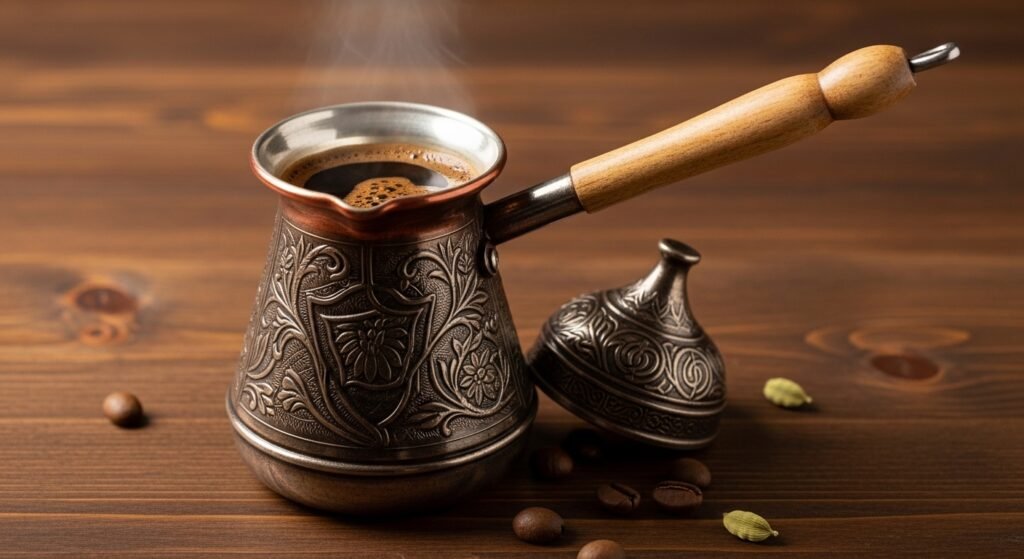
The traditional Cezve is made of copper, often lined with tin or silver. In the “Sensory Laboratory,” we analyze this through the lens of Thermal Conductivity. Copper is an exceptional conductor of heat, which allows the barista to control the temperature of the water with extreme precision.
If you use a stainless steel pot, the heat is distributed unevenly, leading to “hot spots” that can scorch the coffee grounds. In a copper Cezve, the heat is uniform. This allows for a gradual increase in temperature, which is essential for developing the acid vs. bitter balance. The goal is to reach the “near-boil” ($92^\circ C – 95^\circ C$) just as the foam reaches the rim, but without ever letting the liquid actually boil over, which would destroy the aftertaste.
The Protocol: A Step-by-Step Science
To bridge the gap between tradition and the “Barista’s Bench,” we follow a strict scientific ratio:
-
The Ratio: 1:10 (e.g., 7g of coffee to 70ml of water).
-
The Water: Start with room temperature high-quality water. Do not use boiling water, as the extraction needs time to develop as the temperature rises.
-
The Agitation: Mix the coffee and water thoroughly before placing it on the heat source. This ensures that every “impalpable” particle is fully hydrated.
-
The Heat: Use a consistent heat source (sand, gas, or electric). In the lab, the “Sand Brewer” (Kumda Kahve) is prized for providing 360-degree radiant heat to the Cezve.
-
The Rise: Watch for the “Crema” to rise. As soon as the foam reaches the top, remove it from the heat. Some traditions call for multiple “risings,” but in the specialty laboratory, we find that a single, controlled rise preserves the most fruit-forward aromas.

Sensory Analysis: The Strength of Suspension
Drinking Turkish coffee is a lesson in patience. Because the coffee is unfiltered, the “brew” continues in the cup.
-
The Settling Phase: You must wait 2–3 minutes before the first sip. This allows the larger particles to settle at the bottom, creating a “mud” layer, while the smaller fines remain in the liquid to provide body.
-
The Aroma: Because the coffee is never filtered through paper, the lipids (oils) are fully preserved. You will experience an intensity of flavor that makes even the strongest espresso feel thin by comparison.
-
The Finish: A well-made Turkish coffee should have a sweet, lingering aftertaste. If it tastes like “tobacco” or “ash,” the temperature was likely too high or the beans were over-roasted.
Specialty Turkish: Changing the Bean Profile
Historically, Turkish coffee used dark-roasted, lower-quality beans, often flavored with cardamom. In the modern “Sensory Laboratory,” we are using Light-Medium Roasts of high-altitude African beans.
When you use an Ethiopian Yirgacheffe in a Cezve, the result is explosive. The intense floral and citrus notes are amplified by the decoccion process. The cardamom is no longer necessary to hide defects; instead, the coffee’s natural complexity becomes the star. This is the “New School” of Turkish coffee—respecting the ancient vessel but applying the science of specialty extraction.
Conclusion: The Ultimate Immersion
The Turkish Cezve is the ultimate expression of coffee’s history and its future. It reminds us that grind consistency and temperature control are universal laws, whether you are using a $10,000 espresso machine or a $20 copper pot.
By understanding the physics of heat transfer and the biology of mouthfeel, we can take this ancient ritual and turn it into a high-end sensory experiment. The next time you see a Cezve, don’t just see a tradition—see a laboratory. Watch the foam rise, smell the trapped volatiles, and enjoy the most concentrated cup of coffee human history has ever devised.

Kevin Smith is deeply interested in the craft and culture of coffee, with practical experience exploring specialty beans, brewing techniques, and flavor development. Over the years, he has spent time studying preparation methods, observing extraction processes, and understanding how small details influence the final cup.
Through NovaWeHub, Kevin shares clear, practical, and research-based insights designed to make coffee knowledge approachable for everyone — from beginners to enthusiasts. His focus is on simplifying complex concepts and encouraging readers to explore coffee with curiosity, confidence, and a more refined sensory awareness.