
The influence of the earth on coffee flavor is undeniable, and few regions demonstrate this more clearly than the islands of the Pacific. Hawaii and Papua New Guinea are located along the “Ring of Fire,” an area known for its intense volcanic activity. The resulting soils are rich in nutrients, creating ideal conditions for coffee cultivation.
High levels of minerals such as potassium and phosphorus support the development of complex organic acids in the beans. This volcanic terroir contributes to the distinctive flavors and vibrant profiles that make coffees from these islands stand out in the specialty coffee world.
While they share a volcanic foundation, these two origins represent opposite ends of the economic and sensory spectrum. Hawaii is a model of high-tech, high-cost precision, while Papua New Guinea is a land of “wild” gardens, where coffee often grows in untamed conditions. Together, they offer a masterclass in how environment and high-altitude geography shape the soul of the bean.
Hawaii Kona: The Science of the “Afternoon Cloud”
Kona coffee, grown on the slopes of Hualālai and Mauna Loa on the Big Island of Hawaii, is one of the most protected and expensive coffees in the world. In the lab, we analyze Kona as a miracle of “Atmospheric Calibration.”
The Kona district has a unique weather pattern known as the “Afternoon Cloud Cover.” Every day, like clockwork, the morning sun heats the volcanic slopes, and by mid-afternoon, a thick mist rolls in from the Pacific.
-
The Physics: This mist acts as a natural shade, cooling the trees and slowing down the metabolic rate of the coffee cherry.
-
The Result: This slow maturation allows for an incredible accumulation of sugars without the “aggressive” acidity found in African origins.
-
The Profile: A true Kona is defined by its “silky” mouthfeel and notes of milk chocolate, roasted nuts, and a subtle honey sweetness.
Papua New Guinea: The Blue Mountain Legacy
The history of coffee in Papua New Guinea is a botanical detective story. In the 1920s, seeds of the legendary Jamaica Blue Mountain Typica were brought to the highlands of PNG. Because the soil in regions like the Wahgi Valley is so fertile and the altitude is so high (up to 1,900 meters), the plants thrived, but they developed a completely different personality than their Caribbean ancestors.
In the “Sensory Laboratory,” PNG coffee is famous for its “Complex Funk.” Because the country is so rugged and infrastructure is limited, many smallholders use unique, semi-wild processing methods.
-
The Profile: Expect a wild mix of tropical fruit (mango, papaya) and savory, herbal notes (tomato, basil).
-
The Body: Unlike the thin, tea-like body of some high-altitude coffees, PNG has a syrupy, heavy texture that lingers in the aftertaste.
The Volcanic Soil: Minerality and Extraction
Why does volcanic soil make coffee taste better? In our laboratory, we look at the Cation Exchange Capacity (CEC) of the soil. Volcanic ash creates a porous soil that holds onto water and minerals effectively.
-
Potassium: Increases the sugar content in the fruit.
-
Phosphorus: Essential for the production of oils and aromatic compounds.
-
Sulfur: Contributes to the complex protein structures that define the aftertaste.
When we brew these Pacific origins, we often find a distinct “mineral” finish—a clean, almost sparkling sensation on the back of the palate that is a direct result of this soil chemistry.
Sensory Analysis: The Pacific Spectrum
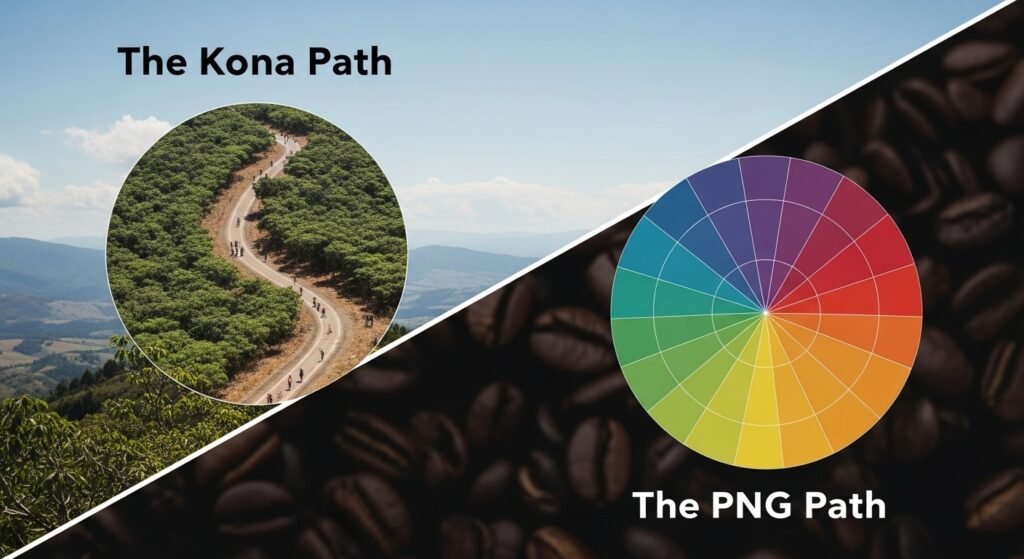
When using the flavor wheel to evaluate Hawaii and PNG, we see two distinct paths:
-
The Kona Path: Focuses on the “Sugar Browning” and “Nutty” quadrants. It is the gold standard for “Classical Balance.”
-
The PNG Path: Focuses on the “Fruity” and “Herbal/Savory” quadrants. It is a “wilder” sensory experience that appeals to the adventurous palate.
Brewing the Islands: Barista’s Bench Recommendations
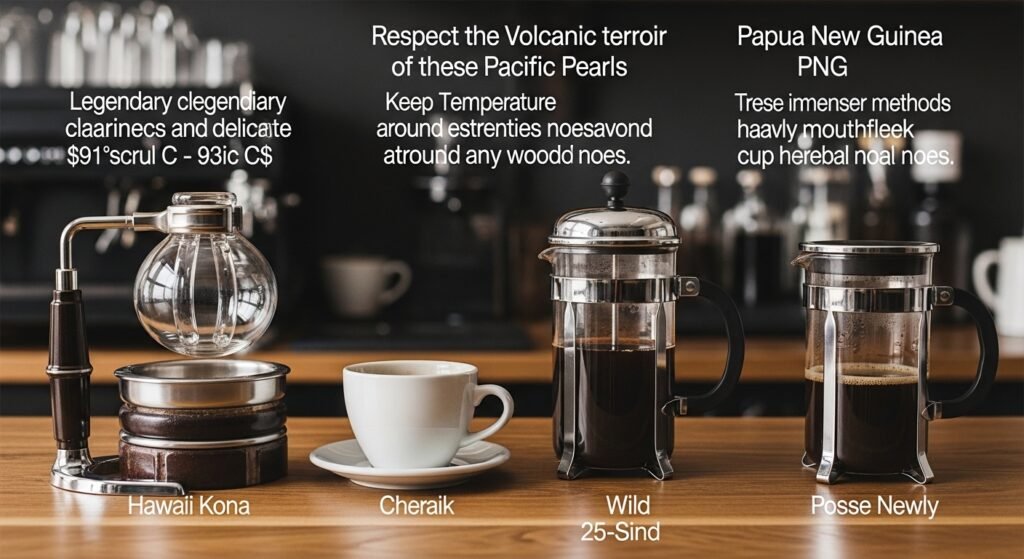
To respect the volcanic terroir of these Pacific pearls, the barista’s bench protocol must be adapted:
-
For Hawaii Kona: Use a Siphon (Vacuum Pot) or a Chemex. These methods highlight the legendary cleanliness and delicate sweetness of the bean. Keep the temperature around $91^\circ C – 93^\circ C$ to avoid extracting any woody notes.
-
For Papua New Guinea: Use a French Press or an AeroPress. These immersion methods handle the “wild” complexity of PNG much better, allowing the heavy mouthfeel and herbal notes to fully integrate.
-
Water Quality: Because these coffees have a unique mineral profile, use water with a moderate magnesium content to amplify the fruit notes without making the cup taste “salty.”
Conclusion: The Resilience of the Ring of Fire
Hawaii and Papua New Guinea are the guardians of the Pacific coffee tradition. They remind us that maintenance of the environment and respect for geography are the most important variables in the “Sensory Laboratory.” One offers the perfection of the cloud-covered mist; the other offers the complexity of the untamed jungle.
Whether you are enjoying the expensive, buttery luxury of a Kona Estate or the unpredictable, tropical intensity of a PNG Sigri, you are tasting the power of the volcano. These coffees connect us to the geological history of our planet and challenge us to refine our palates. Respect the soil, master the extraction, and enjoy the heart of the Pacific.

Kevin Smith is deeply interested in the craft and culture of coffee, with practical experience exploring specialty beans, brewing techniques, and flavor development. Over the years, he has spent time studying preparation methods, observing extraction processes, and understanding how small details influence the final cup.
Through NovaWeHub, Kevin shares clear, practical, and research-based insights designed to make coffee knowledge approachable for everyone — from beginners to enthusiasts. His focus is on simplifying complex concepts and encouraging readers to explore coffee with curiosity, confidence, and a more refined sensory awareness.