
In the global “Sensory Laboratory,” we are constantly searching for the “edge” of what is possible in coffee production. Usually, this search leads us to the extreme altitudes of the Andes or the volcanic peaks of Ethiopia. However, two regions stand out for their ability to produce world-class coffee in environments that seem almost inhospitable: Yemen and China.
Yemen is the birthplace of the commercial coffee trade, where ancient landraces have survived for centuries in the arid, high-altitude terraces of the Sarawat Mountains. China, specifically the Yunnan province, is the rising star of the 21st century, where investment in water quality and processing technology is turning the “Tea Kingdom” into a coffee powerhouse. Both origins rely on the physics of thin air and extreme temperature swings to concentrate the aromas and sugars within the bean.
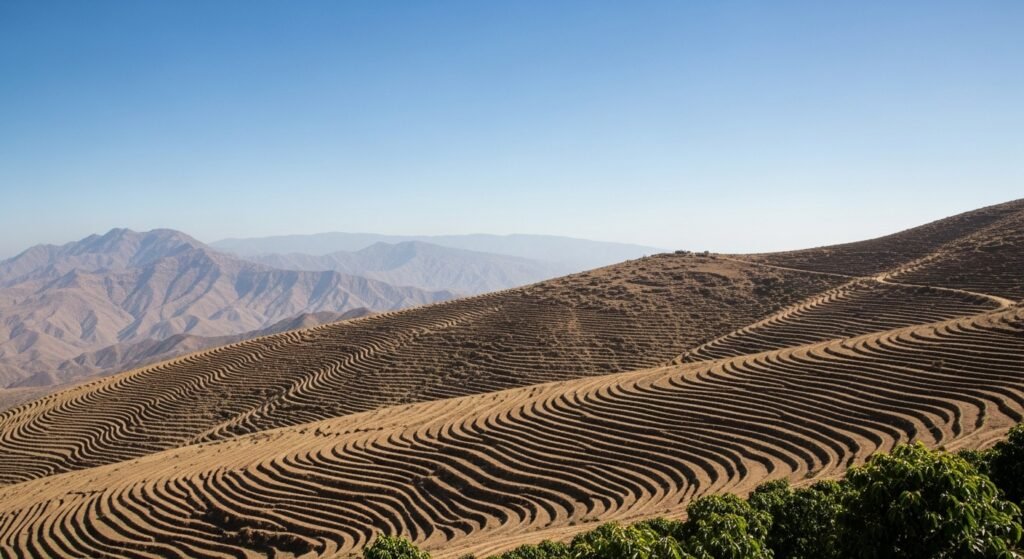
Yemen: The Cradle of “Wild” Genetics
To drink Yemeni coffee is to taste history. Most of the world’s Arabica varieties can be traced back to the seeds that left the port of Al-Makha (Mocha) centuries ago. In our laboratory, we analyze Yemeni coffee as a study in “Drought Resistance” and “Genetic Purity.“
-
The Environment: Coffee in Yemen grows at altitudes between 1,500 and 2,500 meters. The climate is incredibly dry, meaning the plants are under constant “water stress.“
-
The Physics of Stress: In response to the lack of water, the coffee tree concentrates its nutrients in the seeds. This leads to a very small, dense bean with an intense concentration of aromatic volatile compounds.
-
The Processing: Due to the lack of water, almost all Yemeni coffee is “Natural” (dry) processed on rooftops. This results in a “wild,” earthy, and spicy profile.
In the “Sensory Laboratory,” we have recently identified a new mother-population of coffee in Yemen called Yemenia. This genetic group is distinct from the Typica/Bourbon lineage and offers a sensory experience that includes deep notes of sandalwood, dried apricot, and dark chocolate, with a heavy, syrupy body.
China (Yunnan): The Himalayan Specialty Revolution
While Yemen is ancient, Yunnan is a modern marvel. Located in the southwest of China, sharing borders with Myanmar, Laos, and Vietnam, Yunnan accounts for over 95% of China’s coffee production.
The geography here is defined by the Hengduan Mountains—the southeastern edge of the Himalayas.
-
The Altitude: Farms in regions like Pu’er and Baoshan operate at 1,200 to 1,600 meters.
-
The Variety: For years, Yunnan was known for Catimor (a robust-leaning hybrid). However, the “Sensory Laboratory” is now seeing a surge in high-quality Typica and Bourbon plantings.
-
The Profile: Modern Yunnan specialty coffee is surprisingly clean. It often features a balanced acidity, a creamy mouthfeel, and notes of black tea, red berries, and brown sugar.
Sensory Analysis: Earthy Spice vs. Tea-Like Clarity
When comparing these two “Frontier” origins on the flavor wheel, we see a fascinating contrast in aftertaste and complexity.
-
Yemen (The Complex/Earthy): The flavor is “heavy.” It sits on the back of the palate with notes of pipe tobacco, clove, and fermented fruit. It is a coffee that demands a coarser grind and a longer extraction to unlock its deep sweetness.
-
China (The Elegant/Fruity): The flavor is “light.” Because Yunnan has invested heavily in modern washing stations and maintenance, the coffee often exhibits a “washed” clarity that rivals Central American profiles. The finish is short and clean, leaving a lingering sweetness that reminds us of honey.
The Variable of Processing: Innovation in the East
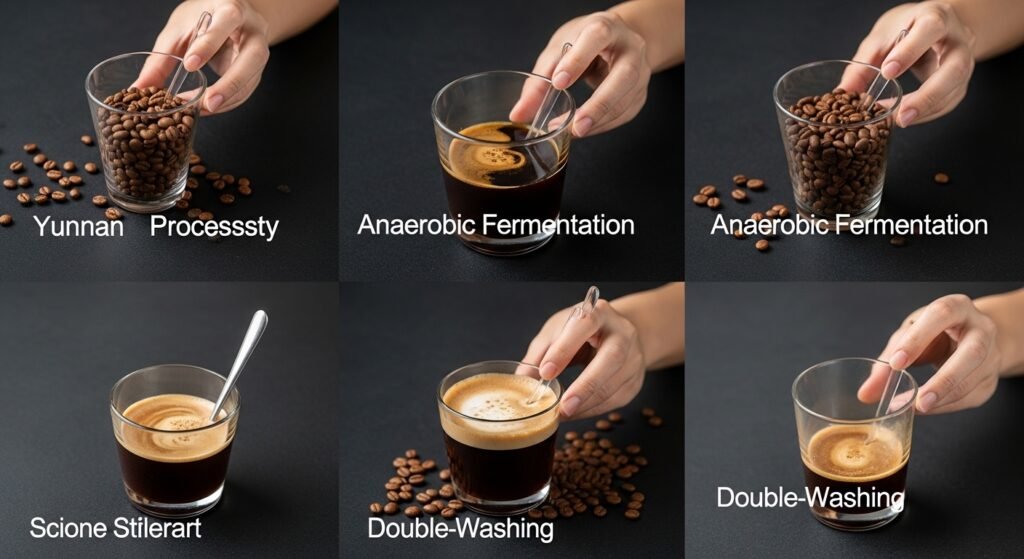
China has become a leader in experimental processing. In our drink laboratory, we have tested Yunnan beans subjected to Anaerobic Fermentation and Double-Washing.
-
The Science: By controlling the microbial environment during fermentation, Yunnanese producers are able to “mask” the woody notes of the Catimor variety and highlight bright, malic (apple-like) acidity.
-
The Result: This has allowed Chinese coffee to break into the “90+ point” category, appearing on the barista’s bench in global competitions.
Brewing the Frontiers: Laboratory Recommendations
Because these two coffees have such different densities and processing histories, the barista’s bench protocol must be surgical:
-
For Yemen (Natural): Use a Siphon or a French Press. These methods allow for the long contact time necessary to dissolve the dense sugars of the Yemeni bean. Use a lower temperature ($90^\circ C – 92^\circ C$) to avoid the “ashy” bitterness that can come from the rooftop drying process.
-
For China (Washed/Specialty): Use a V60 or an AeroPress. These tools highlight the “Tea-like” elegance of Yunnanese coffee. Use a standard Golden Cup ratio of 1:16 to appreciate the balance of fruit and chocolate.
-
Water Quality: For both, use water with a high buffer (Alkalinity) to manage the potentially sharp acidity of the Chinese beans and the “wild” complexity of the Yemeni ones.

Conclusion: The Resilience of the Mountains
Yemen and China represent the two ends of the specialty coffee timeline. One reminds us of where we came from—the ancient terraces, the genetic “mothers,” and the resilience of a crop that survived in the desert. The other shows us where we are going—the precision of modern fermentation, the potential of new territories, and the globalization of the sensory experience.
In the “Sensory Laboratory,” we respect both. We value the maintenance of tradition in Yemen just as much as we value the innovation in China. Both origins prove that high-altitude geography is the most powerful tool in nature’s kit for creating flavor. Whether it is the sandalwood scent of a Harazi or the tea-like clarity of a Pu’er, the high-altitude frontier continues to expand our understanding of what coffee can be.

Kevin Smith is deeply interested in the craft and culture of coffee, with practical experience exploring specialty beans, brewing techniques, and flavor development. Over the years, he has spent time studying preparation methods, observing extraction processes, and understanding how small details influence the final cup.
Through NovaWeHub, Kevin shares clear, practical, and research-based insights designed to make coffee knowledge approachable for everyone — from beginners to enthusiasts. His focus is on simplifying complex concepts and encouraging readers to explore coffee with curiosity, confidence, and a more refined sensory awareness.