
Coffee is often admired for its depth and visual richness—the dark body of a French Press brew or the striped crema on a perfectly pulled espresso. Yet in modern mixology, there is a rising interest in the art of clarification.
Clarification involves removing suspended solids and polyphenols from a beverage, creating a crystal-clear liquid that retains the full aroma and flavor of its ingredients. This technique highlights subtle notes that might be masked in traditional preparations, offering a refined and unexpected sensory experience while preserving the essence of the original coffee or spirit.
Clarifying coffee is a paradoxical challenge. We are essentially trying to strip away the color and the heavy particles while preserving the delicate volatile aromas and the caffeine content. By using ancient techniques like “Milk Washing” or modern molecular Gastronomy tools like “Agar-Agar,” we can create coffee cocktails that defy visual expectations and offer a unique, velvety mouthfeel.

The Science of Milk Washing: Casein and Coagulation
Milk washing is a technique dating back to the 18th century, originally used to mellow the harsh spirits of the era. In the “Sensory Laboratory,” we use it to “engineer” the aftertaste of coffee cocktails.
-
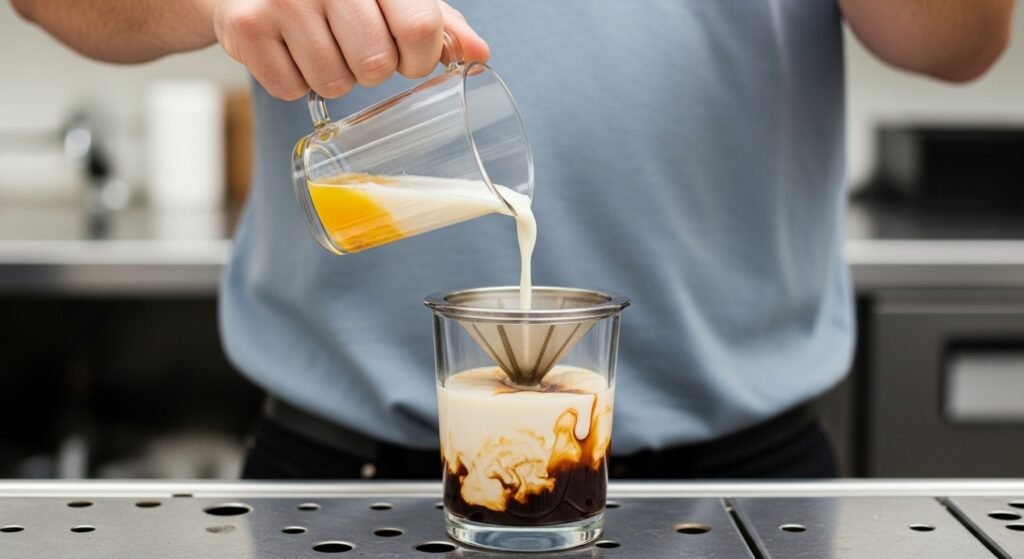
The Reaction: When an acidic coffee mixture (such as coffee mixed with lemon juice or citric acid) is added to milk, the milk curdles. This is because the acid lowers the pH, causing the Casein proteins to unfold and clump together.
-
The Filter: As the casein coagulates, it acts as a molecular “net.” It traps the larger particles of coffee, the pigments (melanoidins), and most importantly, the polyphenols (tannins).
-
The Result: Once the curds are filtered out through a paper filter, the remaining liquid is clear. However, it has picked up whey proteins from the milk, which provide a luxurious, creamy texture without the opacity of dairy.
Agar-Agar: The Vegan “Ice-Clarification” Alternative
For those who want to avoid dairy or seek a more “neutral” clarification, the drink laboratory uses Agar-Agar, a polysaccharide derived from red algae.
-
The Hydrocolloid Bridge: Agar-Agar creates a thermoreversible gel. When a small amount of Agar is dissolved in coffee and then cooled, it forms a “fluid gel” matrix.
-
Syneresis: As the gel is gently broken or frozen and thawed, the water (containing the coffee flavors and caffeine) is expelled from the gel, while the solids and colors remain trapped in the Agar structure.
-
Precision: This method is preferred when working with delicate high-altitude African coffees, as it doesn’t “strip” as much flavor as the milk washing technique, preserving the bright phosphoric acidity.
Sensory Analysis: The Texture of Transparency
A clarified coffee drink presents a fascinating cognitive dissonance. Your eyes see a transparent liquid, but your palate experiences the full aroma wheel.
-
Softened Bitterness: Because the clarification process removes many of the bitter tannins, the coffee notes become “softer.” It highlights the stone fruit and floral notes of the bean.
-
Viscosity: Despite being clear, a milk-washed coffee cocktail has a high viscosity. It coats the tongue in a way that a standard Cold Brew cannot.
-
The Clean Finish: The aftertaste of a clarified drink is incredibly short and clean, making it a perfect “aperitif” style cocktail.
Laboratory Protocol: The Clarified Coffee Punch
To execute a perfect clarification on your barista’s bench, you must follow a strict ratio and temperature control.
-
The Blend: 200ml Cold Brew, 50ml Citrus Juice, 100ml Spirit (optional), and 50ml Simple Syrup.
-
The “Wash”: Always pour the Coffee Mix into the Milk, not the other way around. This ensures an immediate and total curdling of the casein.
-
The Filter: The first few milliliters that pass through the filter will be cloudy. In the lab, we pour these back into the filter. The curds themselves act as the actual filtering medium (the “bed”).
-
Maintenance: Ensure all equipment is sterile. Maintenance matters even more in clarification, as any residual oils in the filter or vessel can “cloud” the final masterpiece.
Stability and Service: The “Forever” Cocktail
One of the greatest benefits of clarified coffee drinks is their stability. Because the proteins and solids have been removed, the drink will not oxidize or “stale” as quickly as fresh coffee.
In our laboratory trials, a clarified coffee punch can be kept in a sealed bottle for weeks without losing its aromatic complexity. This allows baristas to pre-prepare complex drinks and serve them with the speed of a simple pour, often over a single, clear “ice rock” to emphasize the transparency.
The Role of Tannin Management
Why do we want to remove tannins? In the “Sensory Laboratory,” we study how tannins interact with the proteins in our saliva. This interaction creates the “drying” sensation we call astringency.
By using milk washing, we are essentially “pre-binding” those tannins to the milk’s casein before the drink ever touches your tongue. This leaves the coffee’s natural sweetness exposed and unhindered. It is the ultimate expression of mouthfeel engineering.

Conclusion: Complexity Through Removal
Clarification reminds us that in the “Sensory Laboratory,” sometimes less is more. By removing the color and the heavy solids, we force the drinker to focus entirely on the aromas and the texture. It is a bridge between the barista’s bench and the chemist’s lab.
As we conclude Cycle 21, we have explored the physics of particles, the history of the monsoon, the synesthesia of the brain, and finally, the molecular structure of the drink itself. Whether you are mastering your espresso or clarifying a complex punch, the goal is always the same: a deeper understanding of the liquid in the cup. Respect the chemistry, refine the grind, and always keep your equipment maintained.

Kevin Smith is deeply interested in the craft and culture of coffee, with practical experience exploring specialty beans, brewing techniques, and flavor development. Over the years, he has spent time studying preparation methods, observing extraction processes, and understanding how small details influence the final cup.
Through NovaWeHub, Kevin shares clear, practical, and research-based insights designed to make coffee knowledge approachable for everyone — from beginners to enthusiasts. His focus is on simplifying complex concepts and encouraging readers to explore coffee with curiosity, confidence, and a more refined sensory awareness.