
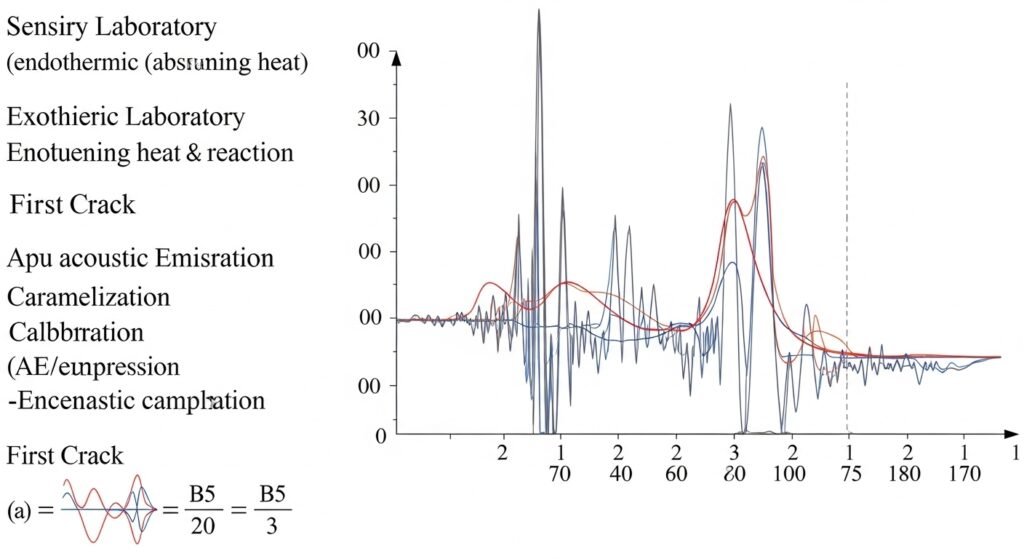
For any seasoned roaster, the “First Crack” is a spiritual moment. It is the audible signal that the coffee bean has reached a critical internal pressure, forcing its structure to expand and releasing the moisture trapped within. In the “Sensory Laboratory,” we recognize this as the transition from an endothermic (absorbing heat) to an exothermic (releasing heat) reaction. But while a roaster’s ears can detect the general onset of this event, they cannot perceive the microscopic “acoustic emissions” that define the climax of the Maillard Reaction and the beginning of Caramelization.
By using high-precision microphones and acoustic emission (AE) sensors, we can now “visualize” the sound of the roast. This data allows us to precisely time the espresso calibration of our beans, ensuring that the aromatic complexity is locked in at its peak. This article deconstructs the physics of the crack and why “listening” to the chemistry of the bean is the future of specialty coffee.
The Chemistry of Maillard and the Physics of Sound
The Maillard reaction is a chemical dance between amino acids and reducing sugars. It starts around $140^\circ C$ and is responsible for the “toasty” and “savory” aromas we love. As this reaction nears its end, the bean begins to lose its structural elasticity.
-
Pressure Buildup: As the internal temperature rises, water vapor and $CO_2$ are generated inside the bean’s cellular matrix.
-
The Glass Transition: The bean transitions from a pliable, rubbery state to a brittle, “glassy” state.
-
Acoustic Emission: When the internal pressure exceeds the strength of the cellular walls, the bean fractures. This fracture releases a burst of elastic energy in the form of sound waves.
In our laboratory trials, we use sensors that detect frequencies far beyond human hearing (up to 300 kHz). These “ultra-sounds” reveal the microscopic fractures that occur before the loud crack we hear. This is the “Pre-Crack” phase, which signals the optimal window for maximizing aftertaste clarity.
First Crack vs. Second Crack: A Frequency Analysis
In the “Sensory Laboratory,” we distinguish between the two cracks based on their frequency signatures:
-
First Crack (The Pop): This is a low-frequency, high-energy event. It sounds like popcorn. It is caused by the sudden expansion of water vapor. This event marks the development of the mouthfeel and body.
-
Second Crack (The Snap): This is a high-frequency, lower-energy event. It sounds like rice cereal. It is caused by the physical fracturing of the woody cellulose matrix (lignin) as $CO_2$ is expelled.
If a roaster waits for the Second Crack, they are entering the territory of “Dark Roasts.” In this phase, the aroma wheel shifts from “Fruity” and “Floral” to “Ashy” and “Smoky.” By monitoring the acoustic emission rate, we can stop the roast at the exact millisecond before the Second Crack begins, preserving the delicate high-altitude characteristics of the bean.
Precision Control on the Barista’s Bench
Why does the sound of the roast matter to the barista? Because the “Sound Profile” of a roast directly correlates with Solubility.
When we calibrate our espresso, we are fighting against the bean’s density. A roast that was ended precisely at the “Acoustic Peak” of the First Crack will have a more uniform pore structure. On the barista’s bench, this translates to:
-
Uniform Extraction: Water can penetrate the bean more evenly.
-
Stable TDS: You won’t see “shot drifting” because the chemical development is consistent throughout the batch.
-
Cleaner Finish: The aftertaste remains vibrant without the “charred” notes that come from over-roasting the cellulose.
Sensory Laboratory Protocol: The “Acoustic Cupping”
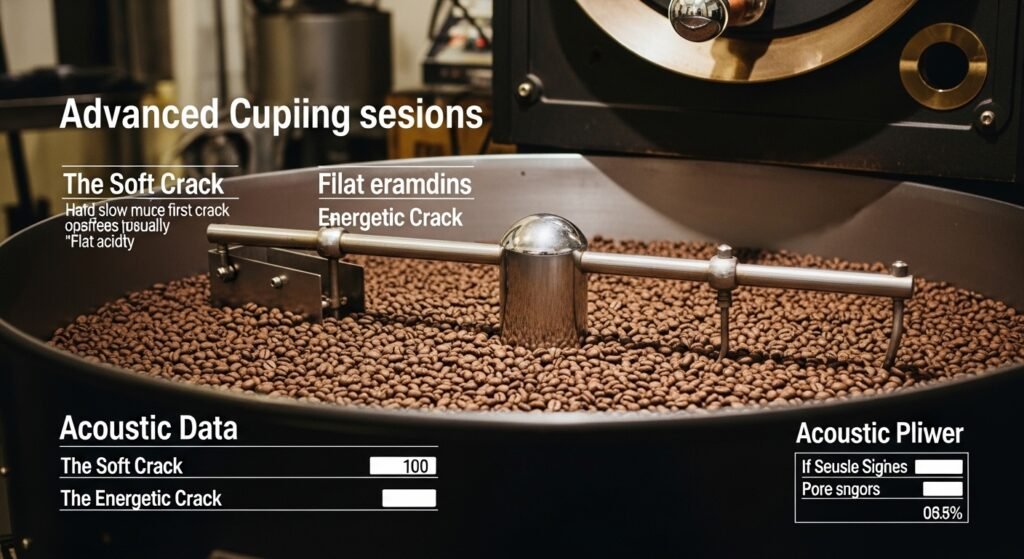
In our advanced cupping sessions, we now include the “Acoustic Data” of the roast on the score sheet.
-
The Soft Crack: Beans that had a slow, muffled first crack often result in a “flat” acidity.
-
The Energetic Crack: A sharp, rapid series of acoustic emissions usually indicates a high-energy roast that highlights the sparkling acidity of African coffees.
-
Maintenance of the Roaster: If the drum is dirty or the airflow is restricted, the acoustic signal becomes “noisy.” Maintenance matters even in the roasting room, as any mechanical vibration can interfere with the AE sensors’ ability to hear the bean’s story.
The Future: AI and Acoustic Roasting
We are moving toward a future where roasting machines will be “self-tuning.” By using Artificial Intelligence to listen to the acoustic emissions in real-time, the machine can adjust the gas burner or airflow to ensure every batch hits the same “Sound Target.“
This level of precision ensures that the water quality in your cafe won’t have to compensate for a poorly developed roast. In the “Sensory Laboratory,” we see this as the final frontier of grind and extraction—the ability to hear the chemistry as it happens.

Conclusion: The Symphony of the Bean
The next time you enjoy a cup of coffee, remember that its flavor was defined by a series of microscopic explosions. The sound of the roast is the bean’s way of telling us when the Maillard reaction has done its job and when the sugars have reached their peak caramelization.
In the “Sensory Laboratory,” we respect the secrets of high altitude and the science of grinding, but we must also listen to the bean. By combining our espresso calibration with acoustic data, we create a sensory experience that is technically perfect and emotionally resonant. Keep your ears open, your equipment maintained, and your palate ready for the symphony of flavor. The perfect cup is not just seen or tasted; it is heard.

Kevin Smith is deeply interested in the craft and culture of coffee, with practical experience exploring specialty beans, brewing techniques, and flavor development. Over the years, he has spent time studying preparation methods, observing extraction processes, and understanding how small details influence the final cup.
Through NovaWeHub, Kevin shares clear, practical, and research-based insights designed to make coffee knowledge approachable for everyone — from beginners to enthusiasts. His focus is on simplifying complex concepts and encouraging readers to explore coffee with curiosity, confidence, and a more refined sensory awareness.