
Brazil is often referred to as the “giant” of the coffee world, and for good reason. For over 150 years, it has been the world’s largest producer, currently accounting for about a third of all coffee consumed globally. However, for a long time, the international market viewed Brazilian coffee as a mere commodity—a consistent, nutty base for espresso blends but lacking the “excitement” of African or Central American beans. That perception is changing rapidly. Today, Brazil is a powerhouse of specialty coffee, boasting a diverse flavor map that ranges from creamy, chocolatey classics to surprising, fermented fruit bombs.
The secret to this diversity lies in Brazil’s massive geography. The country’s coffee-growing regions span several states, each with unique microclimates, altitudes, and soil types. Understanding the “Brazilian Terroir” is essential for any enthusiast because “Brazil” is not a single flavor profile. Depending on whether your beans come from the rolling hills of Minas Gerais or the coastal mountains of Espírito Santo, your experience in the cup will be radically different. In this guide, we will tour the most iconic coffee regions of Brazil and discover what makes each one a vital piece of the global coffee puzzle.
Sul de Minas: The Heart of Production
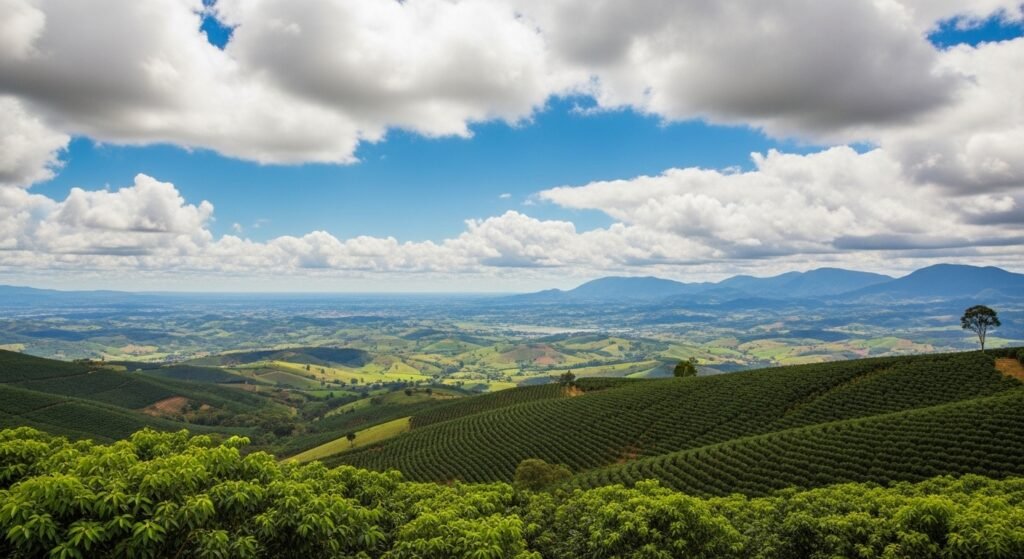
When people think of Brazilian coffee, they are most likely thinking of Sul de Minas. Located in the southern part of the state of Minas Gerais, this region is the single largest coffee-producing area in the world. Its landscape is characterized by high altitudes (ranging from 900 to 1,200 meters) and a mild climate that is perfect for the Arabica plant. The terrain is a mix of mountainous slopes and rolling hills, which allows for a combination of manual and semi-mechanized harvesting.
The classic Sul de Minas profile is the “soul” of Brazilian coffee: a medium body, low acidity, and dominant notes of milk chocolate, toasted nuts, and caramel. Because the region has a very stable climate with well-defined seasons, the quality is incredibly consistent year after year. For the home barista, coffee from Sul de Minas is the ultimate “crowd-pleaser.” It is exceptionally balanced and serves as a perfect foundation for milk-based drinks like lattes and cappuccinos, where its nutty sweetness can cut through the creaminess of the milk without being overpowered.
Mogiana: Tradition and Sweetness
Just across the border from Minas Gerais, in the state of São Paulo, lies the Mogiana region. Named after the Companhia Mogiana de Estradas de Ferro, the railway that once transported the beans to the port of Santos, this region is steeped in history. The coffee here is grown at altitudes similar to Sul de Minas but often experiences slightly warmer temperatures, which contributes to a very high concentration of natural sugars in the coffee cherry.
Mogiana coffee is world-renowned for its “clean” sweetness. It often exhibits a velvety mouthfeel and flavor notes reminiscent of honey, roasted almonds, and dark cocoa. Many of the most famous “Natural” processed coffees in Brazil come from this region. Because the drying process is managed with extreme precision on large brick patios, the coffee develops a deep, syrupy body that is highly prized by espresso roasters worldwide. If you are looking for a cup that feels like a “warm hug”—rich, sweet, and comforting—Mogiana is the region to choose.
Cerrado Mineiro: The Power of Terroir and Technology
The Cerrado Mineiro was the first region in Brazil to receive a “Protected Designation of Origin” (PDO) status, similar to Champagne in France. This is a high-altitude plateau in the center-west of Minas Gerais. Unlike the mountainous south, the Cerrado is flat, which allowed farmers to pioneer advanced irrigation and mechanized harvesting techniques. However, don’t let the technology fool you; the quality here is world-class.
The Cerrado is famous for its “dry” climate during the harvest season, which is a major advantage. It ensures that the coffee cherries dry evenly without the risk of unwanted fermentation from rain. The resulting cup is remarkably clean and “bright” for a Brazilian coffee. It often features a distinct citric acidity—something rare in other parts of the country—paired with a heavy body and intense nutty aromas. The Cerrado Mineiro is a favorite for specialty roasters who want a “modern” Brazilian profile that offers more complexity and a sharper finish than the traditional classics.
Matas de Minas and Espírito Santo: The New Frontier of Acidity
While the inland regions are famous for chocolate and nuts, the coastal and eastern regions are currently the “stars” of the Brazilian specialty scene. Matas de Minas and the neighboring state of Espírito Santo are characterized by extremely rugged, mountainous terrain. Here, large-scale machinery is impossible. Every cherry is picked by hand on steep slopes, often by small, family-run farms.
Because of the Atlantic influence and the humid mountain air, the coffee matures even more slowly here. This is the birthplace of the “Pulped Natural” (Canephora and Arabica) and increasingly, anaerobic fermentations. The flavor profile from Matas de Minas and Espírito Santo can be shocking to those who only know “traditional” Brazil. You will find vibrant notes of red apple, passion fruit, lime, and even floral hints like hibiscus. Espírito Santo is also the world leader in high-quality “Conilon” (Robusta), proving that even Robusta can achieve specialty status when grown in the right terroir with meticulous care.

Conclusion: A Continent of Coffee
Exploring Brazilian coffee regions is like exploring an entire continent. From the industrial efficiency and sweetness of the Cerrado to the artisanal, fruity nuances of Matas de Minas, Brazil offers a solution for every palate. The “Giant” has woken up to the specialty movement, and the result is a massive increase in quality and traceability.
For the consumer, buying Brazilian coffee is no longer about buying “bulk.” It is about choosing a specific micro-region and a specific story. By supporting these diverse regions, you are encouraging the preservation of microclimates and the innovation of processing methods. The next time you see a bag of Brazilian coffee, look closer at the label. Whether it’s from Mogiana, Cerrado, or Sul de Minas, you aren’t just drinking a cup of coffee; you are drinking the diverse geography of one of the most vibrant nations on Earth. Brazil has a flavor for everyone—your job is to find your favorite on this incredible map.

Kevin Smith is deeply interested in the craft and culture of coffee, with practical experience exploring specialty beans, brewing techniques, and flavor development. Over the years, he has spent time studying preparation methods, observing extraction processes, and understanding how small details influence the final cup.
Through NovaWeHub, Kevin shares clear, practical, and research-based insights designed to make coffee knowledge approachable for everyone — from beginners to enthusiasts. His focus is on simplifying complex concepts and encouraging readers to explore coffee with curiosity, confidence, and a more refined sensory awareness.