
The Irish Coffee is perhaps one of the most misunderstood drinks in the world. Often served in airports or casual diners as a messy mixture of lukewarm coffee, cheap whiskey, and a mountain of pressurized whipped cream from a can, the true, authentic version is a masterpiece of temperature, texture, and balance. Created in the 1940s by chef Joe Sheridan at Foynes Port in Ireland to warm up cold travelers, the authentic Irish Coffee is a sophisticated beverage designed to be sipped through a layer of cold, silky cream into a lake of sweetened, hot coffee and whiskey.
The secret to a perfect Irish Coffee lies in the physics of density. It is a “layered” drink, not a stirred one. In the coffee laboratory, we treat the Irish Coffee as a study in contrast: the coldness of the cream against the heat of the coffee, and the silkiness of the dairy against the sharp kick of the Irish whiskey. Mastering this drink is a rite of passage for any home barista or mixologist. In this guide, we will explore the precise techniques needed to ensure your cream always floats and your proportions are historically accurate.
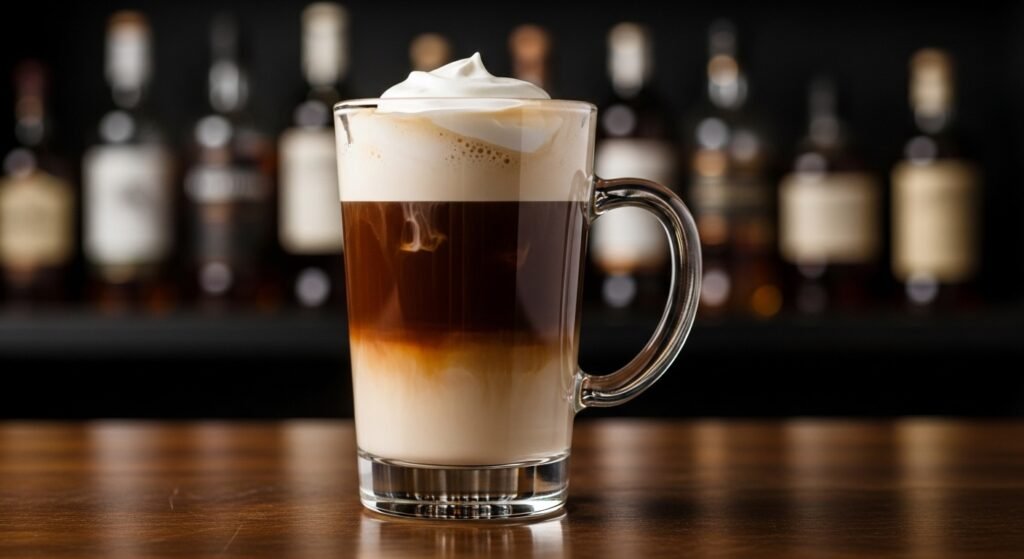
The Foundation: High-Quality Coffee and Proper Whiskey
An Irish Coffee is only as good as its primary ingredients. In the modern era of specialty coffee, we no longer have to settle for “strong and bitter” coffee. For a truly elevated version, you should choose a coffee with a heavy body and low acidity. A medium-to-dark roast from Brazil or India is ideal. These coffees offer notes of chocolate, nuts, and spice that harmonize beautifully with the malt and oak notes found in Irish whiskey. While a pour-over works well, a French Press is often preferred here for the extra body and oils it contributes to the base.
The whiskey must be Irish—this is non-negotiable. Irish whiskey is typically triple-distilled, making it smoother and more approachable than the smokiness of Scotch or the intense sweetness of Bourbon. This smoothness allows the coffee’s nuances to remain the star of the show while the whiskey provides the necessary “warmth” from within. In our laboratory, we recommend a ratio of roughly four parts coffee to one part whiskey, ensuring that neither ingredient masks the other.
The Science of the Float: Preparing the Base
The most common failure in an Irish Coffee is the “sinking cream.” To prevent this, you must understand the role of sugar. Sugar isn’t just for flavor in this cocktail; it is a structural necessity. By dissolving brown sugar (preferably Demerara or Muscovado) into the hot coffee, you increase the liquid’s density. This “heavier” coffee base provides a more stable platform for the cream to sit on top of. Without enough sugar, even the best-whipped cream will likely dive straight to the bottom of the glass.
Temperature also plays a role in density. Before you even begin mixing, you must pre-heat your glassware. Fill your Georgian or Irish Coffee glass with boiling water and let it sit for a minute. If the glass is cold, it will shock the coffee, causing it to lose its heat rapidly and affecting the way the cream settles. Once the glass is hot, discard the water, add your sugar and whiskey, and fill with hot coffee, leaving about an inch of space at the top for the cream. Stir vigorously until every grain of sugar is dissolved; a clear, dark, and hot base is essential for a clean separation.
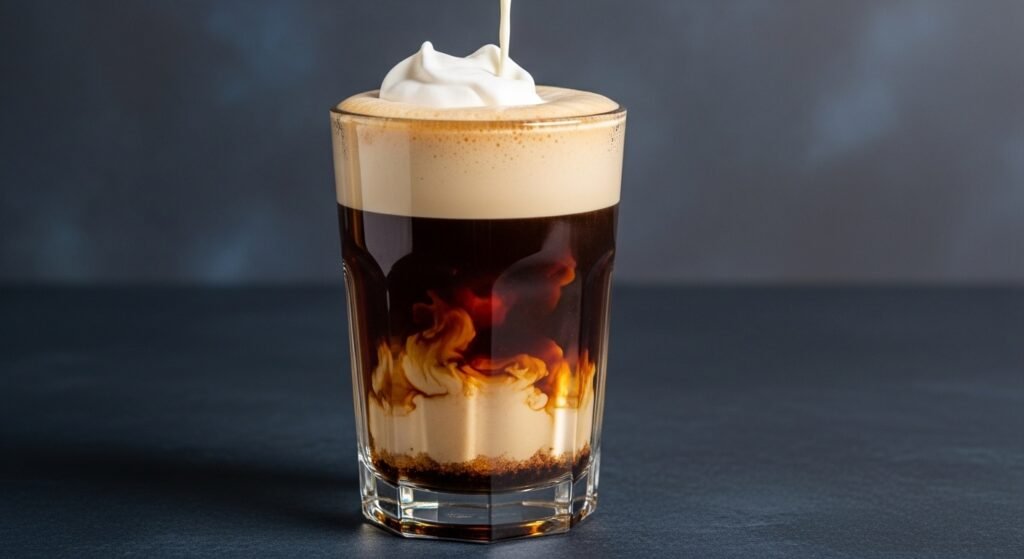
The Secret to the Cream: Under-Whipping is Key
The biggest “crime” committed against Irish Coffee is the use of heavy, stiff-peaked whipped cream. To achieve the correct mouthfeel, the cream should be lightly whipped to a “hand-poured” consistency. This means the cream should still be liquid enough to pour, but thick enough to hold its shape on the surface. Professionals call this “soft peaks.” You want the cream to be cold and fresh—heavy whipping cream with a high fat content (at least 36%) works best.
In the drink laboratory, we recommend shaking the cold cream in a mason jar or using a handheld milk frother for just a few seconds until it reaches the consistency of melted ice cream. If you whip it too much, it becomes a solid block that won’t integrate with the coffee as you sip. If you don’t whip it enough, it will simply mix into the coffee like a standard latte. The goal is a silky, pourable foam that sits on top like a pristine blanket of snow.
The Execution: The Back of the Spoon Technique
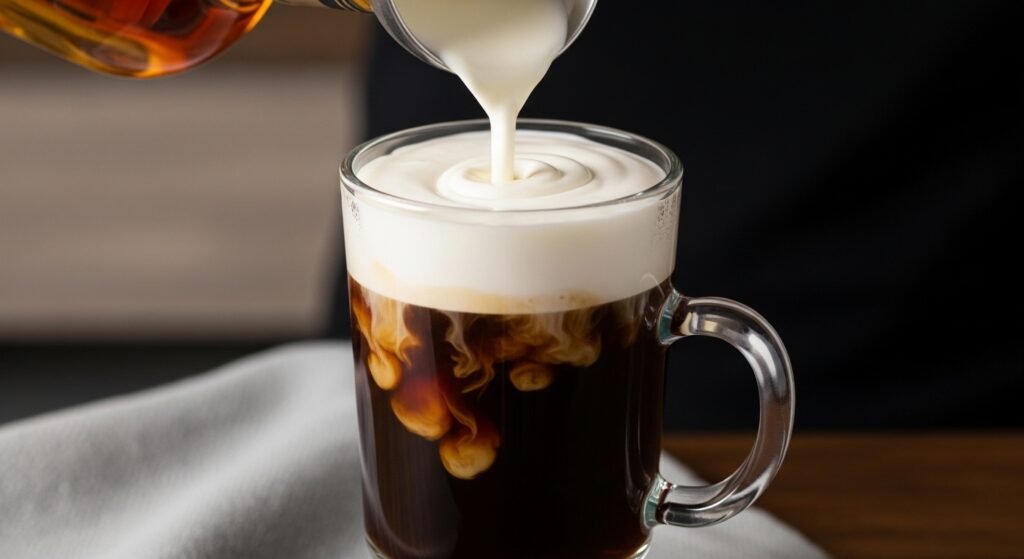
Now comes the moment of truth: the pour. To ensure the cream floats perfectly every time, you must use the “back of the spoon” technique. Hold a warm teaspoon just above the surface of the coffee, with the back of the spoon facing upward. Slowly and gently pour the lightly whipped cream over the back of the spoon. This disperses the weight of the cream across a larger surface area, preventing it from breaking the tension of the coffee.
As the cream flows over the spoon, it will naturally find its place on top of the sweetened coffee. Once you have a layer about half an inch to an inch thick, stop pouring. Do not stir! The beauty of the Irish Coffee is the visual contrast. The drinker should see two distinct layers: dark at the bottom and white at the top. As you drink, the hot coffee-whiskey mixture passes through the cold cream, creating a unique sensory experience that changes with every sip.
Conclusion: A Masterpiece of Balance
The Classic Irish Coffee is a testament to the fact that simplicity, when executed with precision, is the ultimate sophistication. It is not just a drink for St. Patrick’s Day; it is the perfect conclusion to a winter dinner party or a cold afternoon by the fireplace. By treating each step—from the sugar-induced density to the aeration of the cream—as a scientific process, you ensure that this 80-year-old recipe remains as magical today as it was at Foynes Port.
When you serve a perfectly layered Irish Coffee, you are serving a piece of history. The clean lines of the cream, the aromatic steam of the coffee, and the underlying glow of the whiskey create an aesthetic and flavorful harmony that few other drinks can match. So, put away the aerosol cans and the instant coffee. Reach for the scale, the spoon, and the high-quality beans. Your laboratory is ready, and the perfect Irish Coffee is just a careful pour away.

Kevin Smith is deeply interested in the craft and culture of coffee, with practical experience exploring specialty beans, brewing techniques, and flavor development. Over the years, he has spent time studying preparation methods, observing extraction processes, and understanding how small details influence the final cup.
Through NovaWeHub, Kevin shares clear, practical, and research-based insights designed to make coffee knowledge approachable for everyone — from beginners to enthusiasts. His focus is on simplifying complex concepts and encouraging readers to explore coffee with curiosity, confidence, and a more refined sensory awareness.