
Have you ever looked at a bag of specialty coffee and wondered how on earth it could taste like “red berries,” “caramel,” or even “jasmine”? To the uninitiated, coffee often just tastes like, well, coffee. It is usually described as “strong,” “bitter,” or “hot.” However, once you unlock the secret of flavor notes, your morning cup transforms from a simple caffeine kick into a complex sensory journey. Identifying these nuances isn’t a superpower reserved for professional tasters or Q-Graders; it’s a skill that anyone can develop with a bit of patience, the right technique, and a curious palate.
The world of specialty coffee is vast and often intimidating. When we talk about “flavor notes,” we aren’t talking about artificial flavorings added during the roasting process. We are talking about the soul of the bean itself. Every sip of high-quality coffee carries the story of its origin, the chemistry of its soil, and the precision of the roast. Learning to decode this story is what separates a casual drinker from a true coffee enthusiast. In this comprehensive guide, we will explore everything from the science of taste to the practical steps you can take to sharpen your senses.
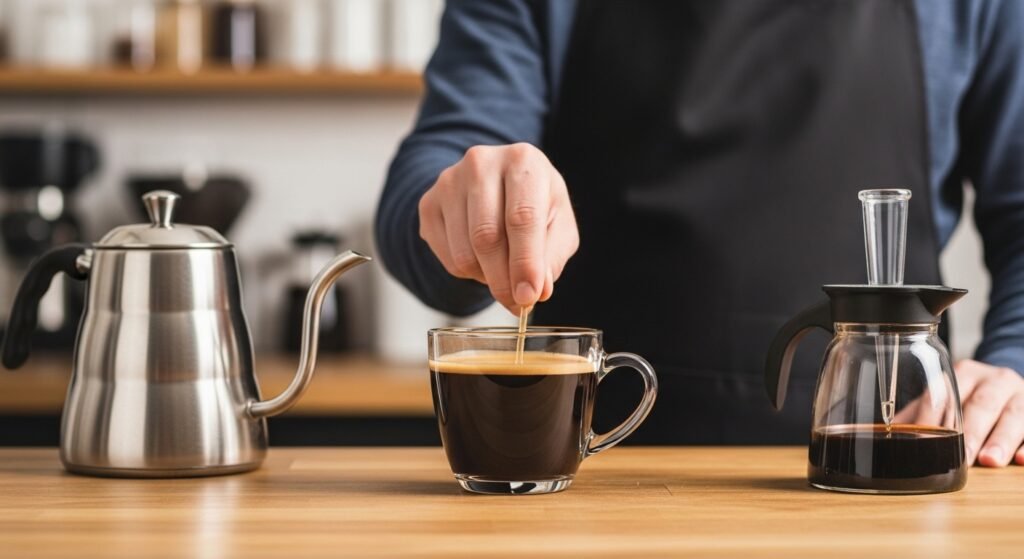
The Science of Flavor: Why Does Coffee Taste Like Other Things?
The first thing to understand is that these flavors are not “added” to the beans. Unlike commercial flavored coffees that use oils or synthetic syrups to mimic vanilla or hazelnut, specialty coffee develops its profile naturally. This happens through a fascinating chemical process. Coffee is one of the most chemically complex beverages in the world, containing over 800 aromatic compounds. For comparison, wine only has about 200 to 300.
When a coffee label says it has notes of “Green Apple,” it means that the coffee contains malic acid, the same organic compound found in apples. If you taste “Chocolate,” you are reacting to the browning of sugars (the Maillard reaction) during the roasting process. This biological and chemical overlap is what allows our brains to make connections between a bean grown in Ethiopia and a fruit grown in your local orchard. It all starts with the terroir—the combination of soil, altitude, and climate where the plant grows.
A bean from the high altitudes of Ethiopia will naturally lean towards floral and citrus notes because the coffee cherries grow slower, allowing more complex sugars and acids to develop. In contrast, a Brazilian bean grown at lower elevations in rich, flat lands might showcase heavy chocolate, peanut, and buttery characteristics. The variety of the plant also plays a massive role; a Bourbon variety will taste different from a Typica or a rare Geisha, even if grown on the same farm.
The Roaster’s Influence: Developing the Potential
While the farmer creates the potential for flavor, the roaster is the one who unlocks it. The roasting process is a delicate dance between time and temperature. A light roast preserves the delicate acidity and fruitiness of the bean, keeping those “volatile” aromatic compounds intact. This is where you find the most vibrant, tea-like, and floral coffees.
As the roast progresses into a medium profile, the sugars begin to caramelize. This is where we see the emergence of honey, toffee, and caramel notes. If the roast goes too dark, the unique characteristics of the origin begin to disappear, replaced by the flavors of the roast itself—smoke, carbon, and intense bitterness. For anyone looking to identify flavor notes, light to medium-light roasts are the best “textbooks” because the origin’s flavors are still the stars of the show.

How to Set Up a Home Tasting (Cupping) Session
If you want to get serious about identifying notes, you need to taste coffee like the pros do. This process is called “cupping.” You don’t need expensive equipment; you just need a few glasses, a spoon, and different types of coffee. By tasting two or three different coffees side-by-side, the differences become much more obvious. It’s hard to describe a coffee as “bright” if you don’t have a “dull” coffee to compare it to.
Start by smelling the dry grounds. This is your first hint of what’s to come. Do you smell something sweet like brown sugar, or something savory like herbs? After adding hot water and letting it steep for four minutes, break the “crust” of grounds at the top with a spoon and inhale deeply. This “wet aroma” is often where the most intense floral and fruity scents are hidden.
When you finally taste the coffee, don’t just take a polite sip. You need to slurp. By forcefully pulling the liquid into your mouth along with a lot of air, you aerate the coffee. This spreads the liquid across your entire tongue and pushes the aromas up into your retro-nasal passage. This is crucial because your tongue can only perceive five basic tastes (sweet, sour, salty, bitter, and umami), but your nose can perceive thousands of nuances.
The Sensory Library: Training Your Brain
One of the biggest hurdles for beginners is not a lack of taste, but a lack of vocabulary. You might sip a coffee and think, “I know this taste, but I can’t name it!” This is where building a “sensory library” comes in. Professional tasters spend years intentionally tasting things and naming them.
You can do this at home. The next time you go to the grocery store, buy different types of citrus: a lemon, a lime, a grapefruit, and an orange. Taste them and notice the difference in their acidity. A lemon is sharp and biting; an orange is sweet and mellow. When you find “citrus” in coffee, you can then ask yourself: “Is this lemon-bright or orange-sweet?“
The same applies to sugars. Taste white sugar, brown sugar, honey, and maple syrup. Notice how the sweetness changes from “clean” to “rich” and “earthy.” By consciously naming these flavors in your daily life, your brain creates a map. When those same compounds appear in your coffee cup, your brain will instantly pull the correct file from its library.

Understanding Body and Aftertaste
Flavor notes aren’t just about fruit and sugar; they are also about the physical sensation of the coffee in your mouth. This is known as “body” or “mouthfeel.” A coffee can feel thin and clean like water, silky like tea, or heavy and creamy like whole milk. A heavy-bodied coffee often supports notes of dark chocolate, molasses, or tobacco. A light-bodied coffee is usually where you find the most delicate jasmine or lemongrass notes.
Finally, pay attention to the aftertaste, or “finish.” Does the flavor disappear immediately, or does it linger on your tongue for minutes? A high-quality specialty coffee will usually have a pleasant, clean finish. If you feel a dry, sandpaper-like sensation (astringency), the coffee might be over-extracted or made from low-quality beans. A great coffee might leave you with a lingering sweetness that reminds you of cocoa powder or dried fruits long after the cup is empty.
In the end, coffee tasting is a personal and subjective experience. There are no “wrong” answers. If a label says “Blueberry” and you taste “Strawberry,” you are both right—you are both identifying red fruit acidity and sweetness. The goal isn’t to be a perfect machine, but to deepen your appreciation for the incredible effort that goes into every single bean. From the farmer in the mountains to the roaster in the city, everyone worked to put those flavor notes in your cup. Your job is simply to slow down, take a slurp, and enjoy the story they are telling.

Kevin Smith is deeply interested in the craft and culture of coffee, with practical experience exploring specialty beans, brewing techniques, and flavor development. Over the years, he has spent time studying preparation methods, observing extraction processes, and understanding how small details influence the final cup.
Through NovaWeHub, Kevin shares clear, practical, and research-based insights designed to make coffee knowledge approachable for everyone — from beginners to enthusiasts. His focus is on simplifying complex concepts and encouraging readers to explore coffee with curiosity, confidence, and a more refined sensory awareness.