
Coffee brewing often involves the pursuit of precision, using calibrated espresso machines and advanced grinders to craft the ideal cup. Yet sometimes, simplicity offers the greatest versatility.
The AeroPress, a humble plastic device created by a toy maker, stands out as one of the most adaptable tools a barista can use. Combining immersion, filtration, and pressure, it allows careful control over extraction, helping to balance acidity and bitterness. Its design makes it possible to experiment with flavor in ways that few other brewing methods can match, demonstrating that innovation doesn’t always require complexity.
The genius of the AeroPress lies in its ability to shorten the journey of the bean from seed to export into a two-minute window. By using manual air pressure to force water through the coffee bed, we can achieve high extraction yields without the bitterness associated with long immersion times. Whether you are brewing a bright African profile or a heavy Brazilian natural, the AeroPress is the ultimate playground for the curious barista.
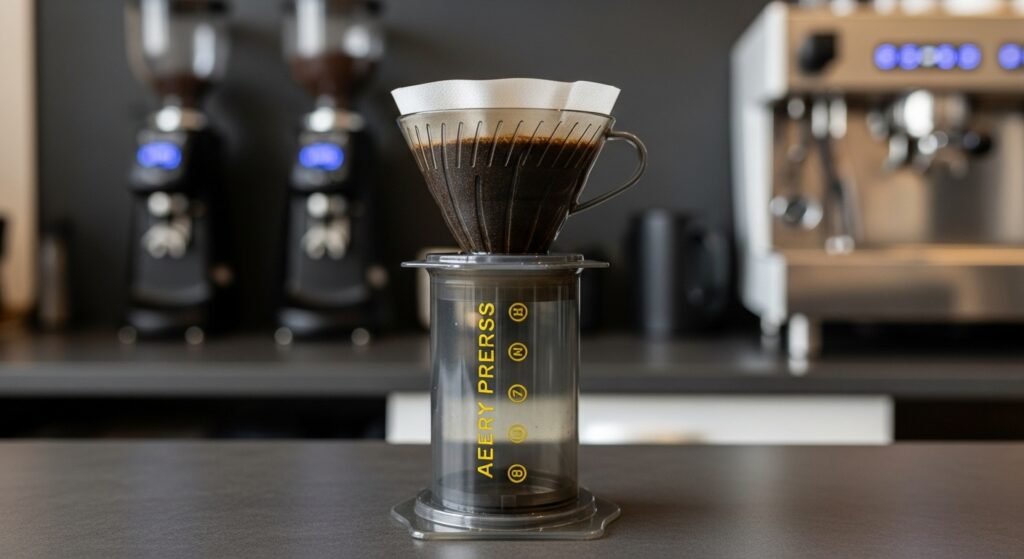
The Physics of Pressure and Solubility
Extraction is the process of water dissolving solids from the coffee grounds. In standard methods, we rely on heat and time. In an AeroPress, we introduce pressure. When you press the plunger, you are creating about 0.3 to 0.5 bars of pressure. While this is nowhere near the 9 bars of a calibrated espresso, it is enough to fundamentally change the chemistry of the cup.
Pressure increases the “solvent power” of water. It forces the liquid into the microscopic pores of the coffee grounds, pulling out the flavor notes that are often left behind in a simple gravity brew. This is why AeroPress coffee often has a higher total dissolved solids (TDS) count than a V60, resulting in a more intense body and mouthfeel.
The “Standard” vs. “Inverted” Methods
In the “drink laboratory,” there are two primary ways to utilize this device, each favoring a different terroir.
-
The Standard Method: You place the AeroPress on top of your mug, add coffee and water, and press. This method involves “percolation”—the water is moving through the grounds from the start. It highlights acidity and clarity, making it perfect for high-altitude Colombian coffees.
-
The Inverted Method: You turn the AeroPress upside down, allowing the coffee and water to steep like a French Press before flipping and plunging. This is a full-immersion technique. It increases the sweetness and highlights the aftertaste of chocolate and nuts found in Brazilian Cerrado beans.
The Importance of the Paper (and Metal) Filter
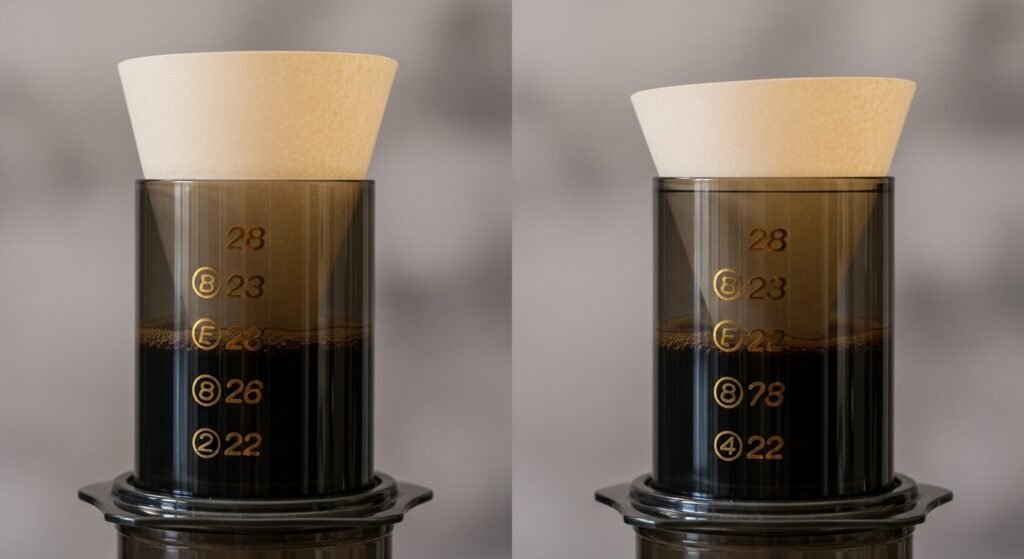
The AeroPress uses a small paper disc that is incredibly efficient at removing “fines” and oils. This results in a cup that is remarkably clean, even with a fast brew time. However, for those who miss the texture of a Modern Carajillo, a metal mesh filter can be used.
Metal filters allow the natural lipids of the coffee to pass through, increasing the body and giving the coffee a weight that mimics espresso. During home cupping sessions, we often test the same bean with both paper and metal to see how the sensory experience shifts.
Dialing In: The Three Variable Dance
To master the barista’s bench with an AeroPress, you must balance three variables:
-
Grind Size: Because of the pressure, you can use a wider range of grind sizes than in other methods. A fine grind (like espresso) will yield a concentrated “shot,” while a medium grind (like sea salt) will produce a clean filter-style cup.
-
Water Temperature: Unlike the V60, the AeroPress often performs better at lower temperatures ($80^\circ C$ to $85^\circ C$). This prevents the extraction of harsh tannins, preserving the aftertaste and sweetness.
-
Pressure Speed: The speed at which you plunge matters. A slow, steady 30-second press ensures a uniform extraction. If you press too hard, you risk “channeling,” where the water finds a path of least resistance and leaves most of the flavor behind in the grounds.
Maintenance and the “Clean” Laboratory
The AeroPress is famous for being “self-cleaning” because the rubber stopper wipes the chamber as you press. However, for the true sensory experience, maintenance matters. Over time, coffee oils can build up on the rubber seal. If not washed with warm soapy water regularly, these oils will oxidize and introduce a “stale” flavor to your freshly ground specialty coffee.
Water quality also plays a huge role. Because the AeroPress is so efficient at extracting, any impurities in your water—like chlorine or excess calcium—will be magnified. Always use filtered water to ensure your flavor wheel notes remain clear and bright.

Conclusion: The Portable Laboratory
The AeroPress is a testament to the fact that you don’t need expensive machinery to achieve professional results. It is a tool of curiosity, allowing us to experiment with pressure, temperature, and time in a compact, durable package.
Whether you are in a professional cafe or on a high-altitude mountain hike, the AeroPress allows you to respect the journey of the bean. It is the bridge between the simplicity of immersion and the complexity of pressure. By mastering the AeroPress experiment, you gain a deeper understanding of the physics of coffee and unlock a world of flavor that is limited only by your imagination.

Kevin Smith is deeply interested in the craft and culture of coffee, with practical experience exploring specialty beans, brewing techniques, and flavor development. Over the years, he has spent time studying preparation methods, observing extraction processes, and understanding how small details influence the final cup.
Through NovaWeHub, Kevin shares clear, practical, and research-based insights designed to make coffee knowledge approachable for everyone — from beginners to enthusiasts. His focus is on simplifying complex concepts and encouraging readers to explore coffee with curiosity, confidence, and a more refined sensory awareness.