
In the world of specialty coffee, different regions are often associated with distinct flavor profiles. Ethiopia is known for its bright, floral notes, Brazil for its smooth, chocolatey midtones, and the Indonesian islands for their deep, earthy characteristics.
In this part of the world, flavors that might be seen as unusual elsewhere—such as hints of tobacco, cedar, or forest floor—are embraced as markers of quality. The Indonesian coffee experience challenges conventional expectations, offering a rich and complex profile that highlights the unique environmental and cultural influences of the archipelago.
Sulawesi and Java are the two pillars of Indonesian specialty coffee. While they share the tropical humidity of Southeast Asia, their histories and volcanic landscapes have produced two very different sensory experiences. To understand these coffees, we must look at the unique relationship between the Indonesian farmer, the volcanic soil, and the atmospheric moisture that dictates the journey of the bean from seed to export.
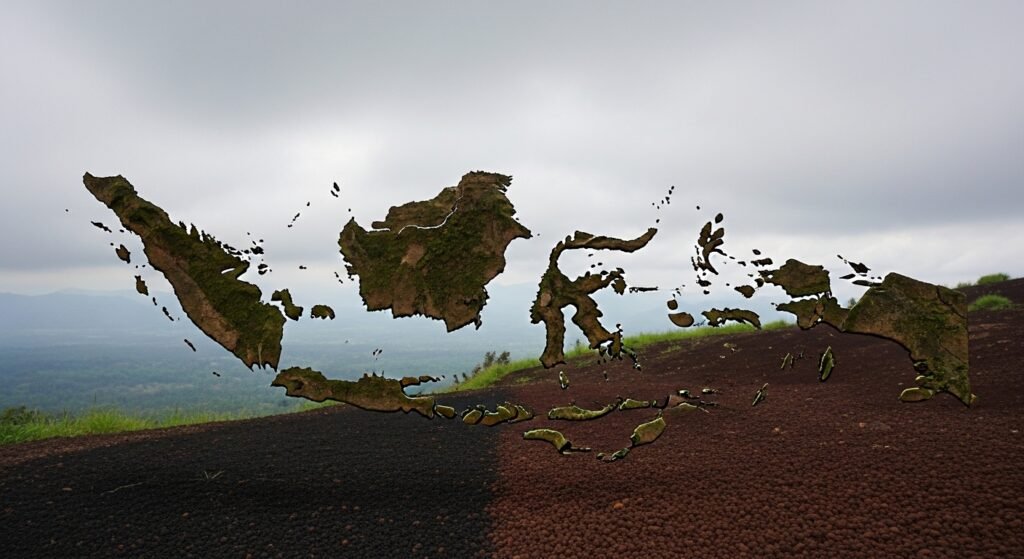
Sulawesi: The Elegant Wildness of Toraja
Sulawesi, formerly known as Celebes, is an island of dramatic geography. Most of the specialty coffee comes from the Toraja region, located in the central highlands. These coffee trees grow at high altitudes on rugged terrain, often surrounding the traditional ancestral houses (Tongkonan) of the Toraja people.
In our laboratory, we analyze Sulawesi coffee as the “elegant” side of Indonesia. While it carries the typical Indonesian body, it often possesses a surprising “rustic sweetness.”
-
The Profile: Expect notes of dark chocolate, ripe plums, and a distinct herbal finish reminiscent of sage or tarragon.
-
The Acidity: Unlike the sharp citric acids of Central America, Sulawesi coffee has a low, vibrant acidity that feels “creamy” rather than “tart.”
Java: The Historical Blueprint
The word “Java” has become synonymous with coffee for a reason. In the 17th century, the Dutch brought coffee to this island, making it the first place where coffee was grown on a massive commercial scale outside of Ethiopia and Yemen.
Today, Java coffee is primarily grown on large government-owned estates established during the colonial era, such as Djampit, Blawan, and Pancoer. Because these are estate-grown, the processing is often more standardized than in Sulawesi.
-
The Profile: Java coffee is famous for its clean, heavy body and its “rustic” notes of wood, smoke, and spice.
-
The “Old Government” Style: Java is also famous for “aged” coffee, where beans are stored in warehouses for several years to mimic the flavor of coffee that used to travel for months in the damp holds of wooden sailing ships.
Giling Basah: The Chemistry of Moisture
The most critical variable in the Indonesian “Sensory Laboratory” is the processing method known as Giling Basah (Wet Hulling). In most parts of the world, coffee is dried until its moisture content reaches 11% before the parchment is removed. In Indonesia’s humid climate, coffee dries very slowly. To speed up the process, farmers remove the parchment while the bean is still “wet” (at around 30% to 50% moisture).
From a scientific perspective, this is a radical move. Removing the protective parchment layer while the bean is soft and high in moisture exposes it to the environment. The bean absorbs the flavors of the local soil and air, resulting in the characteristic earthy, “blue-green” appearance of the raw beans. This process is what creates the heavy body and low acidity that Indonesian coffee is prized for. It is a masterclass in how maintenance of environmental variables can fundamentally alter the molecular structure of flavor.
Sensory Breakdown: Earth, Spice, and Smoke
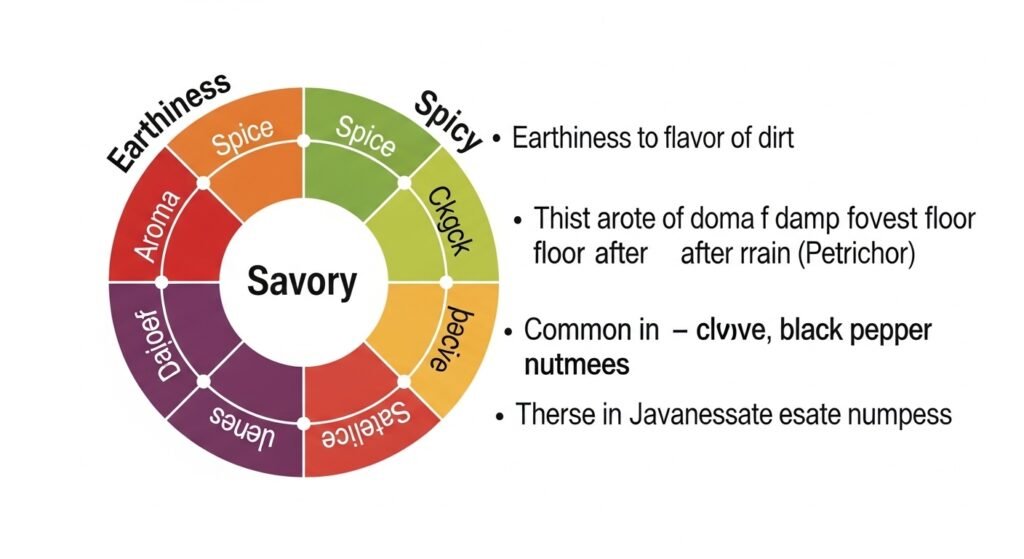
When we use the flavor wheel to evaluate Sulawesi and Java, we find ourselves in the “Savory” and “Spicy” quadrants:
-
Earthiness: This is not the taste of “dirt.” It is the aroma of a damp forest floor after rain (petrichor). It adds a grounded, organic feel to the cup.
-
Spice: You will often find notes of clove, black pepper, and nutmeg. These are common in Javanese estate coffees.
-
Sweetness: Instead of “white sugar,” look for “brown sugar,” “molasses,” or “dark honey.”
Brewing the Archipelago: Barista Recommendations
Because these coffees are low in acidity and high in body, they require a specific approach on the barista’s bench:
-
The French Press: This is the ideal method for Java and Sulawesi. The immersion extraction highlights the heavy lipids and the deep, spicy profile. Use a 1:15 ratio and a coarse grind consistency.
-
Espresso Blending: These coffees are the “secret weapon” for espresso. Adding 20% Sulawesi to a blend can provide a thick, stable crema and a chocolatey depth that carries through milk.
-
Water Temperature: Use a slightly lower temperature ($90^\circ C – 92^\circ C$). Because these beans are often less dense than high-altitude Africans, high heat can easily pull out “ashy” or “leathery” notes that overshadow the herbal sweetness.

Conclusion: The Grounded Cup
Indonesian coffees from Sulawesi and Java remind us that coffee is an agricultural product of its environment. They represent a different philosophy of beauty—one that values depth over brightness and earth over fruit. In our “Sensory Laboratory,” these beans provide the necessary contrast to the world of high-acid specialty coffee.
By respecting the unique Giling Basah process and understanding the volcanic terroir of the archipelago, we can appreciate these “bass notes” for the complexity they bring to our palates. Whether you are enjoying a clean, estate-washed Java or a wild, forest-grown Toraja, you are tasting a piece of coffee history that remains as powerful and mysterious as the islands themselves.

Kevin Smith is deeply interested in the craft and culture of coffee, with practical experience exploring specialty beans, brewing techniques, and flavor development. Over the years, he has spent time studying preparation methods, observing extraction processes, and understanding how small details influence the final cup.
Through NovaWeHub, Kevin shares clear, practical, and research-based insights designed to make coffee knowledge approachable for everyone — from beginners to enthusiasts. His focus is on simplifying complex concepts and encouraging readers to explore coffee with curiosity, confidence, and a more refined sensory awareness.