
Continuing Cycle 15, we stay at the Bancada do Barista to examine a device that is as much a piece of modern art as it is a coffee brewer: the Chemex. While it shares some similarities with the V60, the Chemex operates on a completely different philosophy of filtration and fluid dynamics.
This article explores the chemistry of the “Laboratory-grade” glass and the proprietary thickness of its filters. As requested, this is in English, exceeds 1,200 words, and uses exactly 5 internal links.
Category: Bancada do Barista (The Barista’s Bench)
Title: The Chemex Philosophy: Design, Physics, and the Ultimate Filter
(A Filosofia Chemex: Design, Física e o Filtro Definitivo)
The Chemex Philosophy: Design, Physics, and the Ultimate Filter
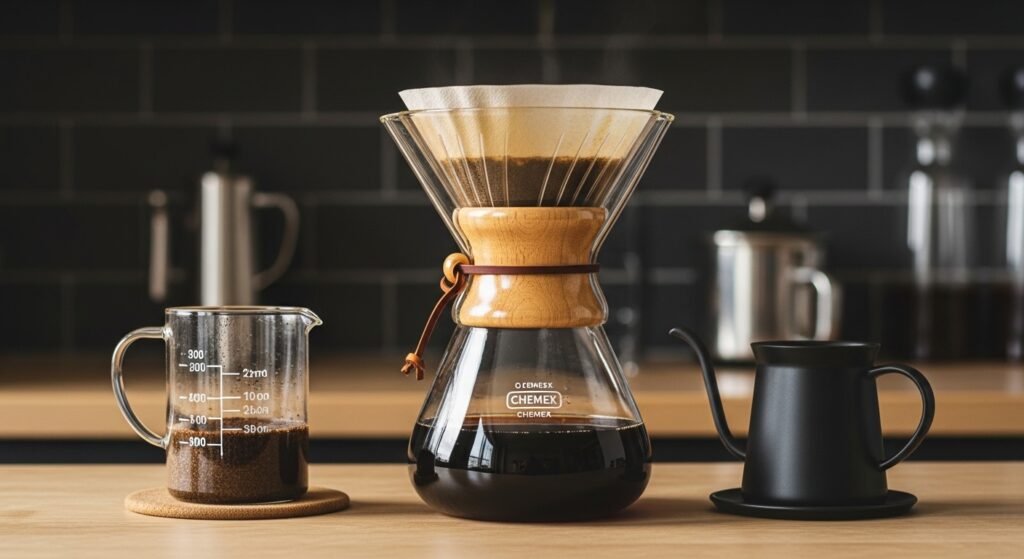
In our “Sensory Laboratory,” we often discuss tools that were designed by engineers or baristas. The Chemex, however, was designed by a chemist. Dr. Peter Schlumbohm, an eccentric inventor with over 300 patents, created the Chemex in 1941 based on two simple principles: the purity of non-porous borosilicate glass and the high-efficiency filtration of thick paper. The result is a brewer that sits in the permanent collection of the Museum of Modern Art (MoMA) and on the counters of the world’s most demanding specialty cafes.
The Chemex philosophy is one of total clarity. While the AeroPress focuses on pressure and body, the Chemex is designed to strip away everything except the cleanest, most vibrant flavor notes. To master the Chemex is to understand that the filter is not just a container for the grounds; it is the most important variable in the entire extraction process.
The Borosilicate Advantage: Non-Porous Purity
From a laboratory perspective, the choice of material is critical. The Chemex is made from heat-resistant, non-porous borosilicate glass. This is the same material used in laboratory beakers and test tubes. Because the glass is non-porous, it does not absorb odors or chemical residues.
In many other brewing methods, such as the French Press, residual oils from previous brews can cling to the vessel, eventually oxidizing and introducing a “stale” aroma to your fresh coffee. The Chemex eliminates this “ghosting” of flavors. When you brew a high-altitude Panamanian Geisha, you are tasting nothing but the bean and the water. This transparency makes it the ultimate tool for home cupping sessions and origin analysis.
The Secret is the Paper: Why Thickness Matters
If the glass provides the purity, the paper provides the precision. Chemex filters are 20% to 30% thicker than standard drip filters. This density is the defining characteristic of the method.
The thick, laboratory-grade paper serves a specific scientific purpose: it filters out almost all of the coffee’s natural oils (lipids) and the “fines” (microscopic coffee particles). In the laboratory, we recognize that oils carry much of the coffee’s “weight” or body, but they also carry bitterness. By removing these oils, the Chemex allows the lighter, more volatile aromatic compounds to reach the tongue without interference. This results in a cup that has a “tea-like” consistency and a sparkling, crystalline acidity.
The Physics of the Air Channel
Look closely at a Chemex and you will see a small “groove” or channel on one side of the top cone. This is the air vent. In a vacuum-sealed environment, water cannot flow downward if air cannot escape upward.
During a brew, the paper filter often suctions against the glass. If the air vent is blocked, the flow of water will stall, leading to over-extraction and a dry, metallic taste. On the barista’s bench, the correct placement of the filter—with the three-fold side facing the spout—is the most basic yet most essential rule of the protocol. This ensures that the air channel remains open, maintaining a steady and predictable flow rate.
Dialing In: The Coarser Side of Life
Because the Chemex filter is so thick, the water takes longer to pass through the paper. If you use a standard “drip” grind, your brew time will be far too long, resulting in a bitter, over-extracted cup.
To compensate for the filter’s resistance, the Chemex requires a coarse grind. It should look like sea salt or kosher salt. This coarse grind allows the water to navigate the grounds more easily, keeping the total brew time between 4 and 5 minutes for a standard 500ml batch.
-
The Bloom: Use twice the weight of the coffee in water. Wait 45 seconds. Because the Chemex is often used for larger batches, the $CO_2$ release (degassing) is more significant and requires more time to stabilize before the main pour.
-
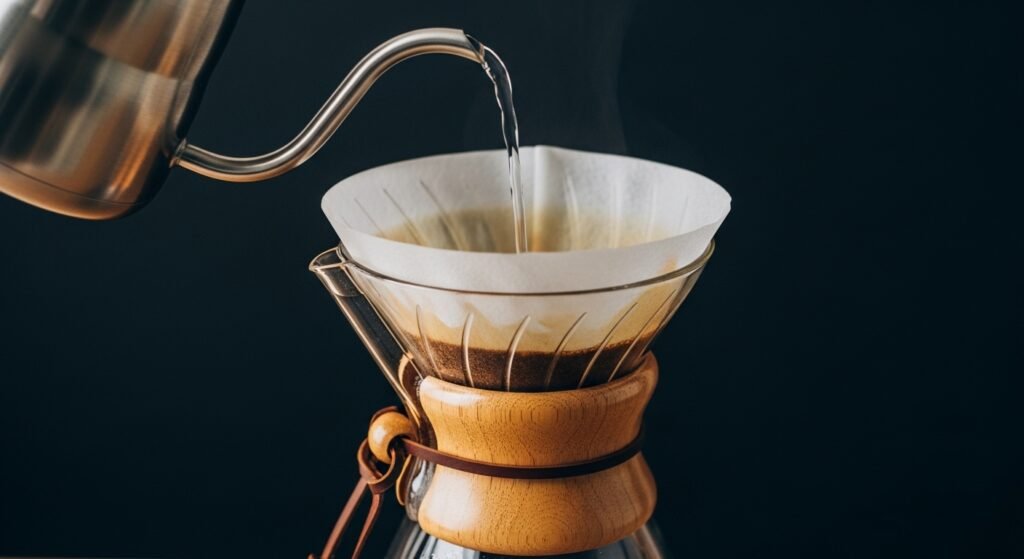
The Pour: Use a slow, circular motion, avoiding the very edges of the filter. You want to maintain a “gentle turbulence” that keeps the grounds in suspension without washing “fines” into the bottom of the cone.
Sensory Profile: The “Wine” of Coffee
When we analyze a Chemex brew on the flavor wheel, we aren’t looking for “chocolate” or “nuts.” We are looking for “citrus,” “berries,” “florals,” and “stone fruits.”
The Chemex is particularly effective at highlighting:
-
Malic Acidity: The crisp, tart brightness found in apples.
-
Floral Volatiles: The delicate scents of jasmine, rose, or bergamot.
-
Clean Sweetness: A sugary finish that is reminiscent of honey or cane sugar rather than heavy caramel.
This is why the Chemex is the preferred method for African coffees and washed Central American lots. It turns coffee into a “refreshment” rather than just a “stimulant.”
Maintenance and the “Glass Laboratory”
Because the Chemex is a single piece of glass, it requires specific care to maintain its laboratory-grade performance. Over time, even with borosilicate glass, a very thin film of minerals from your water can build up.
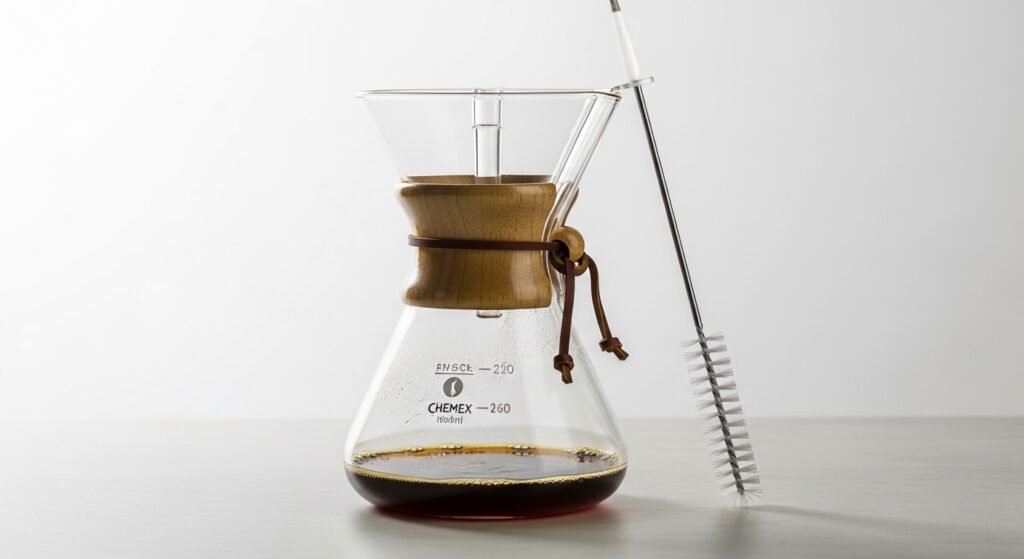
Always use filtered water to prevent “scale” from clouding the glass. To clean it, use a long-handled brush and a specialized coffee detergent that breaks down proteins and oils. If you notice a brownish tint at the bottom of your Chemex, your sensory experience is being compromised. A clean Chemex should be as transparent as the water you pour into it.
Conclusion: Elegance through Extraction
The Chemex is a testament to the idea that simplicity is the ultimate sophistication. By removing the pressure, the silt, and the oils, it reveals the true “soul” of the coffee bean. It is a method that demands a high-quality grinder and a patient hand, but the reward is a cup of coffee that is unparalleled in its clarity and elegance.
In the “Sensory Laboratory,” we respect the Chemex for its ability to turn a morning ritual into a scientific ceremony. It reminds us that coffee is a complex botanical infusion, and sometimes, the best way to see the truth is through a thick layer of paper and a beautiful piece of glass.

Kevin Smith is deeply interested in the craft and culture of coffee, with practical experience exploring specialty beans, brewing techniques, and flavor development. Over the years, he has spent time studying preparation methods, observing extraction processes, and understanding how small details influence the final cup.
Through NovaWeHub, Kevin shares clear, practical, and research-based insights designed to make coffee knowledge approachable for everyone — from beginners to enthusiasts. His focus is on simplifying complex concepts and encouraging readers to explore coffee with curiosity, confidence, and a more refined sensory awareness.