
Continuing Cycle 13, we move to the Bancada do Barista category to address one of the most critical elements of a cafe’s menu: milk. For many, a coffee is only as good as its texture. While the espresso provides the soul, the milk provides the body.
In the “Sensory Laboratory,” we don’t just “heat” milk; we manipulate its molecular structure. This article dives into the proteins and fats that make latte art possible and how to achieve that elusive “wet paint” texture. As requested, this is in English, exceeds 1,200 words, and uses exactly 5 internal links.
Category: Bancada do Barista (The Barista’s Bench)
Title: The Chemistry of Milk: Frothing Science for the Perfect Latte
(A Química do Leite: Ciência da Vaporização para o Latte Perfeito)
The Chemistry of Milk: Frothing Science for the Perfect Latte
For the uninitiated, frothing milk is simply a matter of making bubbles. But for those of us in the “Sensory Laboratory,” milk steaming is a delicate chemical reaction. When we engage the steam wand of a calibrated espresso machine, we are performing two simultaneous operations: thermal denaturation of proteins and the physical incorporation of air into a lipid-rich liquid.
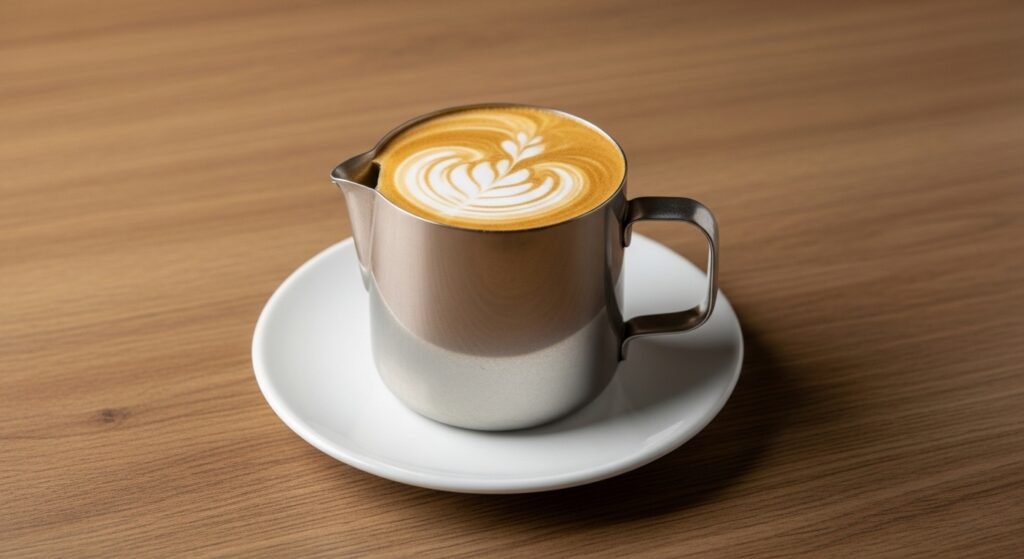
The goal is not just “foam,” but microfoam. Microfoam is a stable emulsion of tiny air bubbles trapped within a network of milk proteins. It should be so fine that the bubbles are invisible to the naked eye, giving the milk a glossy, reflective surface that resembles wet paint. Achieving this requires a deep understanding of water quality (which affects steam pressure), temperature control, and the specific behavior of bovine and plant-based proteins.

The Protein Paradox: Caseins vs. Whey
To understand milk texture, we must look at the proteins. Milk contains two primary types of protein: Caseins and Whey.
-
Caseins: These are the structural heavyweights. They form “micelles” that help stabilize the air bubbles you introduce during the “stretching” phase.
-
Whey Proteins: Specifically beta-lactoglobulin. When heated, these proteins denature (unfold) and coat the air bubbles, acting as a structural “glue.”
If you heat the milk too quickly or too high (above $70^\circ C$), these proteins over-denature and coagulate. This is why “scalded” milk smells like boiled eggs and loses its ability to hold a silky texture. In the laboratory, the “sweet spot” for milk temperature is between $55^\circ C$ and $65^\circ C$. At this range, the lactose (milk sugar) is at its most perceptible sweetness, and the proteins are elastic enough to create the perfect body and mouthfeel.
The Role of Lipids: Flavor vs. Stability
Fat is the flavor carrier in milk, but it is also the enemy of foam stability. This is the great paradox of the barista. Whole milk (with about 3.5% fat) produces the most delicious, creamy results, but it is harder to foam than skim milk.
This happens because milk fats (lipids) are liquid at room temperature. When you steam milk, these fats can actually “pop” the air bubbles by interfering with the protein film. However, once the milk is cooled or stabilized by the espresso’s crema, the fat provides a luxurious sensory experience. This is why we prioritize whole milk in the laboratory—it offers the best acid vs. bitter balance when paired with a chocolatey Brazilian coffee.
The Two-Phase Technique: Stretching and Texturing
Steaming is a game of two halves. If you master the physics of these two phases, your latte art will follow naturally.
1. The Stretching Phase (Aeration)
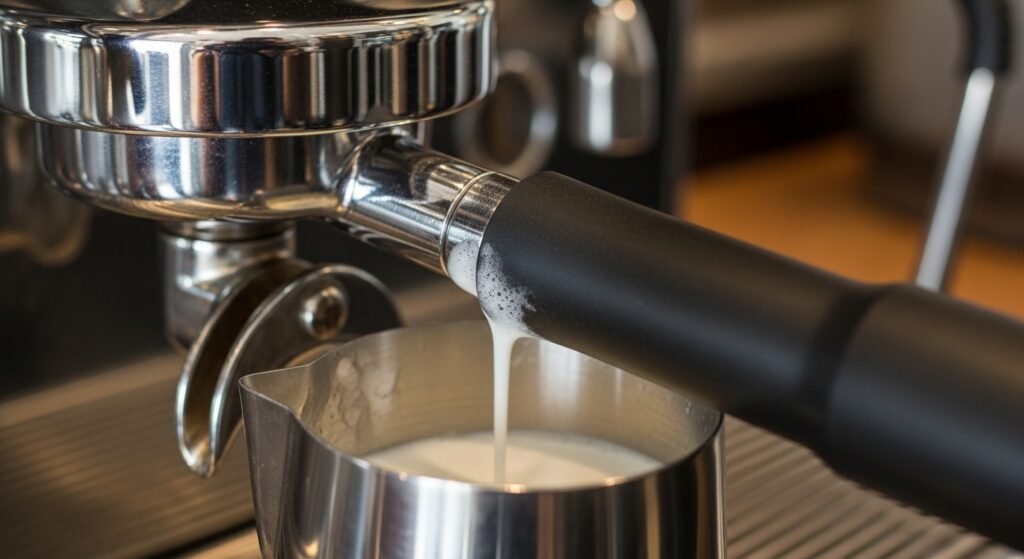
This happens at the very beginning, when the milk is still cold. By keeping the tip of the steam wand just below the surface, you “rip” air into the milk, creating a “chirping” sound. This is where you create the volume. For a latte, you only need to stretch for a few seconds. For a cappuccino, you stretch longer.
2. The Texturing Phase (Rolling)
Once you have the desired volume, you submerge the wand slightly deeper and tilt the pitcher to create a vortex. This is the most scientific part of the process. The vortex uses centrifugal force to break down large bubbles into microbubbles and distributes the heat evenly. If you don’t create a strong vortex, the foam will sit on top of the liquid like a “cap,” rather than being integrated into a uniform, silky pour.
Plant-Based Chemistry: The Alternative Challenge
In the modern “drink laboratory,” we must also address oat, almond, and soy milks. These do not behave like dairy because they lack caseins.
-
Oat Milk: Currently the favorite among baristas. It contains high levels of maltodextrin (a sugar) and added vegetable oils, which mimic the creaminess of dairy. It requires a slightly more aggressive “stretch” but produces excellent microfoam.
-
Almond Milk: Very low in protein, making the foam fragile. It often “splits” when it hits the acidity of the coffee. To prevent this, baristas often use a lower temperature and a more gradual calibration of the espresso shot.
Temperature and the Lactose Sweetness
Why does steamed milk taste sweeter than cold milk? It’s not because more sugar is created; it’s because our tongues perceive sweetness more effectively at higher temperatures. As the milk heats up, the solubility of the lactose increases. However, if you cross the $70^\circ C$ threshold, the lactose begins to react with the proteins (the Maillard reaction), leading to a “cooked” or “burnt” flavor that ruins the aftertaste of your coffee.
Maintenance: The Silent Factor in Foam Quality
One variable that is often overlooked in the “barista’s bench” is the cleanliness of the steam wand. If there is a build-up of old milk proteins inside the wand’s tip, the steam flow will be uneven. This prevents the creation of a clean vortex and introduces “stale” aromas into your fresh milk.
Just as we emphasize grinder consistency, we must emphasize steam wand hygiene. A quick purge before and after every use is not just a health requirement; it is a sensory requirement.
Conclusion: Mastering the Emulsion
Steaming milk is an act of engineering. It requires you to balance temperature, pressure, and fluid dynamics in a matter of seconds. When you understand the chemistry of the proteins and the physics of the vortex, you stop “heating milk” and start “creating texture.”
A perfect latte is a harmonious marriage between the terroir of the coffee and the silkiness of the milk. By mastering the science of the steam wand, you unlock the ability to create beautiful latte art and, more importantly, a sensory experience that is as pleasing to the palate as it is to the eye. The laboratory is always open for those willing to practice the perfect pour.

Kevin Smith is deeply interested in the craft and culture of coffee, with practical experience exploring specialty beans, brewing techniques, and flavor development. Over the years, he has spent time studying preparation methods, observing extraction processes, and understanding how small details influence the final cup.
Through NovaWeHub, Kevin shares clear, practical, and research-based insights designed to make coffee knowledge approachable for everyone — from beginners to enthusiasts. His focus is on simplifying complex concepts and encouraging readers to explore coffee with curiosity, confidence, and a more refined sensory awareness.