
To the untrained eye, steaming milk looks like a simple act of heating a liquid with steam. But in the barista’s laboratory, milk is a complex biological fluid that undergoes a dramatic chemical transformation under the steam wand. Creating “microfoam”—that silky, wet-paint-like texture required for world-class latte art—is an exercise in thermodynamics and molecular stabilization. It is the bridge between the intense, concentrated world of calibrated espresso and the smooth, comforting experience of a latte or flat white.
Understanding the chemistry of milk is essential for anyone looking to master their barista’s bench. Whether you are working with dairy or plant-based alternatives, the goal is the same: to create a stable emulsion of air, water, and fats that complements the flavor notes of your coffee rather than masking them. In this guide, we will break down the science of proteins, the “sweet spot” of temperature, and the physics of the vortex.

Proteins: The Architects of the Bubble
The most important component in milk for a barista is not the fat, but the protein. Milk contains two main types of proteins: Caseins and Whey proteins. When you introduce steam into the milk, you are doing two things: heating it and “stretching” it (adding air).
As the air enters, the whey proteins unfold (denature) and wrap themselves around the air bubbles, creating a protective shield. This is what creates the structure of the foam. If the milk is too cold, the proteins won’t unfold properly; if it’s too hot, the proteins will collapse, and your foam will turn into stiff, dry “bubbles” that resemble dish soap. Caseins, on the other hand, help stabilize the body and mouthfeel of the liquid. Achieving perfect microfoam means creating millions of tiny “micro-bubbles” that are so small they are invisible to the naked eye, giving the milk a glossy, reflective surface.
The Role of Fats and Sweetness
While proteins create the bubbles, fats are what give the milk its luxurious texture. However, fats are also “foam killers.” Large globules of fat can actually interfere with the protein structure, causing bubbles to pop. This is why skim milk (low fat) foams very easily but tastes “thin,” while whole milk (high fat) is harder to foam but produces a much richer aftertaste.
Then there is the lactose—the natural sugar in milk. Lactose is a disaccharide that becomes more soluble and perceptibly sweeter as it is heated. This is why a perfectly steamed latte tastes sweet even without added sugar. However, there is a limit. Once you pass 70°C (158°F), the lactose begins to react with the proteins (the Maillard reaction), leading to a “cooked” or “burnt” flavor that ruins the acid vs. bitter balance of your specialty coffee. In the lab, we find the “sweet spot” to be between 55°C and 65°C.
The Physics of the Vortex: Incorporation and Rolling
To achieve microfoam, you must master the two-stage process of steaming:
-
Stretching (Aeration): This happens at the very beginning when the steam wand is just near the surface, making a “chirping” sound. This introduces the air.
-
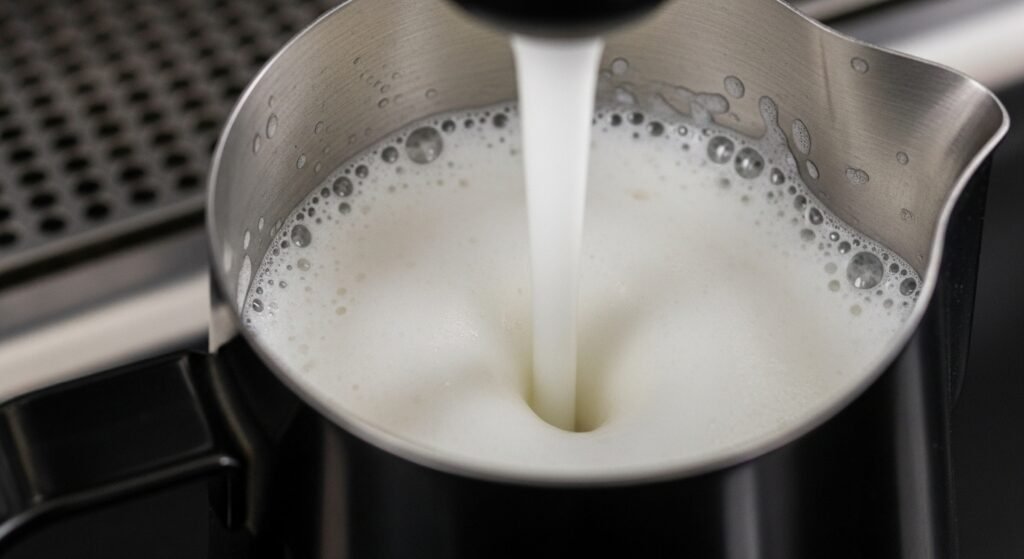
Rolling (Texturing): Once you have added enough air (usually by the time the pitcher feels like body temperature), you submerge the wand slightly and tilt the pitcher to create a powerful vortex (a whirlpool).
The vortex is a mechanical filter. It takes the large bubbles you created during the stretching phase and pulls them down into the blades of the steam, “chopping” them into micro-bubbles. This ensures that the foam is integrated throughout the entire pitcher, rather than just sitting on top. This integrated texture is what allows you to pour latte art—without it, you’ll just get a “blob” of foam followed by watery milk. This level of precision is just as important as maintaining your equipment to ensure the steam pressure is consistent.
Plant-Based Alternatives: A Different Chemical Map
In the modern laboratory, we must also consider oat, almond, and soy milks. These liquids have different protein and fat structures. Oat milk, for example, is high in carbohydrates and requires a slightly different approach to heat to prevent it from becoming “slimy.”
Most “Barista Edition” plant milks have added stabilizers (like dipotassium phosphate) to mimic the water quality and protein behavior of cow’s milk. When working with these, the window for “stretching” is often shorter, and the rolling phase is even more critical to prevent separation. Understanding these differences is part of the terroir of the final drink—how the “origin” of the milk interacts with the origin of the bean.
Latte Art: The Visual “Finish”
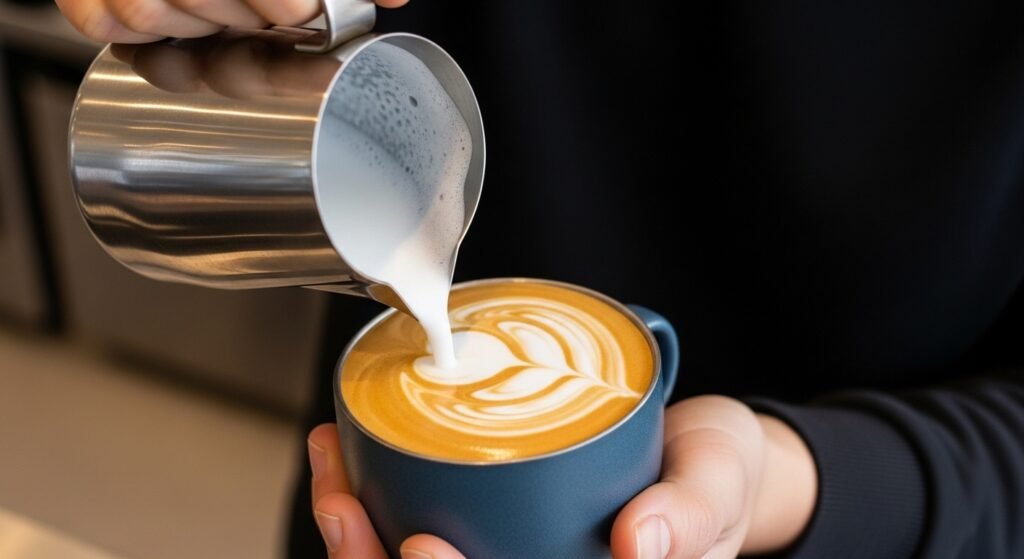
Latte art is the ultimate sign of a calibrated barista. It is only possible if the density of the milk is perfectly matched to the density of the espresso crema. When you pour, you are using the flow of the milk to lift the crema to the surface, creating white patterns against a dark brown background.
Whether you are pouring a heart, a tulip, or a rosetta, the physics remain the same: height, speed, and proximity. Pouring from a height allows the milk to sink; pouring close to the surface allows the foam to “float.” This visual contrast is a psychological trigger, as discussed in our piece on the psychology of coffee, signaling to the drinker that the beverage has been prepared with care and precision.
Conclusion: Mastering the White Gold
Milk is not just a secondary ingredient; it is a canvas. By mastering the chemistry of proteins, fats, and sugars, you move away from “hot milk” and toward “liquid silk.” Every time you step up to your barista’s bench, remember that you are managing a delicate chemical reaction.
Respect the temperature, master the vortex, and choose the right milk for your flavor notes. Whether you are serving a simple cappuccino or an elaborate coffee cocktail, the quality of your milk work is a testament to your dedication to the craft. The laboratory is always open for experimentation—so grab your pitcher, purge your steam wand, and start creating.

Kevin Smith is deeply interested in the craft and culture of coffee, with practical experience exploring specialty beans, brewing techniques, and flavor development. Over the years, he has spent time studying preparation methods, observing extraction processes, and understanding how small details influence the final cup.
Through NovaWeHub, Kevin shares clear, practical, and research-based insights designed to make coffee knowledge approachable for everyone — from beginners to enthusiasts. His focus is on simplifying complex concepts and encouraging readers to explore coffee with curiosity, confidence, and a more refined sensory awareness.