
Conversations about renowned coffee origins often focus on well-known producing regions such as the Ethiopian highlands or the volcanic landscapes of Colombia. However, in the Gulf of Guinea, directly along the equator, lies the island nation of São Tomé and Príncipe — a place with a remarkable yet often overlooked history in global coffee production. Once recognized as one of the world’s leading coffee exporters, the archipelago is now experiencing renewed attention within the specialty coffee scene.
This revival highlights coffees that present a sensory identity distinct from the bright and highly acidic profiles commonly associated with East African origins. Influenced by tropical climates, fertile soils, and traditional cultivation methods, coffees from São Tomé and Príncipe tend to emphasize balance, sweetness, and depth, contributing to the growing diversity of flavors available in today’s specialty market.
The coffee of São Tomé is a product of “Extreme Isolation.” Because the islands are separated from the mainland by deep Atlantic waters, the coffee varieties brought there in the 1800s—primarily Arabica Typica—have evolved in a genetic vacuum. Combined with deep basaltic soils and a hyper-humid equatorial climate, this creates a mouthfeel and aromatic profile defined by dark chocolate, tropical resins, and an almost savory sweetness.
IMAGEM1
The Geology of the “Chocolate Islands”
São Tomé and Príncipe are part of the Cameroon Line, a chain of volcanoes that stretches from the African continent into the ocean. In the “Sensory Laboratory,” we analyze this soil as a “Mineral Reservoir.“
-
Basaltic Foundation: The soil is primarily composed of weathered basalt and phonolite. This volcanic rock is rich in iron, magnesium, and potassium.
-
The Nutrient Cycle: The intense equatorial rainfall quickly breaks down the volcanic rock into a deep, nutrient-dense clay. This allows coffee trees to develop extensive root systems that reach minerals unavailable in more depleted continental soils.
-
The Result: High mineral content in the soil often correlates with a heavier aftertaste and a denser cup structure. While high-altitude beans in other regions might emphasize acidity, the basalt of São Tomé emphasizes “Weight” and “Richness.“
Genetic Time Capsules: The Preservation of Typica
One of the most exciting aspects for the “Sensory Laboratory” is the genetic purity found on the islands. When the Portuguese introduced coffee to the archipelago, they brought the Typica variety.
-
Natural Selection: Over two centuries, these trees have adapted to the intense humidity and sea salt of the Atlantic. They have become “Santomense Typica”—a sub-variety that is naturally more resilient to local pests.
-
The Flavor Profile: Unlike modern hybrids designed for high yield, these heirloom trees produce a cup with low acidity but high clarity. During a cupping session, you will find notes of molasses, cedar, and a distinct “marine” saltiness that balances the sugar.
-
The Altitude Paradox: Although the peaks of São Tomé reach 2,024m (Pico de São Tomé), most coffee is grown in the “Cloud Forest” at 800m to 1,200m. Because it is on the equator, the “effective altitude” is higher due to the constant cloud cover and lower temperatures, mimicking the science of high altitude found in much higher continental ranges.
The Challenge of the Equatorial Climate: Processing Science
The greatest enemy of quality coffee in São Tomé is Humidity. With annual rainfall exceeding 3,000mm in some areas, the maintenance of drying beds is a constant battle.
-
The Drying Crisis: Traditional sun-drying is nearly impossible during the peak of the rains. This has led to the development of “Equatorial Drying” techniques, using covered raised beds with forced airflow.
-
The Fermentation Profile: Because the ambient temperature is warm and humid, fermentation happens very rapidly. If not monitored, the coffee can develop “over-fermented” or “boozy” notes. However, when controlled, this produces the intense “wild fruit” aromas that are becoming a hallmark of the island’s specialty grade.
-
Water Quality in Processing: The islands have an abundance of pure, mineral-rich mountain water. Using this for “Washed” processing enhances the clean, resonant aftertaste that distinguishes Santomense coffee from the earthier Robusta often found in neighboring countries.
Sensory Analysis: Deconstructing the “Santomense” Cup
In the “Sensory Laboratory,” we categorize São Tomé coffee as a “Foundation Origin.” It provides the structure that many lighter coffees lack.
-
Mouthfeel: It has a “buttery” or “velvety” viscosity. This is due to the high lipid (oil) content typical of the old Typica variety grown in volcanic soil.
-
Acidity: It is “muffled” rather than “sparkling.” Think of the acidity of a ripe plum rather than a lemon.
-
The “Cocoa” Connection: São Tomé is also famous for its high-quality cocoa. There is a fascinating theory in the lab that because coffee and cocoa are often intercropped (grown together), they share the same soil microbiome and fungal networks, leading to a “Flavor Synergy” of chocolatey notes.
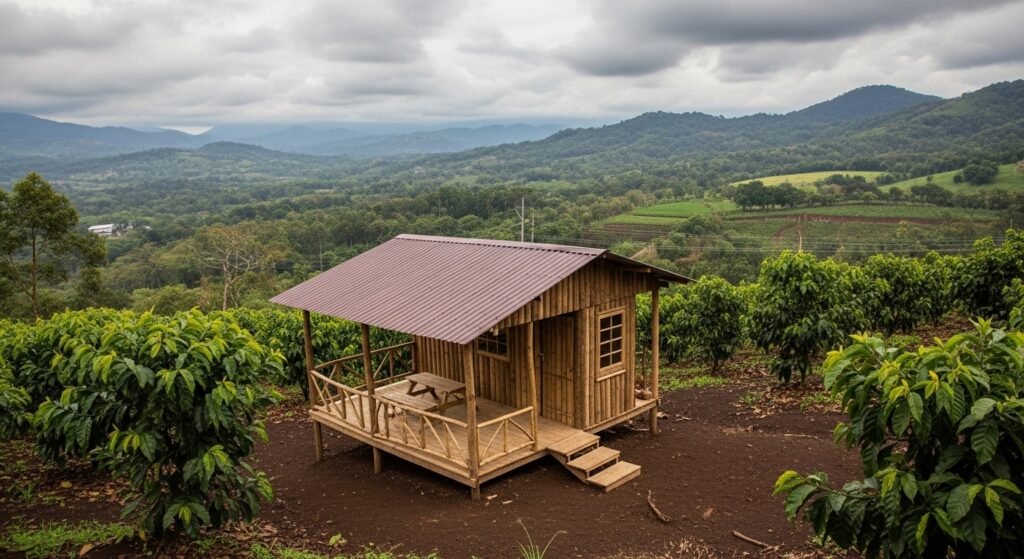
Barista’s Bench: Calibrating for Volcanic Density
Because these beans are grown in such mineral-rich soil, they are exceptionally dense. On the barista’s bench, you must adjust your calibration:
-
The Grind: Use a slightly coarser grind than you would for a Brazilian coffee. The density of the Santomense bean means it resists water flow; if you grind too fine, the shot will choke and produce an overly bitter aftertaste.
-
The Temperature: Use water at $92^\circ C – 93^\circ C$. You want enough heat to extract the heavy sugars, but not so much that you pull out the “woody” tannins associated with the Typica variety.
-
The Method: These coffees shine in Immersion methods like the French Press or AeroPress. The long contact time allows the volcanic minerals to fully express themselves in the mouthfeel.
Maintenance and the Future of the Islands
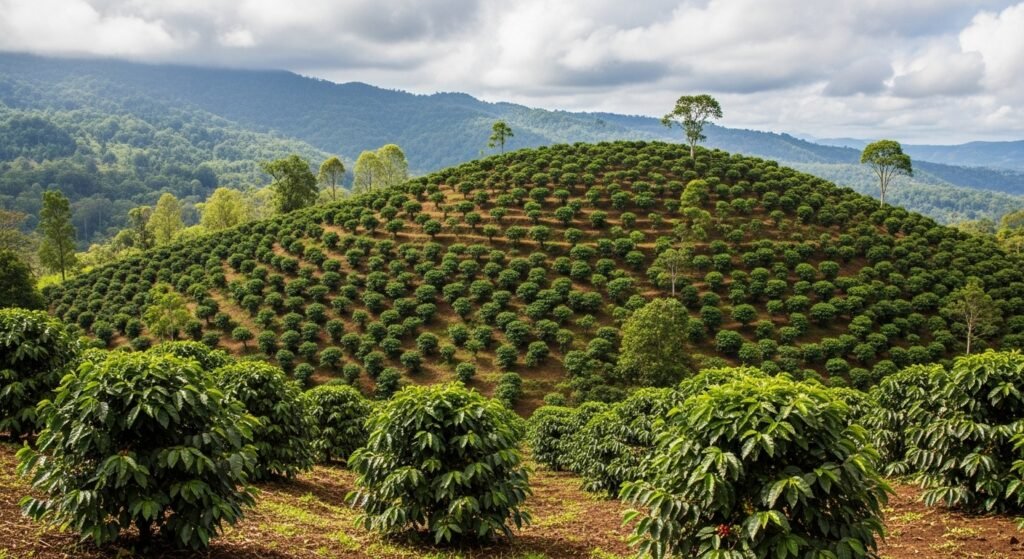
The revival of coffee in São Tomé depends on meticulous maintenance. Many of the old “Roças” (coffee estates) were abandoned for decades. Restoring them requires:
-
Pruning of Heirloom Trees: Some of these trees are over 50 years old and need careful rehabilitation to produce specialty-grade cherries.
-
Soil Protection: Preventing erosion on the steep volcanic slopes is essential to maintaining the water quality of the islands’ pristine springs.
Conclusion: A Return to the Source
São Tomé and Príncipe represent a bridge to the past and a laboratory for the future. They remind us that terroir is not just about height—it’s about the chemical marriage between a volcano and the sea. The forgotten islands offer a sensory experience that is deep, chocolatey, and structurally immense.
In the “Sensory Laboratory,” we value these rare origins because they expand our understanding of the aroma wheel. As you explore these volcanic beans, respect their density, calibrate your grind, and savor the history of the “Ilhas do Café.” The perfect cup is sometimes found in the most isolated corners of the map. Keep your equipment maintained, your water filtered, and your palate open to the volcanic soul of the equator.

Kevin Smith is deeply interested in the craft and culture of coffee, with practical experience exploring specialty beans, brewing techniques, and flavor development. Over the years, he has spent time studying preparation methods, observing extraction processes, and understanding how small details influence the final cup.
Through NovaWeHub, Kevin shares clear, practical, and research-based insights designed to make coffee knowledge approachable for everyone — from beginners to enthusiasts. His focus is on simplifying complex concepts and encouraging readers to explore coffee with curiosity, confidence, and a more refined sensory awareness.