
In the world of specialty coffee, consistency is the difference between a lucky cup and a professional one. We have all had that experience: one morning the coffee tastes divine—sweet, balanced, and vibrant—but the next morning, using the same beans, it tastes thin or unpleasantly bitter. Most of the time, this inconsistency comes down to a lack of measurement. While many people still rely on “scoops” or “tablespoons,” the true barista knows that the only way to achieve perfection is through the “Golden Ratio.” This is the scientific relationship between the weight of your coffee grounds and the weight of your water.
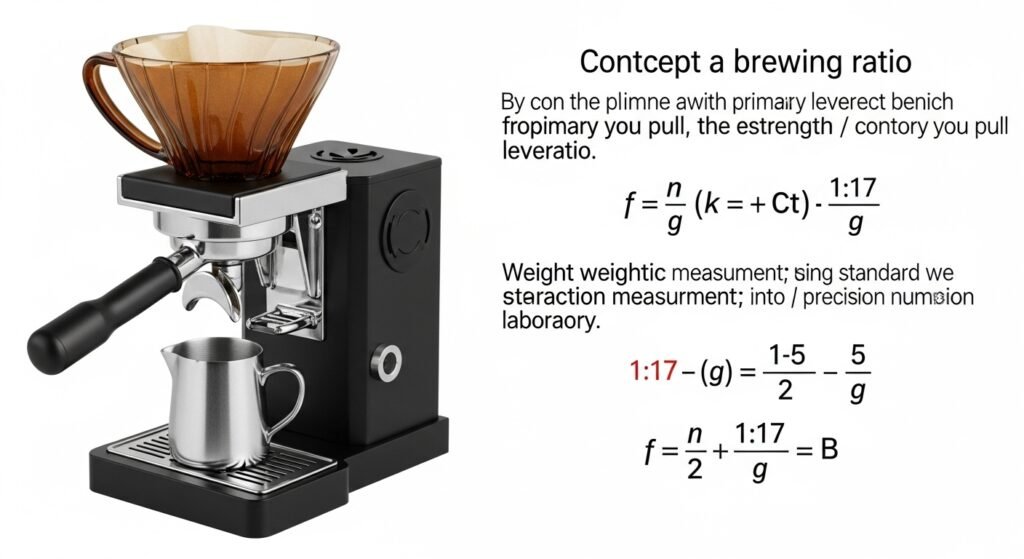
The concept of a brewing ratio is the foundation of the barista’s bench. It is the primary lever you pull to control the strength and extraction of your beverage. By moving away from volumetric measurements (which are inaccurate due to bean density) and toward weight-based measurements (using grams), you transform your kitchen into a precision laboratory. In this guide, we will explore the math behind the perfect cup, why the 1:17 ratio is the industry standard, and how you can adjust these numbers to suit your personal palate.
Why Weight Beats Volume: The Science of Density
Before we dive into the specific ratios, we must address the “scoop” problem. Coffee beans are organic products with varying densities. A dark-roasted bean is physically larger and lighter than a light-roasted bean because it has lost more moisture and expanded during the roasting process. If you use a scoop, you might be getting 7 grams of a dark roast but 10 grams of a light roast in the same volume. This 3-gram difference is massive in the world of extraction and will completely change the flavor of your cup.
Water is also deceptive. Depending on the temperature, the volume of water can shift slightly, but its mass remains constant. This is why every professional barista uses a digital scale. By measuring in grams, you are ensuring that your “inputs” are identical every single time. When you eliminate the variables of “guessing” how much coffee is in your spoon, you can finally focus on the other variables like grind size and temperature. In the laboratory of coffee, the scale is your most important diagnostic tool.
Defining the Golden Ratio: The 1:17 Standard
The Specialty Coffee Association (SCA) and professional baristas worldwide often point to a “Golden Ratio” for filter coffee, which usually falls between 1:15 and 1:18. The most common starting point is 1:17. This means that for every 1 gram of coffee, you use 17 grams of water.
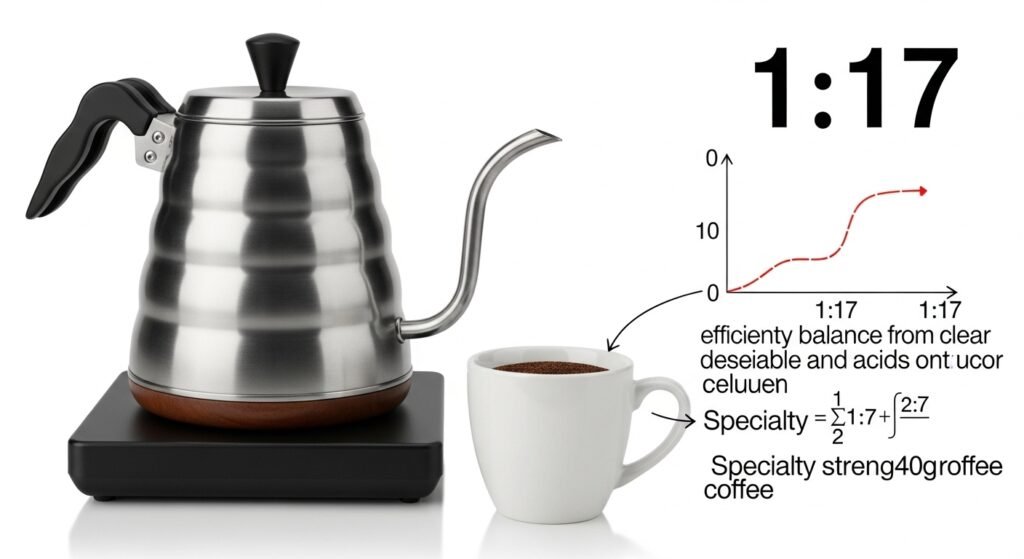
Why 1:17? This ratio has been mathematically proven to provide the ideal balance for the average human palate. At 1:17, there is enough water to efficiently dissolve the desirable sugars and acids from the coffee grounds without over-extracting the bitter, woody cellulose. It produces a cup that is “specialty-strength”—meaning it is clear enough to allow the delicate floral or fruity notes to shine, but strong enough to have a satisfying body. If you are brewing a standard 340g (12oz) mug of coffee, a 1:17 ratio would mean using exactly 20 grams of coffee.
Adjusting the Ratio: Strength vs. Extraction
Once you master the 1:17 starting point, you can begin to use the ratio as a creative tool. It is important to distinguish between Strength (how concentrated the coffee is) and Extraction (how much flavor you took out of the beans). If you find your coffee feels “thin” or “watery,” you might prefer a 1:15 ratio (e.g., 20g of coffee to 300g of water). This will result in a more concentrated, intense beverage with a heavier mouthfeel.
Conversely, if you are brewing a very delicate, expensive light roast—perhaps a Geisha from Panama—you might move toward a 1:18 or 1:19 ratio. By adding more water relative to the coffee, you are increasing the “solvent power.” This can help “stretch out” the flavors, making it easier to perceive the subtle, tea-like nuances that might be crushed in a tighter, stronger ratio. However, be careful: if you go too high (like 1:20), you risk over-extraction, where the water begins to pull out the dry, astringent flavors from the plant fibers.
Ratios Across Different Methods: From Espresso to French Press
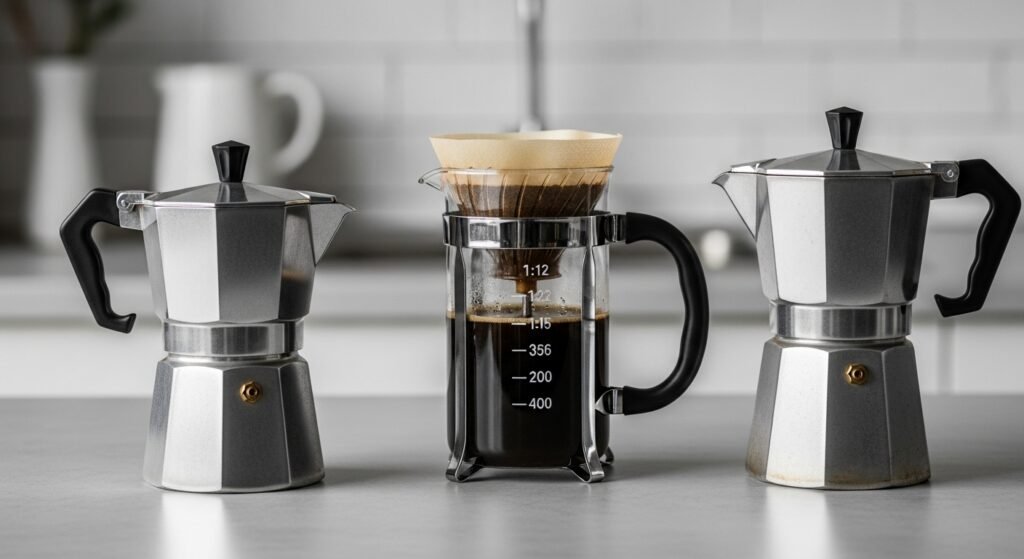
The “Golden Ratio” is not a one-size-fits-all number for every brewing method. The ratio must change based on how the coffee is filtered and how much pressure is involved. For example, Espresso is a highly concentrated form of coffee. The standard ratio for a modern espresso is 1:2 (e.g., 18g of coffee producing 36g of liquid). Because espresso uses high pressure, it can extract flavors very quickly with a very small amount of water.
The French Press, which is an immersion method, typically requires a slightly tighter ratio like 1:12 or 1:15. Because the coffee sits in the water for a long time (4 to 5 minutes) without a paper filter, a higher concentration of coffee helps create that signature bold, heavy body. On the other hand, the Moka Pot often sits somewhere in the middle, around 1:10. Understanding these “method-specific” ratios is what allows a barista to jump from one piece of equipment to another while maintaining a consistent flavor profile.
Conclusion: Mastering the Math of Flavor
Mastering the Golden Ratio is the moment a coffee drinker becomes a coffee maker. It is the “magic number” that demystifies the brewing process. When you stop guessing and start weighing, you gain total control over your morning ritual. You no longer have to wonder why your coffee tastes different today; you can look at your notes, check your ratio, and make a logical adjustment.
We encourage you to experiment. Start with 1:17, but don’t be afraid to try a 1:15 if you want something “punchy” or a 1:18 if you want something “elegant.” Your palate is the ultimate judge. By treating your coffee bench like a laboratory and your ratio as a fundamental law of physics, you ensure that every cup you brew is a masterpiece of balance and flavor. The Golden Ratio isn’t just a rule; it’s your roadmap to the perfect cup.

Kevin Smith is deeply interested in the craft and culture of coffee, with practical experience exploring specialty beans, brewing techniques, and flavor development. Over the years, he has spent time studying preparation methods, observing extraction processes, and understanding how small details influence the final cup.
Through NovaWeHub, Kevin shares clear, practical, and research-based insights designed to make coffee knowledge approachable for everyone — from beginners to enthusiasts. His focus is on simplifying complex concepts and encouraging readers to explore coffee with curiosity, confidence, and a more refined sensory awareness.