
High-quality coffee is often linked to freshness, with shorter intervals between harvest and roasting helping to preserve vibrant aromas and flavor clarity. Yet India offers a remarkable exception through its Monsooned Malabar coffee. Rather than emphasizing immediate freshness, this variety undergoes a carefully controlled aging process influenced by coastal weather conditions.
Exposed to monsoon winds and humidity over several months, the beans develop a distinctive profile. Acidity is significantly reduced, while a deep, mellow sweetness emerges, accompanied by earthy and slightly pungent notes. This unique transformation demonstrates how deliberate environmental manipulation can create flavors that stand apart from conventional expectations of specialty coffee.
To understand Monsooned Malabar, one must understand the interaction between cellulose structure and high-humidity environments. It is a study in how moisture can expand the physical volume of a bean while fundamentally altering its mouthfeel. In the modern era, where we obsess over water quality in the cup, India teaches us about the importance of water quality in the air.

The Historical Accident: Coffee on the High Seas
The origins of Monsooned Malabar are rooted in the physics of 19th-century shipping. In the days of wooden sailing ships, it took months for Indian coffee to reach Europe. During this journey, the beans were stored in the damp holds of the ships, exposed to the salty, humid winds of the Arabian Sea.
-
The Transformation: By the time the ships reached Europe, the beans had changed color from green to a pale, golden yellow. They had also swollen in size.
-
The Sensory Shift: European drinkers grew accustomed to this “mellowed” coffee. When faster steamships shortened the journey, the coffee arrived “fresh” (green and acidic), and the market rejected it. They wanted the “monsooned” flavor.
Today, this process is replicated in the “Sensory Laboratory” of the Malabar Coast using controlled warehouses that allow the monsoon winds to circulate through the beans.
The Science of Swelling: Cellular Expansion
The “monsooning” process occurs between June and September. The dry-processed (Natural) cherry is spread out in specialized open-walled warehouses.
-
Hydroscopic Absorption: Coffee beans are naturally hydroscopic—they absorb moisture from the air. In the Malabar coast, the humidity often exceeds 90%.
-
Physical Change: Over 12 to 16 weeks, the beans absorb so much moisture that they double in size. In our lab analysis, we see that the density of the bean drops significantly. This low density is a critical factor for the barista’s bench, as it requires a completely different approach to grinding science.
-
Color Degradation: The chlorophyll and other pigments degrade, turning the bean into a characteristic “straw” color.
[Image showing a side-by-side comparison of a standard green coffee bean vs. a swollen, golden Monsooned Malabar bean]
Chemical De-acidification: The Mellowing Process
In the “Sensory Laboratory,” the most striking feature of Monsooned Malabar is its pH level. While high-altitude African coffees are prized for their bright phosphoric or citric acidity, monsooned coffee is almost neutral.
-
Enzymatic Breakdown: The prolonged exposure to moisture triggers internal enzymatic reactions that break down the organic acids (such as chlorogenic and citric acids).
-
The “Pungent” Profile: What remains is a high concentration of minerals and sugars. The flavor wheel for this coffee shifts entirely toward the “Earthy,” “Musty,” and “Spicy” quadrants. You will find notes of tobacco, leather, malt, and black pepper.
-
The Aftertaste: Because the acidity is so low, the aftertaste is exceptionally long and heavy, though it lacks the “sparkle” of other specialty origins.
The Roasting Challenge: Thermodynamics of Low Density
Roasting Monsooned Malabar is a test of a roaster’s skill. Because the beans are so large and low in density, they behave differently in the drum.
-
Heat Transfer: They act as insulators. If the roaster applies too much initial heat, the outside will scorch before the inside is developed.
-
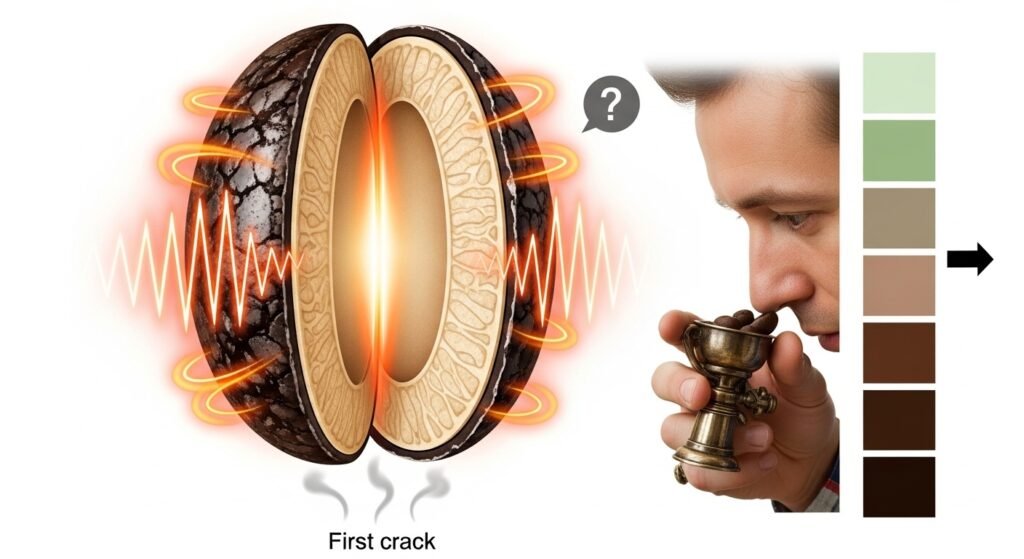
The “Pop”: Unlike standard coffee, the “First Crack” in monsooned coffee is very quiet, almost non-existent. The roaster must rely on olfactory cues and color changes rather than sound.
Sensory Analysis: The King of the “Old School” Espresso
In the “Sensory Laboratory,” we often use Monsooned Malabar as a “Body Component” in espresso blends.
-
Crema Production: Because of its unique cellular structure and low acidity, it produces a massive amount of thick, persistent crema.
-
The Blend: When paired with a high-altitude bean, the Indian component provides the “syrupy” mouthfeel and earthiness, while the other bean provides the aromatic high notes.
Brewing the Monsoon: Barista’s Bench Protocol
If you are brewing a 100% Monsooned Malabar on the barista’s bench, you must adapt your variables:
-
The Grind: Because the beans are so brittle and “puffy,” they produce more fines than usual. You may need to grind coarser than you expect to prevent clogging.
-
The Temperature: Use slightly higher temperatures ($94^\circ C – 95^\circ C$) to try and extract whatever residual sweetness remains in the fiber.
-
The Method: It excels in a French Press or a Syphon. These immersion methods complement the heavy mouthfeel and highlight the spice notes.

Conclusion: The Beauty of Controlled Decay
Monsooned Malabar is a reminder that in the “Sensory Laboratory,” “perfection” is subjective. While the specialty world often chases the cleanest, most acidic cups, India offers a masterclass in the beauty of transformation. It is a coffee that challenges our definitions of maintenance and freshness.
By understanding the physics of humidity aging and the chemistry of de-acidification, we can appreciate Monsooned Malabar for what it is: a historical artifact that has been perfected by science. It is a bridge between the ancient trade routes and the modern barista’s bench. Respect the monsoon, calibrate for the density, and enjoy the most unique aftertaste in the world of coffee.

Kevin Smith is deeply interested in the craft and culture of coffee, with practical experience exploring specialty beans, brewing techniques, and flavor development. Over the years, he has spent time studying preparation methods, observing extraction processes, and understanding how small details influence the final cup.
Through NovaWeHub, Kevin shares clear, practical, and research-based insights designed to make coffee knowledge approachable for everyone — from beginners to enthusiasts. His focus is on simplifying complex concepts and encouraging readers to explore coffee with curiosity, confidence, and a more refined sensory awareness.