
In coffee tasting, the most important instrument isn’t a high-end grinder or a refractometer—it’s the human palate. Its effectiveness, however, depends on the ability to articulate what is being experienced.
When a barista describes a coffee as having “notes of jasmine,” it’s more than poetic language. Such descriptors point to specific chemical compounds in the beans, revealing details about their origin, cultivation, and processing. Developing this sensory vocabulary allows for a deeper understanding of coffee, connecting taste directly to the story behind each cup.
Mastering coffee descriptors is the process of building a “mental library” of flavors. It requires moving away from subjective opinions (“I like this”) toward objective analysis (“This has high malic acidity and a silky mouthfeel”). By the end of this masterclass, you will understand how to use the SCA Flavor Wheel to deconstruct your morning cup and communicate your findings with the precision of a professional Q-Grader.
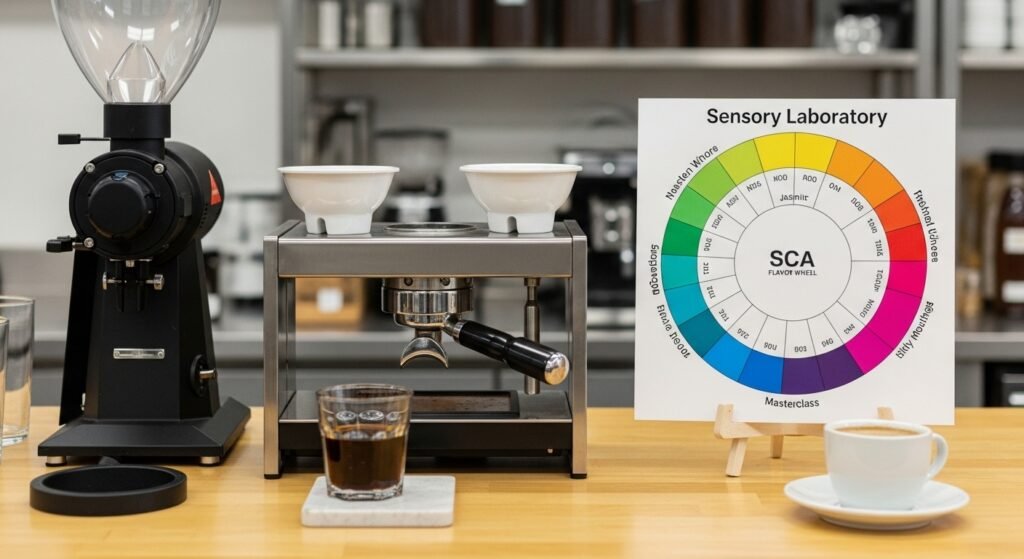
The Difference Between Taste and Flavor
In the lab, we must first make a critical distinction: Taste is what happens on the tongue, while Flavor is a multi-sensory experience.
-
Taste (Gustation): This is limited to the five basic building blocks: Sweet, Sour, Salty, Bitter, and Umami. When you evaluate an espresso shot, you should first identify the balance of these five. Is the sourness overwhelming the sweetness? That is a taste observation.
-
Flavor (Olfaction): This is where descriptors like “strawberry,” “cedar,” or “caramel” come in. These are perceived through retronasal olfaction—aromatic molecules traveling from the back of your mouth to your nose while you swallow.
To describe coffee accurately, you must learn to separate these two. A coffee can have a “lemon” flavor (olfaction) because of its aromatic profile, but if it lacks “sour” taste (gustation), it won’t be a convincing representation of the fruit.
The Hierarchy of Descriptors: Broad to Specific
When you are at the barista’s bench, don’t try to find the “hidden” notes immediately. Start at the center of the flavor wheel and move outward.
-
Level 1: The Category (Broad): Is the coffee Fruity, Roasted, Floral, or Nutty? This is the easiest distinction to make.
-
Level 2: The Sub-Category: If it’s “Fruity,” is it Citrus, Berry, or Stone Fruit?
-
Level 3: The Specific Descriptor: If it’s “Citrus,” is it Lemon, Lime, Orange, or Grapefruit?
This hierarchical approach prevents the “imagination trap,” where your brain tries to force a flavor that isn’t there. For example, a high-altitude Kenyan coffee will almost always fall into the “Berry” category. If you start by looking for “Blackcurrant” (a specific descriptor), you might miss the broader “Tart” and “Sweet” profile that defines the lot.
Deconstructing Acidity: The Fruity Acids
Acidity is the most prized characteristic in specialty coffee, yet it is often the most misunderstood. In the “Sensory Laboratory,” we classify acidity by the fruits they mimic:
-
Citric Acid: Sharp, bright, and refreshing. Found in lemons and limes. Common in washed Central American coffees.
-
Malic Acid: Crisp and “sparkling,” like a green apple or a pear. This acidity often adds a sense of “cleanness” to the aftertaste.
-
Tartaric Acid: This is the acidity of grapes. It is often accompanied by a slight “puckering” sensation and a heavy sweetness.
-
Phosphoric Acid: Unique to Kenyan coffees, this isn’t fruity so much as it is “tingly,” similar to the sensation of a carbonated soft drink.
Describing Texture: The Mouthfeel Lab
A descriptor isn’t always a flavor; sometimes it’s a physical sensation. Mouthfeel (or body) is the weight and texture of the liquid on your tongue. In professional cupping, we use descriptors like:
-
Silky/Tea-like: Very light and refined. Often used for washed Ethiopian Geishas.
-
Syrupy/Creamy: Thick and coating. This is the hallmark of a high-quality Brazilian natural.
-
Juicy: A combination of high acidity and high sweetness that makes the mouth water.
-
Astringent: A dry, sandpapery feeling (usually a sign of over-extraction or poor water quality).
The Role of Sweetness: Beyond “Sugar”
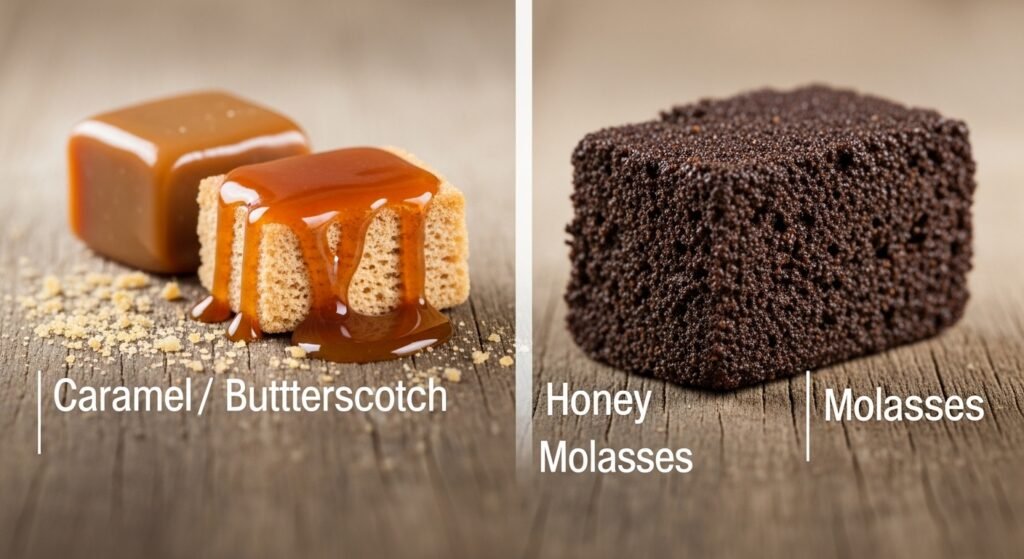
Sweetness in coffee is rarely like eating a piece of candy. It is usually a “perceived sweetness” created by the balance of sugars and aromatics.
-
Caramel/Butterscotch: Deep, cooked-sugar notes.
-
Honey: A floral sweetness.
-
Molasses: A heavy, dark, and slightly bitter sweetness.
When you identify the type of sweetness, you can often deduce the roast level. Caramel notes usually emerge during the Maillard reaction (mid-roast), while bright, floral honey notes are more common in light “filter” roasts.
Calibrating Your Palate: The Training Protocol
How do you train your brain to recognize these notes? In the lab, we use “Calibration.“
-
Taste Everything: When you eat an orange, pay attention. Is it sweet or sour? Is it the peel or the juice? Memorize that sensory profile.
-
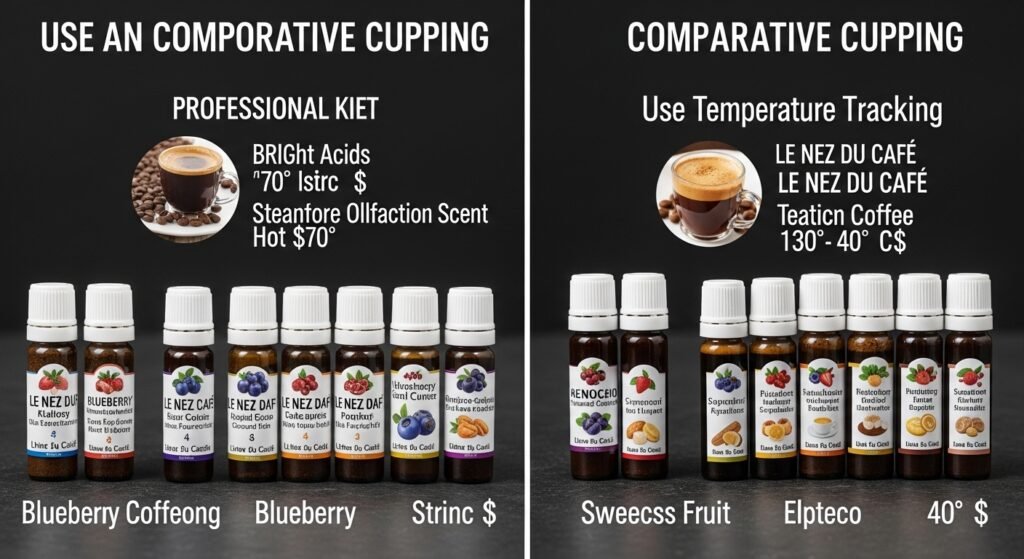
Comparative Cupping: Brew two different coffees side-by-side. It is much easier to identify “blueberry” in one coffee when the one next to it tastes like “peanut butter.“
-
Use an Aroma Kit: Professional kits (like Le Nez du Café) contain small vials of the most common coffee scents. This helps isolate the “olfaction” part of the flavor without the distraction of the “taste” part.
-
Temperature Tracking: Coffee flavors change as they cool. Bright acids are prominent when hot ($70^\circ C$), while sweetness and specific fruit notes emerge as it reaches room temperature ($30^\circ C – 40^\circ C$).
Conclusion: Becoming a Sensory Scientist
The language of coffee descriptors is not about being “fancy”; it is about being clear. It allows us to communicate with farmers, roasters, and other enthusiasts in a way that respects the complexity of the bean.
When you can accurately describe the jasmine aroma of an Ethiopia or the syrupy body of a Brazil, you move from being a consumer to being a participant in the coffee journey. The laboratory is always open, and the best experiment is the one in your cup right now. Take a sip, close your eyes, and ask yourself: “What is this coffee really trying to tell me?”

Kevin Smith is deeply interested in the craft and culture of coffee, with practical experience exploring specialty beans, brewing techniques, and flavor development. Over the years, he has spent time studying preparation methods, observing extraction processes, and understanding how small details influence the final cup.
Through NovaWeHub, Kevin shares clear, practical, and research-based insights designed to make coffee knowledge approachable for everyone — from beginners to enthusiasts. His focus is on simplifying complex concepts and encouraging readers to explore coffee with curiosity, confidence, and a more refined sensory awareness.