
Few coffee brewing tools are as iconic as the octagonal aluminum Moka Pot. Introduced by Alfonso Bialetti in 1933, it aimed to bring café-style espresso into homes across Italy. Despite its reputation, many modern coffee enthusiasts approach the Moka Pot with caution.
Often linked to bitter, metallic, or slightly burnt flavors, the device is sometimes blamed for less-than-ideal results. In reality, achieving the perfect cup depends largely on understanding its mechanics—grind size, heat control, and water placement all play critical roles in how flavors are extracted and balanced.
To master the Moka Pot is to master the relationship between heat, pressure, and time. Unlike the precision of the V60, which relies on gravity, the Moka Pot uses the expansion of air and steam to force water upward through a coffee bed. It is a violent, high-temperature extraction that requires a different set of rules than a French Press or a calibrated espresso machine. When executed correctly, the Moka Pot produces a cup with an intensity and body that sits perfectly between a filter coffee and an espresso.
The Thermodynamics of the Three Chambers
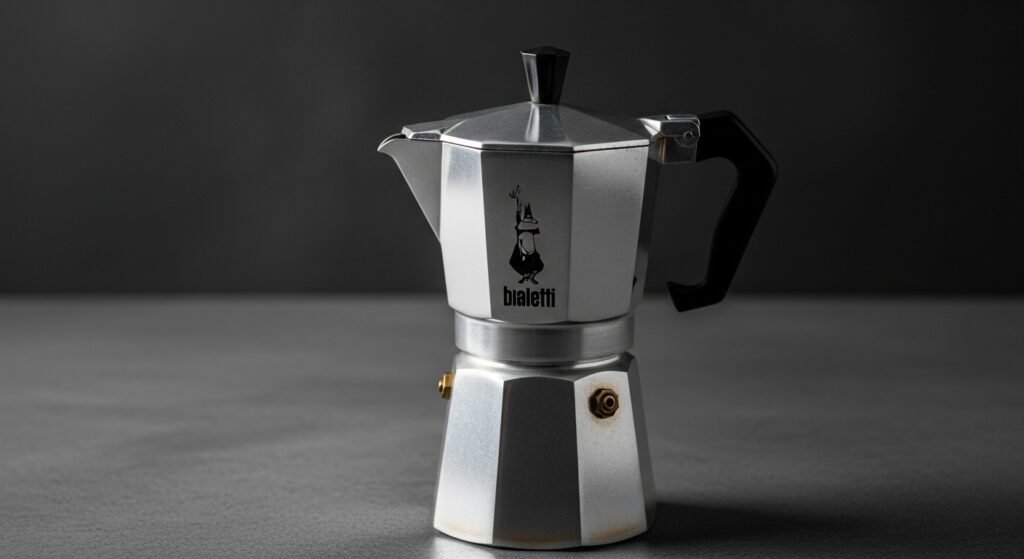
The Moka Pot is divided into three distinct sections: the bottom boiler, the funnel-shaped coffee basket, and the top collection chamber. The “magic” happens in the boiler, but it’s not just about boiling water.
As the water in the bottom chamber heats up, it begins to evaporate, creating steam. This steam expands, increasing the pressure in the headspace above the water. It is this air pressure, not the boiling water itself, that pushes the liquid down and then up through the funnel. In the lab, we call this “displacement.”
The danger lies in the temperature. If the water reaches a rolling boil before it begins to move, the temperature of the extraction will be too high, leading to the “burnt” aftertaste that gives the Moka Pot a bad reputation. To solve this, professional baristas use a “hack”: they fill the bottom chamber with already boiled water. This shortens the time the coffee grounds sit on the hot stove, preventing them from “baking” before the water arrives.
The “Sputter” Phase: The Enemy of Clarity
One of the most critical moments in the Moka Pot process is the end of the brew. As the water level in the boiler drops below the bottom of the funnel, the pressure suddenly releases a mixture of steam and boiling water. This is the “sputter” or “gurgle” phase.
From a sensory experience perspective, this phase is a disaster. This steam is far too hot for coffee extraction, and it pulls out the most bitter, astringent tannins from the spent grounds. In the laboratory, we use a “kill switch” technique: the moment the coffee starts to turn pale or the gurgling begins, we remove the pot from the heat and run the bottom chamber under cold tap water. This immediately stops the pressure and saves the flavor notes from being destroyed by the heat.
Grind Size and the “No-Tamp” Rule
A common mistake is trying to treat the Moka Pot like an espresso machine. Because the Moka Pot only reaches about 1.5 bars of pressure (compared to the 9 bars of an espresso machine), it cannot push water through a very fine, compacted puck.
-
The Grind: You need a “medium-fine” grind. It should be coarser than espresso but finer than a V60. If you grind too consistently fine, the water will struggle to pass through, the pressure will build up dangerously, and the coffee will taste “muddy.”
-
The Tamp: Never “tamp” or compress the coffee in a Moka Pot. Simply fill the basket, level it off with a finger, and close the pot. The coffee needs space to expand as it absorbs water.
Material Science: Aluminum vs. Stainless Steel
The “folklore” of the Moka Pot suggests that you should never wash it with soap, allowing a “seasoning” of coffee oils to build up. In our “Sensory Laboratory,” we must debunk this myth. Coffee oils turn rancid quickly. A “seasoned” pot is actually a “dirty” pot that will ruin the acid vs. bitter balance of your beans.
-
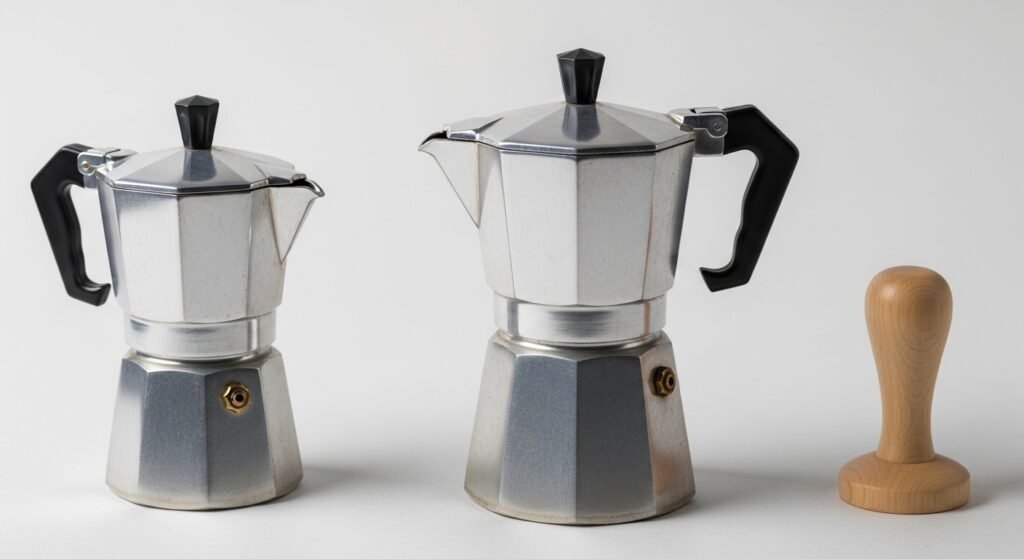
Aluminum: The classic choice. It conducts heat very quickly but can sometimes impart a metallic taste if not cleaned properly. It is also prone to oxidation.
-
Stainless Steel: The modern choice. It is much easier to clean, does not react with the coffee, and works on induction stoves. While it takes longer to heat up, it provides a more stable thermal environment for the extraction.
Regardless of the material, maintenance matters. Always check the rubber gasket and the safety valve. If the gasket is hard or cracked, the pressure will leak, and your extraction will fail.
Choosing the Right Bean for the Pot
Because the Moka Pot emphasizes body and intensity, it is the perfect tool for Brazilian coffees. The natural chocolate and nutty notes of a Sul de Minas bean are amplified by the pressure, resulting in a cup that feels “rich.”
However, if you are feeling adventurous, a medium-roast Panamanian coffee can produce a surprisingly “syrupy” fruit profile. The key is to avoid very light roasts, which may end up tasting unpleasantly sour due to the lack of high-pressure clarity that an espresso machine would provide.
Conclusion: Respecting the Icon
The Moka Pot is not a “failed espresso machine.” It is a unique brewing method that requires respect for its thermodynamic limits. By using hot water to start, avoiding the “sputter” phase, and keeping the equipment meticulously clean, you transform the Moka Pot from a source of bitterness into a source of incredible strength and character.
In the “Sensory Laboratory,” we value the Moka Pot for its history and its ability to provide a “heavy” experience without the need for thousands of dollars in equipment. It is the bridge between the old world of the Italian kitchen and the new world of specialty coffee. Master the physics of the steam, and the mystery of the Moka Pot will finally be solved.

Kevin Smith is deeply interested in the craft and culture of coffee, with practical experience exploring specialty beans, brewing techniques, and flavor development. Over the years, he has spent time studying preparation methods, observing extraction processes, and understanding how small details influence the final cup.
Through NovaWeHub, Kevin shares clear, practical, and research-based insights designed to make coffee knowledge approachable for everyone — from beginners to enthusiasts. His focus is on simplifying complex concepts and encouraging readers to explore coffee with curiosity, confidence, and a more refined sensory awareness.