
We have all experienced it: you take a sip of an exceptional coffee, and minutes later, you still find yourself tasting notes of jasmine, cocoa, or dried fruit. This lingering sensation is known as “Aftertaste” or “Finish.” In the specialty coffee industry, the quality and duration of the aftertaste are critical factors in determining a bean’s score. A short, thin finish can make even a flavorful coffee feel disappointing, while a long, evolving aftertaste can turn a simple cup into a memorable event.
But what exactly is happening in your mouth? Unlike the initial flavors you perceive, which are driven by immediate contact with your taste buds, the aftertaste is a complex chemical “echo.” It involves the slow release of heavy organic molecules and oils that have coated your palate. In this sensory laboratory, we will explore the biological and chemical mechanisms that make coffee linger and how you can learn to evaluate the finish like a professional taster.
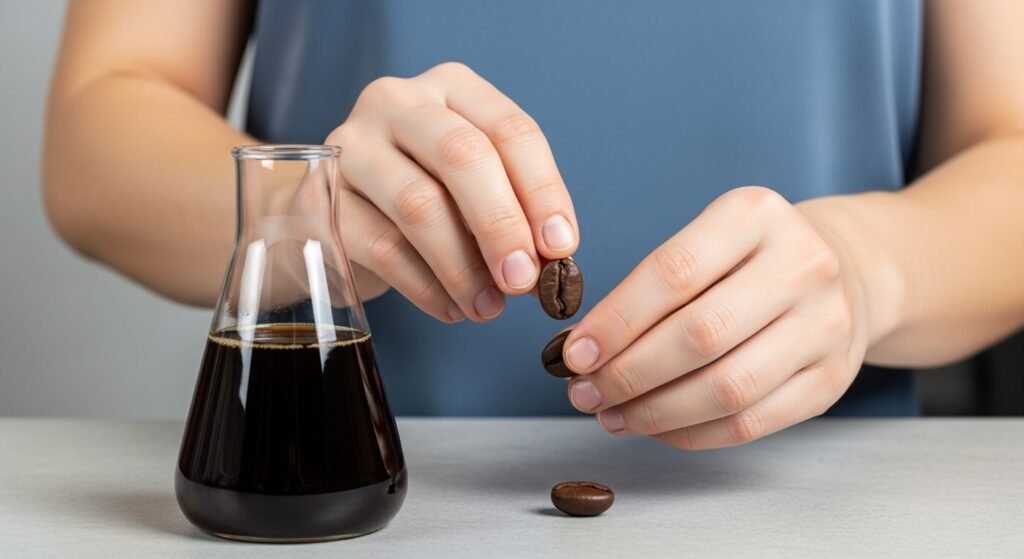
The Molecular Weight of Flavor: Why Oils Matter
The primary drivers of aftertaste are the coffee’s natural oils and heavy aromatic compounds. When you brew coffee, especially using methods that preserve oils—like we discussed in our guide on body and mouthfeel—you are extracting lipids that don’t dissolve in water but remain suspended.
These oils are “hydrophobic,” meaning they tend to stick to the surfaces of your mouth rather than washing away with the liquid. As they sit on your tongue and throat, they slowly release volatile aromatic compounds that travel up the back of your throat to your olfactory system (retro-nasal olfaction). This is why the aftertaste often feels different from the initial sip; you are tasting the “heavy” molecules that took longer to reach your sensors. If you have used a high-quality grinder to achieve a uniform extraction, these oils will be clean and pleasant, leading to a sweet, lingering finish.
Clean vs. Dirty Finish: The Role of Defects
In the coffee cupping process, baristas distinguish between a “clean” and a “dirty” finish. A clean finish is one that fades away smoothly, leaving a pleasant sweetness or a specific flavor note (like dark chocolate). A dirty finish, however, leaves a sensation of dryness, ash, or a metallic tang.
Often, a bad aftertaste is the result of over-extraction or poor-quality beans. If the water was too hot or the grind too fine, you might have extracted tannins—the same compounds found in over-steeped tea—which create a “sandpaper” feeling on the tongue. This is a common issue when people struggle with the acid vs. bitter balance. While a noble bitterness (like cocoa) is desirable in the aftertaste, an astringent bitterness is a sign that the brewing variables need adjustment on your barista’s bench.
Terroir and the “Long Finish”
Certain regions are world-famous for their incredible aftertaste. For instance, African coffee regions like Kenya are known for a “sparkling” finish that can last for up to fifteen minutes, often tasting of blackcurrant or grapefruit. This is due to the high concentration of phosphoric and citric acids found in high-altitude volcanic soils.
In contrast, Brazilian coffee regions tend to offer a “shorter” but much sweeter aftertaste, focused on caramel, praline, and honey. This isn’t necessarily a lack of quality; it’s simply a different terroir characteristic. A short, sweet finish is often preferred for espresso-based drinks like the modern Carajillo, where the liqueur provides its own lingering botanical notes.

How to Evaluate Aftertaste at Home
To truly appreciate the science of aftertaste, you must change the way you swallow. After taking a sip of coffee, don’t immediately take another or drink water. Instead, swallow, then exhale slowly through your nose with your mouth slightly open. This forces the air from your lungs to carry those trapped aromatics across your olfactory sensors.
Ask yourself these three questions:
-
Intensity: How strong is the flavor 30 seconds after swallowing?
-
Quality: Is the flavor pleasant (sweet/fruity) or unpleasant (dry/ashy)?
-
Evolution: Does the flavor change? Sometimes a coffee that tastes like citrus initially can leave a chocolatey aftertaste as the acidity fades.
In our home laboratory, we often use the aftertaste as the ultimate “diagnostic” for our brewing ratios. If the aftertaste is sweet, you’ve hit the mark. If it’s unpleasantly dry, you may need to coarsen your grind or lower your water temperature.

Conclusion: The Memory of the Coffee
The aftertaste is the “soul” of the coffee experience. It is the part of the drink that stays with you, long after the cup is empty. By understanding the chemistry of oils and retro-nasal olfaction, you move away from being a passive consumer and toward being an active participant in the journey of the bean.
Great coffee is defined by its ability to leave a positive, lasting impression. It respects your palate and rewards your attention. The next time you brew a cup, don’t rush. Slow down, take a sip, and listen to the echo. The science of aftertaste is a reminder that in the world of specialty coffee, the best moments are often the ones that linger.

Kevin Smith is deeply interested in the craft and culture of coffee, with practical experience exploring specialty beans, brewing techniques, and flavor development. Over the years, he has spent time studying preparation methods, observing extraction processes, and understanding how small details influence the final cup.
Through NovaWeHub, Kevin shares clear, practical, and research-based insights designed to make coffee knowledge approachable for everyone — from beginners to enthusiasts. His focus is on simplifying complex concepts and encouraging readers to explore coffee with curiosity, confidence, and a more refined sensory awareness.