
In espresso preparation, much attention is given to measurable factors such as water temperature, pump pressure, and overall water quality. Yet there is another crucial element that often goes unnoticed: the design of the portafilter basket.
Although it appears to be just a simple stainless steel cup, the shape of its walls and the placement of its perforations play a key role in controlling fluid flow during extraction. These subtle geometric features influence how water interacts with the coffee grounds, directly affecting flavor balance, consistency, and the overall quality of the final cup.
When we approach the barista’s bench to dial in a new coffee, we must decide between Straight (Ridgeless) and Tapered (Conical) baskets. This choice is not merely aesthetic; it determines how water travels through the coffee puck and how much aromatic complexity we can extract before bitterness sets in.
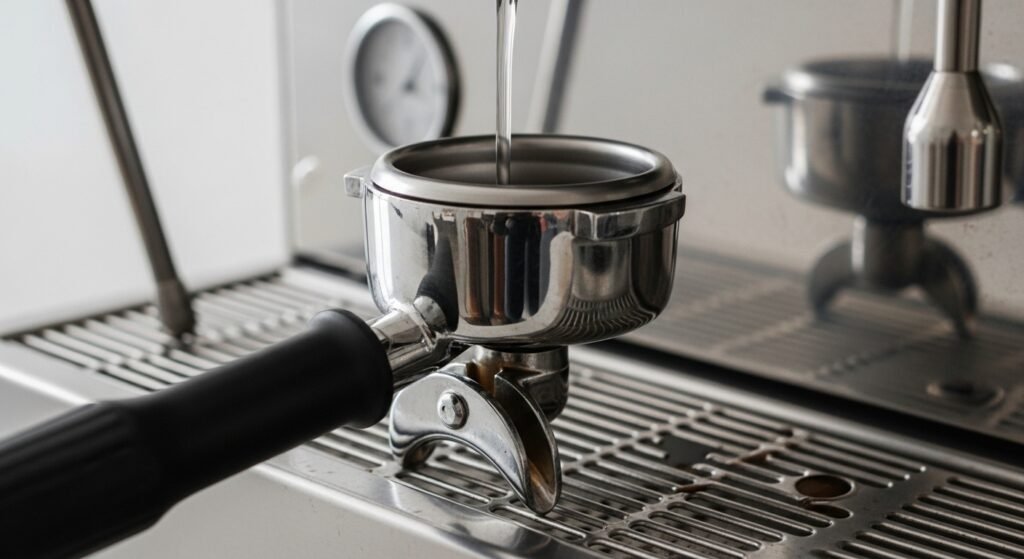
Fluid Dynamics: The Path of Least Resistance
To understand basket geometry, we must first understand the “Path of Least Resistance.” In any pressurized system, water will always look for the easiest way out.
-
Vertical Flow: In a perfect world, water travels vertically from the shower screen to the bottom of the basket.
-
Horizontal Migration: In reality, water also moves horizontally. If the walls are tapered, the water is forced toward the center.
-
The Extraction Gradient: This movement creates a gradient where different parts of the puck are extracted at different rates. In the lab, we analyze this as “Extraction Entropy.”
Straight-Walled Baskets: The Pursuit of Uniformity
Straight-walled baskets (like the VST precision series) feature walls that are perfectly vertical ($90^\circ$).
-
Uniform Resistance: Because the walls are straight, the depth of the coffee puck is consistent from the edge to the center. This means every gram of coffee is subjected to the same volume of water.
-
The “Sweet Spot”: These baskets are favored in the “Sensory Laboratory” for high-altitude African beans. They allow for a high extraction yield (EY) without the harsh aftertaste often associated with uneven flow.
-
Barista Technique: Straight walls are unforgiving. If your tamping is slightly off-center, you will experience “Edge Channeling,” where water bypasses the coffee and flows down the smooth metal wall.
Tapered Baskets: Forgiveness and Body
Tapered baskets have walls that curve inward toward the bottom. These were the industry standard for decades and are still preferred by many traditionalists.
-
The “V” Effect: The tapering forces the water to converge in the center of the puck. This creates a higher density of coffee at the bottom than at the top.
-
Forgiveness: Because the water is pushed toward the center, tapered baskets are less likely to show edge channeling. They are more “forgiving” of imperfect grind consistency.
-
Texture and Mouthfeel: In our laboratory trials, tapered baskets often produce a heavier mouthfeel and body. However, this often comes at the cost of clarity. The center of the puck tends to be over-extracted while the edges are under-extracted, creating a “blended” profile that works well for milk-based drinks.
Hole Distribution: The “Dead Zone” Phenomenon
The geometry of the walls is only half the story; we must also look at the hole pattern. In the “Sensory Laboratory,” we measure the Total Open Area (TOA).
-
Edge to Edge Coverage: In straight-walled precision baskets, the holes usually go all the way to the edge of the base. This ensures that water moving down the walls still has an exit point.
-
The “Dead Zone”: Many tapered baskets have a ring of solid metal at the edge before the holes begin. This forces water to migrate horizontally to find a hole, which increases the contact time and can lead to a dry, astringent aftertaste.
-
Maintenance: Maintenance matters here because oil buildup in the peripheral holes of a tapered basket will quickly exacerbate the “dead zone” effect, ruining your calibration.

Impact on the Brew Ratio and Extraction Yield
The shape of your basket changes how you should calculate your extraction ratios.
-
Dose Sensitivity: Straight-walled baskets are very sensitive to dose. If you under-fill a straight basket, the puck will lack the structural integrity to resist the 9 bars of pressure, leading to “puck lift” and a messy extraction.
-
Yield Targets: If you are aiming for a high-clarity 1:2.5 ratio with a floral Ethiopian coffee, a straight-walled basket is essential. If you want a thick, chocolatey 1:1.5 ristretto, the tapered geometry will help you achieve that syrupy mouthfeel.
The “Ridge” vs. “Ridgeless” Debate
Another geometric detail on the barista’s bench is the “ridge”—the small indentation that holds the basket in place in the portafilter.
-
Ridged Baskets: The ridge can act as a “shelf” that traps coffee grounds during tamping. In the “Sensory Laboratory,” we have found that this can interfere with the vertical seal of the puck, increasing the risk of channeling.
-
Ridgeless Baskets: These have perfectly smooth interior walls. They allow for a much cleaner maintenance routine and ensure that the tamper can travel all the way down without hitting an obstruction.
Laboratory Protocol: Choosing the Right Basket for the Bean
When setting up your espresso calibration, follow these guidelines:
-
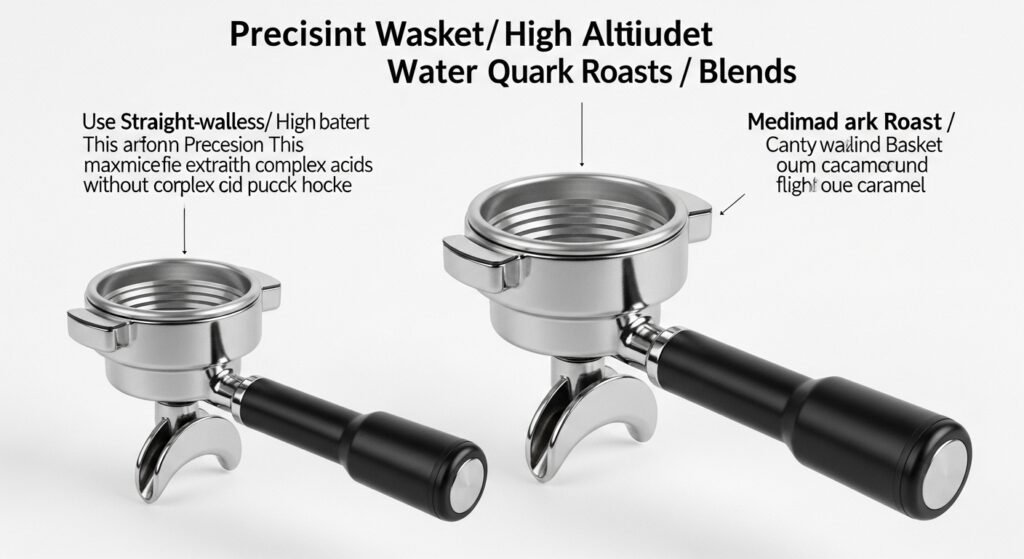
Light Roasts / High Altitude: Use a straight-walled, ridgeless precision basket. This maximizes the flow and ensures you can grind fine enough to extract the complex acids without causing the puck to choke.
-
Medium-Dark Roasts / Blends: A slightly tapered basket can help “round out” the flavors, hiding minor grinder inconsistencies and emphasizing the cocoa and caramel notes.
-
Water Quality Adjustment: If your water quality is very high in minerals (hard water), avoid tapered baskets with “dead zones,” as they will scale up faster and become impossible to clean, leading to a permanent metallic aftertaste.
Conclusion: Engineering the Flow
The basket is the final gatekeeper of flavor. By understanding the physics of straight vs. tapered walls, we move away from “luck-based” extractions and toward true engineering on the barista’s bench.
In the “Sensory Laboratory,” we believe that every variable should be intentional. Whether you choose the surgical precision of straight walls or the comforting body of a tapered design, remember that maintenance matters. A clean, well-chosen basket is the foundation of a mouthfeel that lingers and an aroma that defines the terroir. As we approach the 100th article, let us not forget that the most important science is often found in the shape of the steel.

Kevin Smith is deeply interested in the craft and culture of coffee, with practical experience exploring specialty beans, brewing techniques, and flavor development. Over the years, he has spent time studying preparation methods, observing extraction processes, and understanding how small details influence the final cup.
Through NovaWeHub, Kevin shares clear, practical, and research-based insights designed to make coffee knowledge approachable for everyone — from beginners to enthusiasts. His focus is on simplifying complex concepts and encouraging readers to explore coffee with curiosity, confidence, and a more refined sensory awareness.