
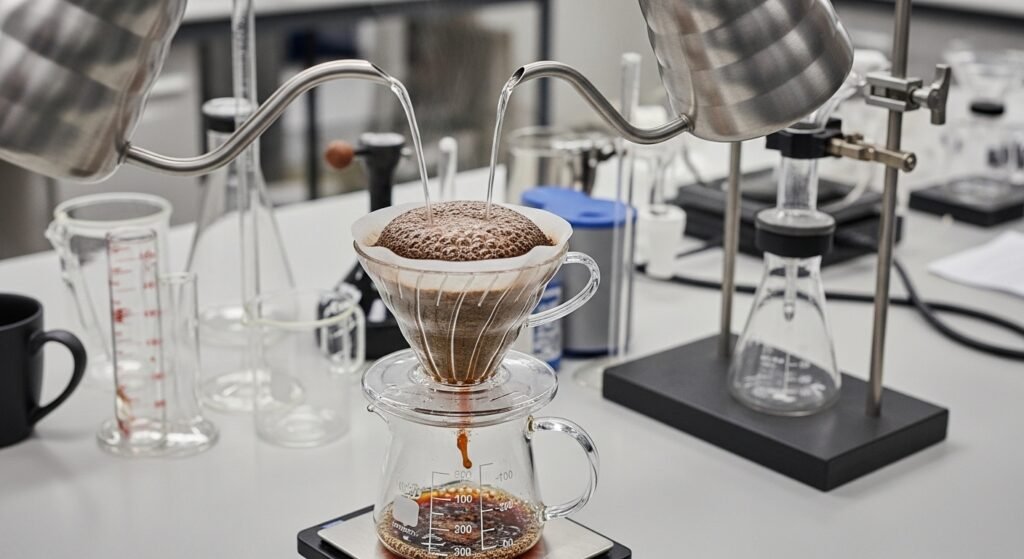
When discussing coffee preparation in a sensory-focused environment, extraction is often described as a controlled and delicate chemical interaction. Yet, the moment hot water meets freshly ground coffee, something far more dynamic takes place. This initial reaction, known as the bloom, is marked by visible bubbling and expansion caused by the release of carbon dioxide (CO₂) retained inside the coffee beans during the roasting process.
Beyond its visual appeal in brewing methods such as pour-over, the bloom plays an essential role in how water interacts with the grounds. Proper gas release at this stage helps promote a more balanced extraction, directly influencing flavor clarity, aroma development, and the overall quality of the final cup.
To understand the bloom is to understand the “Breath of the Bean.” If the coffee does not bloom, it is “dead”—the volatile gases have escaped, taking the aromatic profile with them. Conversely, an aggressive bloom can interfere with the water’s ability to saturate the coffee particles. Mastering the bloom is the first step on the barista’s bench to ensuring that the water quality can do its job of dissolving sugars and acids.
The Physics of Degassing: Why $CO_2$ is a Barrier
During the roasting process, the complex sugars and cellulose in the coffee bean undergo thermal degradation, producing significant amounts of $CO_2$. This gas is locked inside the “glassy” matrix of the roasted bean.
-
The Gas Shield: When water hits the grounds, the $CO_2$ wants to escape. Because gas and water are in a constant battle for space, the escaping $CO_2$ creates a high-pressure zone around each coffee particle.
-
Repelling the Solvent: This “gas shield” physically prevents the water from entering the pores of the coffee. In the “Sensory Laboratory,” we call this “Hydrophobic Interference.”
-
The Solution: The purpose of the bloom (adding a small amount of water and waiting 30-45 seconds) is to allow this gas to escape so that the remaining water can actually reach the soluble solids. Without a proper bloom, the mouthfeel of the coffee often feels thin and watery, regardless of the grind size.
The Anatomy of the Bubble: Sound and Freshness
The intensity of the bloom is a direct indicator of the roast date.
-
The “Snap and Pop”: Freshly roasted coffee (1-7 days off roast) has a high internal gas pressure. When water is added, the bubbles pop loudly. This sound is the acoustic signature of freshness.
-
The “Flat” Bloom: If coffee is more than 30 days old, the $CO_2$ has leaked out through the valve. The bloom will be stagnant. In our cupping sessions, “flat” coffee consistently lacks the vibrant aromatic notes found in fresher roasts because the escaping gas is what carries the volatile compounds to our nose.
-
The Shape of Expansion: A healthy bloom should look like a rising loaf of bread (the “Dome”). If the dome collapses instantly, the water quality might be too soft, or the coffee might be starting to go stale.
Surface Tension and Water Chemistry
In the “Sensory Laboratory,” we have discovered that water quality dramatically affects how the bloom behaves.
-
Mineral Content: Water with a high magnesium and calcium content has a higher surface tension. This makes it harder for the water to penetrate the gas shield.
-
Temperature: The hotter the water, the faster the $CO_2$ is released. However, if the water is too hot (above $96^\circ C$), the bloom can be so violent that it causes “Micro-Channeling,” where the gas blows holes in the coffee bed, leading to an uneven aftertaste.
-
The “Sweet Spot”: For most high-altitude beans, a bloom temperature of $92^\circ C – 94^\circ C$ provides the perfect balance of degassing and gentle saturation.
Sensory Laboratory Protocol: The “Agitated” Bloom
To maximize the mouthfeel and body, many baristas use “Agitation” during the bloom.
-
The Technique: Use a small spoon or a rapid circular pour to stir the bloom.
-
The Reason: Agitation ensures that no “Dry Pockets” remain. Even a small amount of dry coffee trapped by $CO_2$ will result in under-extraction and a sour, salty profile.
-
The Impact on the Aroma Wheel: A well-agitated bloom releases a concentrated burst of fragrance. In the “Sensory Laboratory,” we use this moment to evaluate the “Wet Aroma”—the truest expression of the coffee’s aromatic profile before it is diluted by the full brew.
Espresso vs. Filter: The Pressure Factor
In espresso calibration, the “bloom” happens under pressure. This is known as Pre-Infusion.
-
Manual Pre-Infusion: By holding the pump at low pressure (2-3 bars), we allow the puck to bloom inside the basket.
-
The Result: The gas is compressed rather than released. This compression helps the puck expand and seal against the basket walls, which is essential for preventing channels and ensuring a heavy, syrupy mouthfeel.
-
Maintenance Matters: If your shower screen is dirty, the water will hit the puck unevenly, causing the bloom to be lopsided. This is why maintenance matters for the visual and physical integrity of the brew.

The “Bloom” as a Diagnostic Tool
On the barista’s bench, you should use the bloom as a diagnostic tool for your roast:
-
Dark Roasts: These have more $CO_2$ because the cellular structure is more broken down. They bloom aggressively and need more water in the bloom stage.
-
Light Roasts: These have less gas and denser structures. They bloom slowly and often benefit from a longer bloom time (up to 60 seconds) to ensure the aftertaste is fully developed.
-
High-Altitude Beans: Beans from regions like Ethiopia or Kenya are exceptionally dense. In the “Sensory Laboratory,” we have found that these beans need a “Double Bloom”—two small pours of water—to fully overcome the $CO_2$ barrier and reveal their complex acidity.
Conclusion: Respect the Breath
The bloom is more than just a step in a recipe; it is a conversation between the water and the bean. It is the moment where the coffee “wakes up” and prepares to give up its aromatic secrets. By understanding the science of degassing, you can control the mouthfeel, improve the aftertaste, and verify the freshness of your roast.
In the “Sensory Laboratory,” we believe that every detail counts—from the water quality to the sound of a popping bubble. Keep your machines maintained, your grind consistent, and always give your coffee the time it needs to breathe. The perfect cup is not just brewed; it is born from the bloom.

Kevin Smith is deeply interested in the craft and culture of coffee, with practical experience exploring specialty beans, brewing techniques, and flavor development. Over the years, he has spent time studying preparation methods, observing extraction processes, and understanding how small details influence the final cup.
Through NovaWeHub, Kevin shares clear, practical, and research-based insights designed to make coffee knowledge approachable for everyone — from beginners to enthusiasts. His focus is on simplifying complex concepts and encouraging readers to explore coffee with curiosity, confidence, and a more refined sensory awareness.