
Coffee is often considered the central element in specialty beverages, but the ingredients that accompany it play an equally important role in shaping the final experience. In coffee-based cocktails and refined mixed drinks, balance depends not only on the quality of the coffee itself but also on how sweetness and texture are introduced into the recipe.
Rather than serving only as a source of sweetness, a well-crafted syrup can enhance aroma, support consistency, and help harmonize contrasting flavor elements such as bitterness, acidity, and the intensity of distilled spirits. When thoughtfully prepared, these components work together to highlight the character of the coffee while creating a smoother and more cohesive drink.
Understanding the science of syrups involves mastering the relationship between solubility, viscosity, and preservation. When we infuse coffee into a sugar base, we are performing a delicate extraction where the sugar acts as both a flavor carrier and a preservative. This article deconstructs the physics of creating the perfect coffee-based modifier for your drink laboratory.

The Chemistry of Sugar Concentration: Brix and Viscosity
The first variable in the lab is the Brix scale, which measures the sugar content of an aqueous solution. In mixology, we primarily use two ratios:
-
Simple Syrup (1:1): One part sugar to one part water. This has a lower viscosity and integrates quickly into cold drinks like the Espresso Tonic.
-
Rich Syrup (2:1): Two parts sugar to one part water. This is much denser and provides a luxurious mouthfeel and body to the cocktail.
From a scientific standpoint, a 2:1 syrup is “shelf-stable” because the high sugar concentration creates high osmotic pressure, which prevents the growth of bacteria and mold. In our “Sensory Laboratory,” we prefer the 2:1 ratio for coffee infusions because the lower water content prevents the coffee’s delicate aromas from being over-diluted.
Infusion Methods: Hot vs. Cold
How do we get the coffee flavor into the sugar? There are three primary laboratory techniques:
1. The Hot Reduction
This involves simmering brewed coffee with sugar.
-
The Physics: Heat increases the solubility of the sugar, allowing for a fast integration.
-
The Risk: Cooking the coffee can cause the organic acids to break down, resulting in a “burnt” or “stale” aftertaste. This method is best for robust, dark-roasted coffees where you want a “caramelized” profile.
2. The Cold Brew Infusion
Instead of using water, you use Cold Brew as the liquid base for your syrup.
-
The Physics: Because no heat is applied, the volatile floral and fruity notes are preserved.
-
The Result: This is the gold standard for syrups using high-altitude African beans. It results in a bright, clean syrup that tastes exactly like the origin of the coffee.
3. Whole Bean Maceration
This is a “slow-science” method where roasted whole beans are placed directly into a finished simple syrup and left to macerate for 24–48 hours.
-
The Physics: The sugar acts as a solvent, pulling out the aromatic lipids (oils) from the surface of the bean without extracting the heavy tannins from the interior.
-
The Result: A crystal-clear syrup with an intense “roasted” aroma but almost zero bitterness.
The Role of pH and Acidity
In our “Sensory Laboratory,” we know that water quality and pH levels affect how we perceive sweetness. Coffee is naturally acidic (pH ~5). When you add coffee to a sugar solution, you lower the pH.
If a syrup becomes too acidic, the sugar can begin to “invert” (break down into glucose and fructose). While this makes the syrup sweeter, it also changes its viscosity and shelf-life. To maintain stability in the drink laboratory, we sometimes add a tiny pinch of sodium citrate or salt. Salt acts as a “bitter-blocker” on the tongue, allowing the nuances of the coffee syrup to shine through the “burn” of the alcohol in a cocktail.
Cascara: The “Upcycled” Syrup
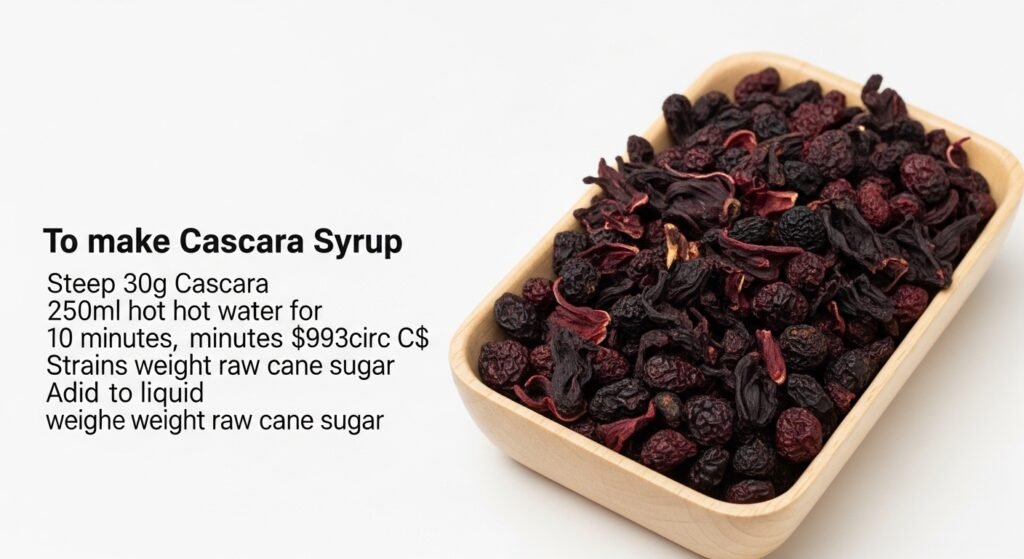
One of the most exciting experiments in the “Sensory Laboratory” is the use of Cascara (the dried husks of the coffee cherry). Cascara is rich in antioxidants and has a flavor profile completely different from the bean—think hibiscus, dried cranberry, and honey.
To make a Cascara syrup:
-
Steep 30g of Cascara in 250ml of hot water ($93^\circ C$) for 10 minutes.
-
Strain and weigh the liquid.
-
Add an equal weight of raw cane sugar. This syrup is the perfect bridge for botanical drinks like the Coffee Gin & Tonic, adding a “fruity” layer that complements the gin’s juniper without the “heaviness” of roasted coffee.
Stability and Maintenance: Preventing Crystallization
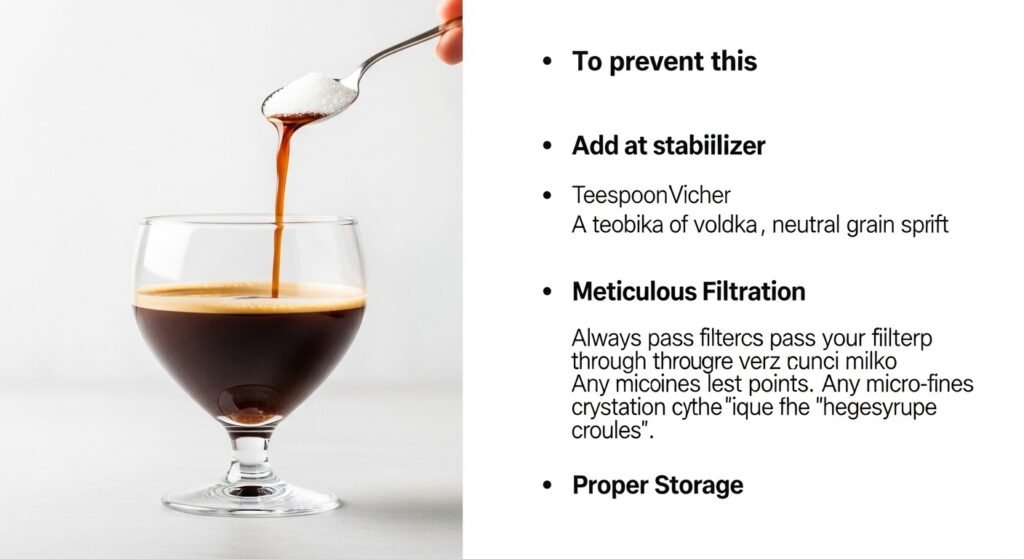
A common problem in the “Laboratório de Drinks” is the crystallization of rich syrups. If the sugar molecules find a “seed” (like a piece of undissolved sugar or a coffee ground), they will begin to bond together, turning your liquid syrup back into a solid.
To prevent this:
-
Add a stabilizer: A teaspoon of vodka or neutral grain spirit acts as a preservative and helps prevent crystallization.
-
Meticulous Filtration: Always pass your coffee syrup through a paper filter or a very fine nut-milk bag. Any micro-fines left in the syrup will serve as “nucleation points” for crystals to form.
-
Proper Storage: Store in glass, never plastic, and keep refrigerated. Maintenance matters—a syrup with coffee solids will spoil much faster than a plain simple syrup.
Conclusion: The Architect of Flavor
Creating coffee syrups is where the barista’s bench meets the chemist’s lab. It is about understanding that sweetness is not a monolithic experience, but a variable that can be manipulated to highlight the terroir of the bean.
By mastering the Brix ratio, infusion temperatures, and pH stability, you gain the power to create cocktails with unparalleled depth. The next time you shake an Espresso Martini or stir a Coffee Old Fashioned, remember that the “secret ingredient” isn’t just the coffee—it’s the science you put into the syrup.

Kevin Smith is deeply interested in the craft and culture of coffee, with practical experience exploring specialty beans, brewing techniques, and flavor development. Over the years, he has spent time studying preparation methods, observing extraction processes, and understanding how small details influence the final cup.
Through NovaWeHub, Kevin shares clear, practical, and research-based insights designed to make coffee knowledge approachable for everyone — from beginners to enthusiasts. His focus is on simplifying complex concepts and encouraging readers to explore coffee with curiosity, confidence, and a more refined sensory awareness.