
Coffee brewing is often described as a combination of art and science. The artistry comes from the barista’s intuition and the sensory experience of tasting, while the science is grounded in measurable principles.
Each time a cup is prepared, water acts as a solvent, extracting soluble compounds from the coffee grounds in a process similar to a controlled chemical operation. One of the key tools for managing this extraction is the brew ratio, which determines the balance of water to coffee and directly influences the flavor, body, and clarity of the final cup.
Understanding the relationship between the weight of your coffee and the weight of your water is the first step toward consistency. However, a ratio is only half the story. To truly master the barista’s bench, we must also understand Extraction Yield and TDS (Total Dissolved Solids). These metrics allow us to navigate the “Brew Chart” and achieve the elusive “Golden Cup Standard”—the mathematical “sweet spot” where coffee tastes its best.
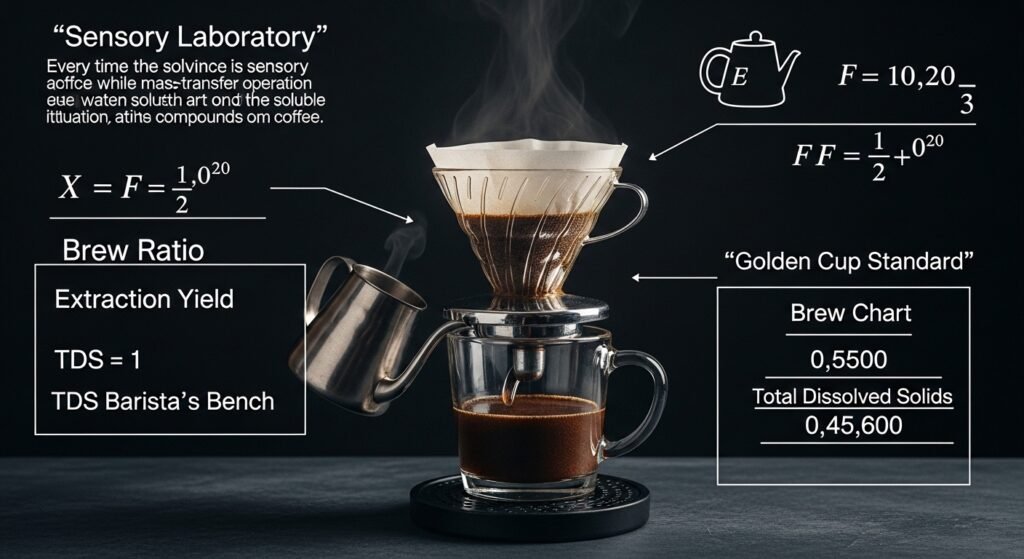
The Brew Ratio: The Architect’s Blueprint
A brew ratio is the weight of dry coffee grounds relative to the weight of the water used for brewing. In the lab, we always measure in grams to ensure precision.
-
Strength vs. Extraction: A common misconception is that a “stronger” ratio (more coffee, less water) always leads to a better cup. In reality, a ratio dictates the Strength (Intensity) of the coffee, while the brewing technique dictates the Extraction (Quality).
-
Standard Ratios: Most specialty protocols range from 1:15 (for a heavy body) to 1:18 (for a tea-like, clear profile typical of high-altitude African coffees).
If you use too much water (e.g., 1:20), you risk over-extraction, where you pull out woody, bitter compounds that ruin the aftertaste. If you use too little water (e.g., 1:12), you might end up with an under-extracted cup that is “sour” and “salty” because the water was saturated before it could dissolve the complex sugars.
TDS and Refractometry: Measuring the Invisible
How do we know if our ratio worked? In our “Sensory Laboratory,” we use a Refractometer. This device measures how much light “bends” as it passes through the coffee, which tells us the TDS (Total Dissolved Solids).
-
TDS Percentage: This tells us how “concentrated” the coffee is. A standard filter coffee usually sits between 1.15% and 1.45% TDS. This means that 98.5% of your cup is still just water.
-
Extraction Yield (EY): This is the percentage of the dry coffee’s mass that ended up in the cup. The “Golden Cup” standard suggests an EY of 18% to 22%.
If your EY is below 18%, the coffee is under-developed. If it is above 22%, it usually begins to taste “dry” or “astringent.” In the lab, we use the ratio as a lever: if the TDS is high but the taste is sour, we need to increase our extraction by adjusting the grind or the temperature.
The “Golden Cup” Control Chart: Navigating the Map
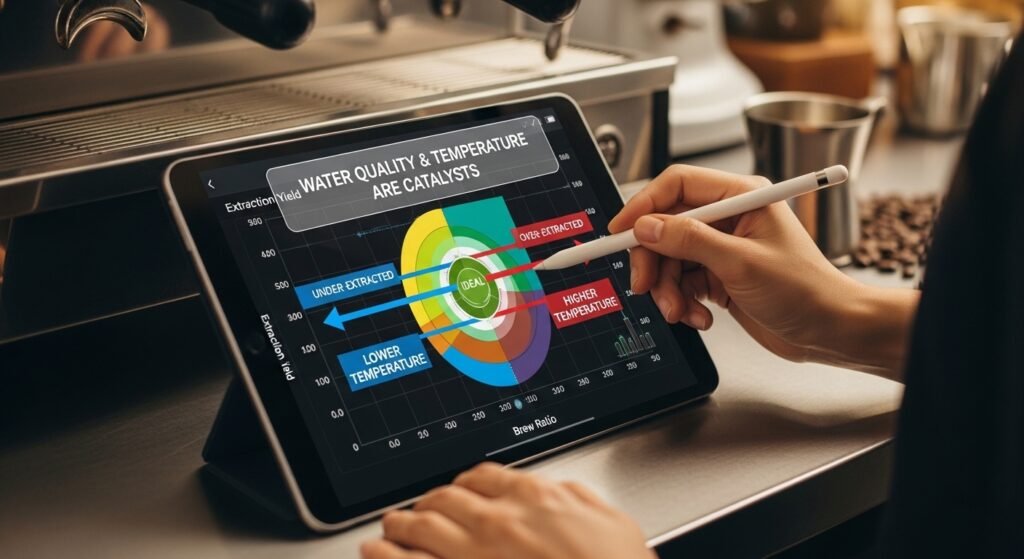
The SCA (Specialty Coffee Association) Brewing Control Chart is the map of our laboratory. It features two axes: Strength (TDS) on the vertical and Extraction (EY) on the horizontal.
-
The Center: The “Golden Cup” zone. This is where the acid vs. bitter balance is perfect.
-
The Top Left (Strong & Under-extracted): The coffee is intense but sour. This often happens with a 1:13 ratio and a coarse grind.
-
The Bottom Right (Weak & Over-extracted): The coffee is thin but bitter. This is typical of a 1:20 ratio with a grind that is too fine.
To move within this chart, the barista must understand that water quality and temperature also act as catalysts. Higher temperatures increase the rate of extraction, effectively moving you to the right on the chart without changing the ratio.
Precision Variables: Retention and Bypass
In advanced laboratory brewing, we must also consider Water Retention. When you pour 300g of water over 20g of coffee, you will not get 300ml of coffee in your cup. The coffee grounds act as a sponge, retaining approximately 2 grams of water for every 1 gram of coffee.
Furthermore, we must account for Bypass. In some automatic brewers or specific AeroPress techniques, baristas brew a “concentrate” (a tight ratio) and then add fresh water to the final cup. This changes the TDS without changing the Extraction Yield. In the lab, this is a powerful tool to maintain the clarity of floral aromas while controlling the perceived intensity of the drink.
The Role of Scale Maintenance
None of these mathematical calculations matter if your equipment is not calibrated. In the “Sensory Laboratory,” maintenance matters.
-
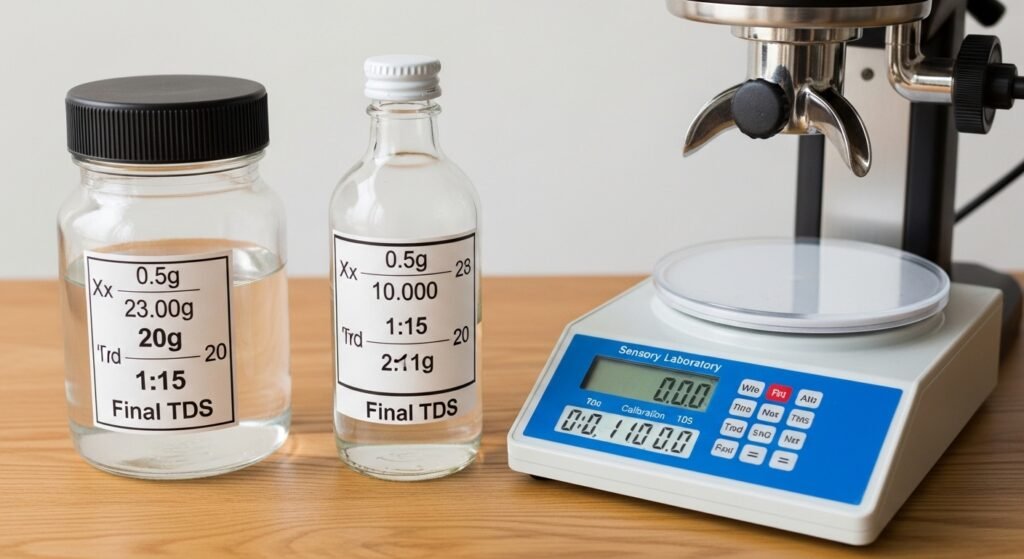
Scale Calibration: A 0.5g error might seem small, but in a 1:15 ratio, it represents a significant shift in the final TDS.
-
Water Hardness: As we know from our study on water quality, “hard” water extracts solids faster than “soft” water. You may need to adjust your ratio depending on the mineral content of your solvent to stay within the Golden Cup zone.
Conclusion: Mastering the Golden Equilibrium
The “Golden Cup Standard” is not a rigid rule, but a compass. It provides a scientific foundation that allows the barista to repeat their success. By understanding the interaction between Brew Ratios, TDS, and Extraction Yield, we remove the guesswork from the barista’s bench.
In the “Sensory Laboratory,” we use these numbers to protect the spirit of the bean. Whether you are aiming for the “syrupy” intensity of a 1:15 Brazilian Natural or the “elegant” clarity of a 1:17 Kenyan, the math remains the same. Use your scale, trust your refractometer, but always let your palate have the final word. The science gets you to the neighborhood; your senses find the house.

Kevin Smith is deeply interested in the craft and culture of coffee, with practical experience exploring specialty beans, brewing techniques, and flavor development. Over the years, he has spent time studying preparation methods, observing extraction processes, and understanding how small details influence the final cup.
Through NovaWeHub, Kevin shares clear, practical, and research-based insights designed to make coffee knowledge approachable for everyone — from beginners to enthusiasts. His focus is on simplifying complex concepts and encouraging readers to explore coffee with curiosity, confidence, and a more refined sensory awareness.