
Many coffee enthusiasts focus on speed and consistency in brewing, yet some methods invite a more deliberate approach. The Siphon, or Vacuum Pot, is one such technique.
Originating in the 1830s with Loeff of Berlin and later refined by Madame Vassieux in Lyons, the Siphon is both a precise brewing tool and a visual spectacle. Its preparation showcases the principles of thermodynamics in action, producing a cup that is as much a performance as it is a flavorful experience. The method encourages patience and attention, rewarding those who engage fully with its elegant process.
But beyond the glass globes and the open flames, the Siphon is a masterclass in immersion extraction. It combines the full saturation of a French Press with the crystalline clarity of a V60. To master the Siphon is to master the delicate balance between vapor pressure and gravity, resulting in a cup that highlights the most volatile aromas of the bean.
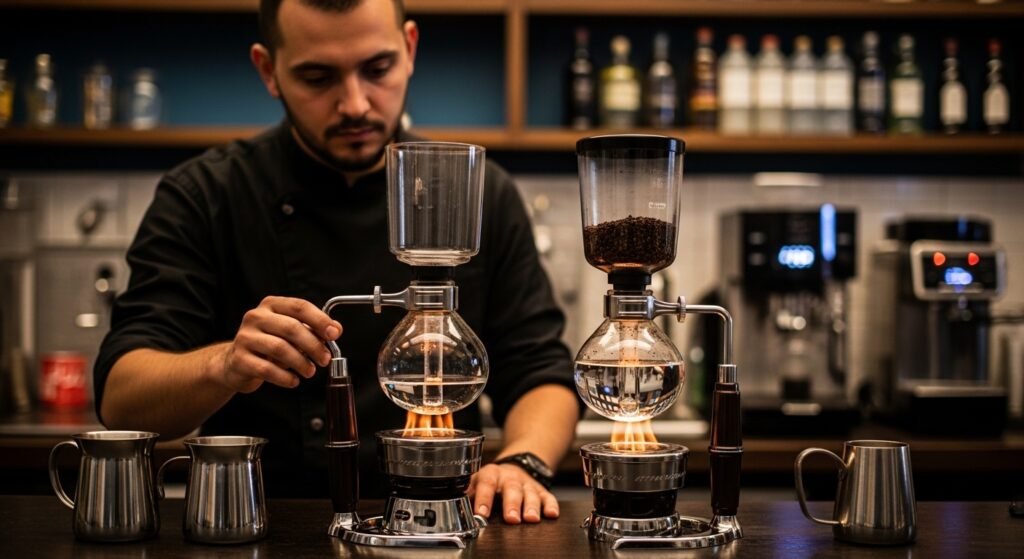
The Physics of the Vacuum: How It Works
The Siphon consists of two primary chambers: the lower bulb (the boiler) and the upper hopper (the brewing chamber). The process is a four-stage cycle governed by the ideal gas law.
-
Vapor Pressure: As the water in the lower bulb is heated, it turns into steam. This steam creates pressure that forces the remaining hot water up through a tube into the upper chamber.
-
Total Immersion: The coffee grounds are added to the water in the upper chamber. Because the heat source remains under the lower bulb, the water in the top stays at a very stable, high temperature ($90^\circ C – 94^\circ C$), allowing for a rapid and efficient extraction.
-
The Vacuum (Draw-Down): When the heat source is removed, the air in the lower bulb cools and contracts. This creates a vacuum (negative pressure) that “sucks” the brewed coffee back down through a filter (cloth, paper, or glass) into the bottom bulb.
-
Filtration: The “Draw-Down” phase is where the magic happens. The vacuum force is much stronger than gravity, pulling the liquid through the filter with enough speed to prevent the “over-extracted” aftertaste that often plagues slower methods.
Why the Siphon Tastes Different
In our laboratory, we value the Siphon for its Aromatic Intensity. Because the Siphon is a nearly closed system during the brewing phase, fewer volatile organic compounds (aromas) escape into the air. Instead, they are trapped within the liquid.
When you sip a Siphon-brewed coffee, the first thing you notice is the “cleanliness.” Unlike the French Press, which can be muddy, the Siphon uses a cloth or paper filter that removes almost all sediment while allowing the coffee’s natural lipids (oils) to pass through. This results in a medium-bodied cup with a “sparkling” clarity that amplifies the acid vs. bitter balance.
The Cloth Filter: The Artisan’s Choice
The most traditional filter for a Siphon is made of cloth. In the “Sensory Laboratory,” the cloth filter is a double-edged sword.
-
The Benefit: Cloth allows for more oils to pass through than paper, giving the coffee a “silky” texture that is unique to this method.
-
The Risk: Cloth filters are notorious for harboring old oils and bacteria. If you do not follow a strict maintenance protocol, the cloth will turn rancid, ruining the sensory experience.
In the lab, we recommend storing your cloth filters in a jar of clean water inside the refrigerator between uses. This prevents the fibers from drying out and the oils from oxidizing.
The Variable of Heat: Butane vs. Halogen
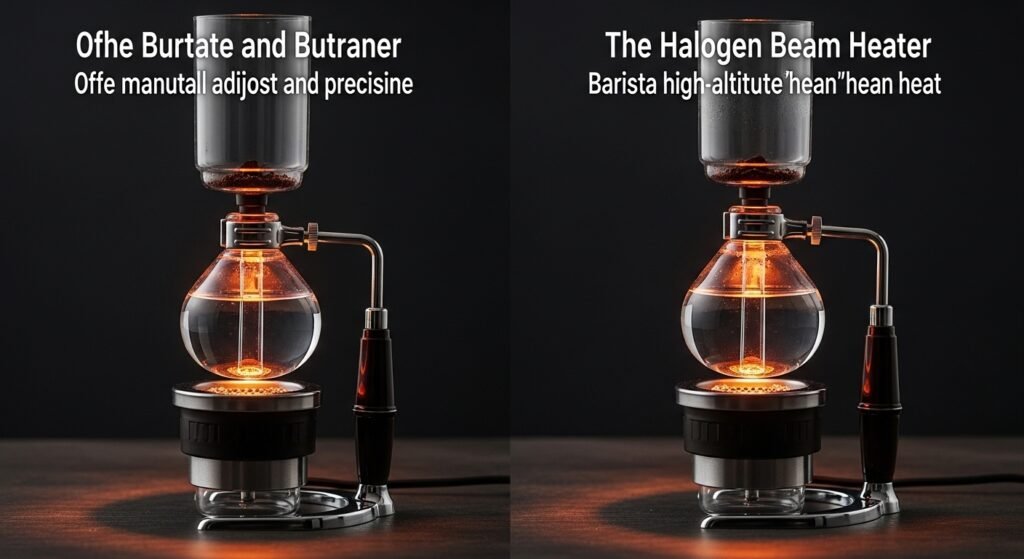
The heat source is the engine of the Siphon. In the laboratory, we compare two primary methods:
-
The Butane Burner: Offers portability and precision. You can manually adjust the flame to control the “turbulence” in the upper chamber.
-
The Halogen Beam Heater: The ultimate “theater” tool. It uses high-intensity light to heat the water. It provides the most stable and controllable heat, allowing the barista to maintain a perfect “rolling boil” without overheating the glass.
Regardless of the source, the goal is to keep the water in the upper chamber at a temperature that facilitates high-altitude bean extraction without scalding the grounds.
Dialing In the Siphon: Barista’s Protocol
Because the Siphon is a fast method with high heat, the grind consistency is paramount.
-
The Grind: Aim for “Medium-Fine”—slightly coarser than espresso but finer than a standard V60.
-
The Ratio: 1:15 (20g of coffee to 300ml of water).
-
The Agitation: Once the water has risen to the top chamber, add the coffee and give it three gentle stirs to ensure total saturation. Wait 45 to 60 seconds.
-
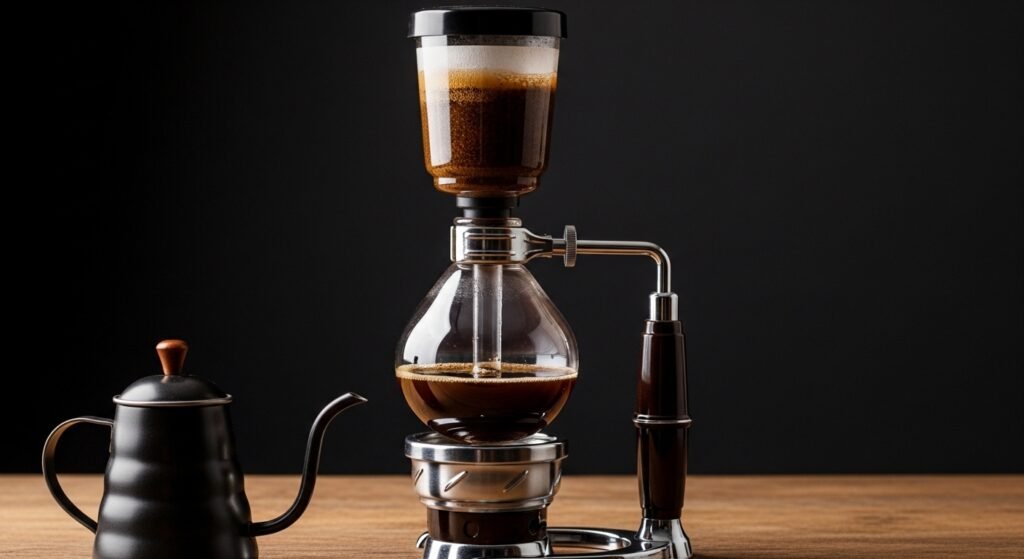
The “Spin”: As you remove the heat and the draw-down begins, give the coffee a final “whirlpool” stir. This forces the grounds to settle in a “dome” shape on the filter, which ensures an even filtration and a clean aftertaste.
Conclusion: The Ultimate Scientific Ceremony
The Siphon is the bridge between 19th-century engineering and 21st-century specialty coffee. It is a method that demands respect for the physics of the vacuum and the chemistry of the aroma wheel. While it may be too labor-intensive for a busy morning, it remains the “gold standard” for a weekend ritual in the “Sensory Laboratory.”
When you watch the coffee being pulled down through the filter, forming a perfect dome of grounds, you aren’t just watching a drink being made—you are watching the laws of nature perfectly calibrated for your enjoyment. The Siphon reminds us that coffee is not just fuel; it is an experiment, a theater, and a profound sensory journey.

Kevin Smith is deeply interested in the craft and culture of coffee, with practical experience exploring specialty beans, brewing techniques, and flavor development. Over the years, he has spent time studying preparation methods, observing extraction processes, and understanding how small details influence the final cup.
Through NovaWeHub, Kevin shares clear, practical, and research-based insights designed to make coffee knowledge approachable for everyone — from beginners to enthusiasts. His focus is on simplifying complex concepts and encouraging readers to explore coffee with curiosity, confidence, and a more refined sensory awareness.