
Coffee experiences can be broadly categorized by either intensity or clarity. While drinks like the Espresso Tonic emphasize bold, effervescent flavors, the Hario V60 showcases a different approach: precision and transparency.
The V60 is more than a simple dripper—it is a tool designed to highlight the subtle, high-frequency elements of coffee. Acidity, delicate floral notes, and fine sugars are all brought forward, offering a clean and nuanced cup that might be masked in heavier or less controlled brewing methods.
The name “V60” comes from the 60-degree angle of its cone. While it looks simple, the engineering behind it is complex. It challenges the barista to manage the flow of water with surgical precision, making it a favorite for those who enjoy the “Science of Coffee.” To master the V60 protocol, one must understand the relationship between vortex dynamics, paper porosity, and how precision grinding dictates the final aftertaste.
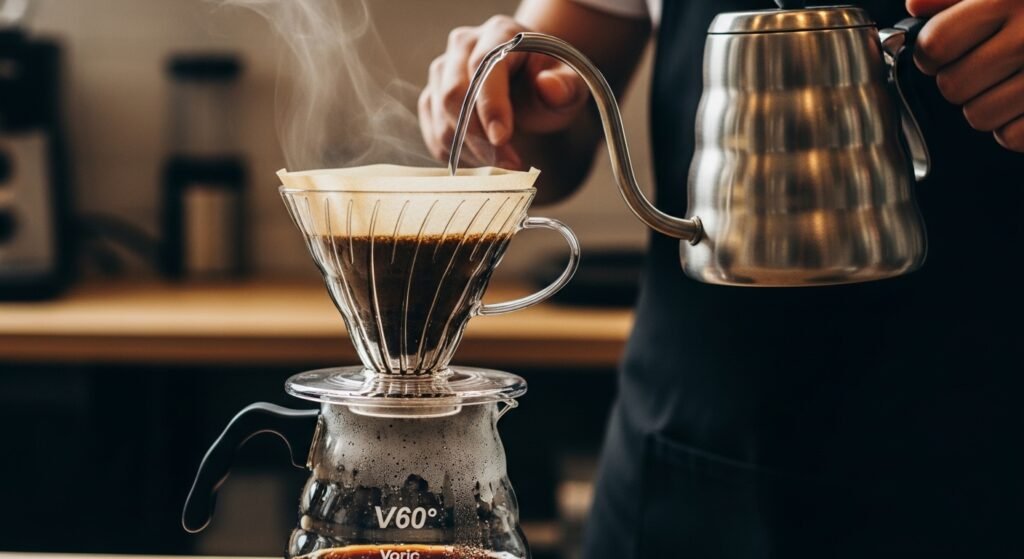
The Geometry of Extraction: The 60-Degree Cone
The V60’s design is a deliberate piece of fluid engineering. Unlike flat-bottom drippers, the cone shape forces water to travel toward the center of the coffee bed. This creates a deeper layer of grounds for the water to pass through, which increases the contact time and allows for a more efficient extraction of the terroir.
One of the most distinctive features of the V60 is the internal spiral ribs. These ribs are not just for decoration; they serve two vital scientific functions:
-
Air Flow: They create a gap between the paper filter and the wall of the dripper, allowing air to escape as water enters. Without this airflow, the brew would “stall,” leading to over-extraction and a dry, bitter finish.
-
Surface Area: They prevent the paper from sticking to the walls, ensuring that water can flow through the sides of the filter as well as the bottom, promoting a more uniform extraction across the entire coffee bed.
[Image showing the cross-section of a V60 dripper with arrows indicating airflow and water movement through the spiral ribs]
The Paper Variable: Porosity and Oils
In the “drink laboratory,” we treat the filter as a chemical sieve. The V60 paper is notably thinner than the paper used in a Chemex. This allows for a faster flow rate and permits some of the coffee’s natural oils and fine particles to pass through into the cup.
This is the secret to the V60’s “sparkle.” Because it is less restrictive than other paper filters, it preserves the volatile acids of a high-altitude coffee. However, this also means that the barista has no “safety net.” Any mistake in the grind consistency or pouring technique will be immediately apparent in the cup. This is why we always recommend rinsing the filter with hot water before brewing to remove any “paper taste” and to pre-heat the ceramic or glass dripper.
The Pouring Technique: Turbulence vs. Laminar Flow
On the barista’s bench, the way you add water is just as important as the coffee itself. We use a gooseneck kettle for a specific reason: Control.
When brewing a V60, we aim for “controlled turbulence.” If you pour too aggressively, you stir up the grounds too much, which can cause “fines” to migrate to the bottom and clog the filter (a phenomenon known as “clogging” or “stalling”). If you pour too gently, you may create “channels” where water finds a path of least resistance, leaving large portions of the coffee under-extracted.
The ideal V60 protocol involves a “Bloom” phase—adding a small amount of water and waiting 30 seconds to allow $CO_2$ to escape—followed by a series of circular pours that keep the coffee bed agitated but stable. This ensures that every gram of water is working to extract the flavor notes you identified on the flavor wheel.

Dialing In the V60: Matching Origin to Method
The V60 is the preferred method for exploring African coffee profiles and washed Central Americans. Because of its clarity, it acts as a magnifying glass for the “enzymatic” flavors of the bean.
-
For Floral/Tea-like Coffees (Ethiopia/Panama): Use a slightly coarser grind and a higher water temperature ($94^\circ C – 96^\circ C$). This highlights the volatile floral aromas without pulling out heavy, woody notes.
-
For Fruity/Acidic Coffees (Kenya/Colombia): A medium-fine grind and a steady pour will emphasize the citric and malic acids, resulting in a cup that feels “juicy.”
-
For Balanced/Nutty Coffees (Brazil): While the V60 can brew Brazilian coffees, you must be careful not to over-extract. A lower temperature ($90^\circ C$) can help preserve the sweetness and prevent a bitter aftertaste.
The Importance of Water Quality
As we have discussed in our “sensory laboratory,” water quality is the silent solvent. In a V60, where the coffee is 98-99% water, the mineral content is paramount. If your water is too “hard” (high in calcium and magnesium), it will extract too much too quickly, leading to a heavy, muddy cup. If it is too “soft,” the coffee will taste flat and sour. Using a filtered water system or a tailored mineral solution allows the terroir to remain the undisputed star of the show.

Conclusion: The Ultimate Test of Skill
Mastering the V60 is a rite of passage for any serious coffee enthusiast. It is a method that demands patience, observation, and a deep understanding of the science of extraction. It does not hide your mistakes; it reflects them. But when you get it right—when the grind, the temperature, and the pour are in perfect harmony—the reward is a cup of coffee that is unparalleled in its elegance and clarity.
The V60 protocol reminds us that coffee is a living chemistry experiment. By respecting the physics of the cone and the psychology of the environment, we transform a simple morning routine into a profound sensory journey. So, grab your kettle, weigh your beans, and prepare to see your coffee in a whole new light.

Kevin Smith is deeply interested in the craft and culture of coffee, with practical experience exploring specialty beans, brewing techniques, and flavor development. Over the years, he has spent time studying preparation methods, observing extraction processes, and understanding how small details influence the final cup.
Through NovaWeHub, Kevin shares clear, practical, and research-based insights designed to make coffee knowledge approachable for everyone — from beginners to enthusiasts. His focus is on simplifying complex concepts and encouraging readers to explore coffee with curiosity, confidence, and a more refined sensory awareness.