
Even when using high-quality water with the ideal mineral balance, temperature control remains one of the most critical factors in espresso brewing. Locking a portafilter into an espresso machine starts a precise, high-pressure extraction process, where consistency depends on the water hitting the coffee grounds at a stable temperature.
For the best results, this temperature typically needs to stay within a very narrow range—often within ±0.5°C. Any fluctuations during the extraction can alter the balance of flavors, producing a cup where acidity and bitterness compete rather than complement each other. Maintaining thermal stability ensures that the espresso delivers a harmonious and well-rounded taste.
The engineering of the “Group Head”—the part of the machine that meets the coffee—is the key to this stability. Whether a system is Saturated or Semi-Saturated dictates how heat is managed and how the barista must approach their calibration process.
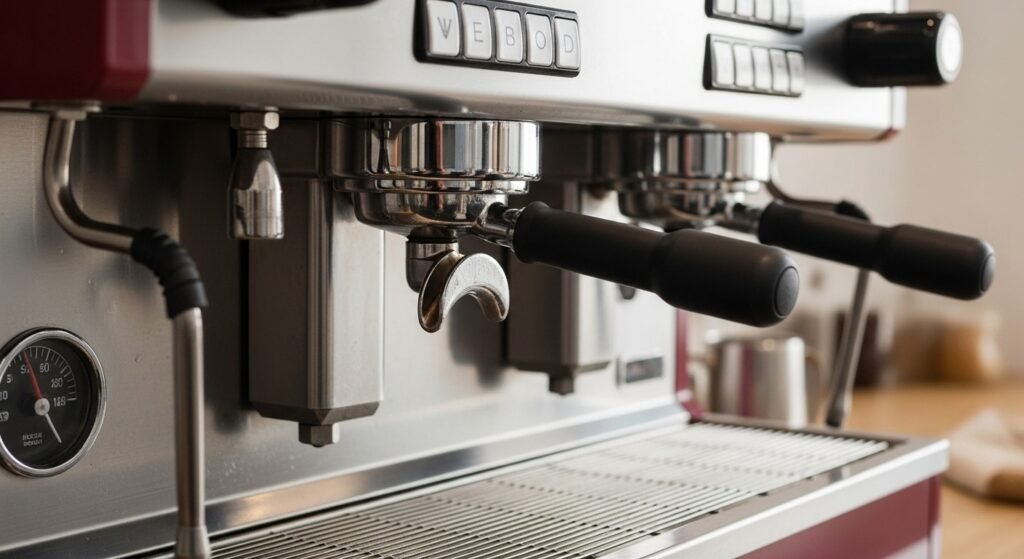
The Physics of Heat Loss: Why Stability is Difficult
Water is an excellent conductor of heat, but as it moves from the boiler to the coffee, it encounters various metal components (pipes, valves, and the group head itself). In the lab, we call this the “Thermal Gradient.“
-
Thermal Inertia: Large chunks of brass or steel take a long time to heat up, but once hot, they resist temperature changes. This is why maintenance and warm-up times are non-negotiable on the barista’s bench.
-
The Cooling Flush: In older machines, water sitting in the pipes could become too hot (steam), requiring a “flush” to bring the temperature back down to the target range for aroma preservation.
Saturated Group Heads: The Gold Standard of Consistency
Saturated groups, famously pioneered by brands like La Marzocco, are designed to eliminate the thermal gradient. In this system, the group head is an extension of the boiler itself.
-
The Design: The group head is “welded” to the boiler or hollowed out so that the boiler water circulates directly inside the group head.
-
The Physics: Because the metal of the group head is constantly bathed in the same water used for brewing, it stays at exactly the same temperature as the boiler. There is no “cold” metal for the water to hit.
-
Sensory Impact: This leads to incredible shot-to-shot consistency. When you are working with delicate high-altitude African beans, where a $1^\circ C$ difference can make the difference between “floral” and “sour,” a saturated group is the ultimate tool.
Semi-Saturated Group Heads: The Versatile Alternative
Semi-saturated systems (often found in E61-style or modern multi-boiler machines) are separate from the main boiler but are heated through secondary means, such as a thermosyphon or dedicated heating elements.
-
Thermosyphon Systems: These rely on the natural convection of hot water rising and cooler water falling to keep the group head hot. While effective, they are susceptible to “stalling” if the maintenance of the pipes is neglected or if the machine is idle for too long.
-
The Advantage of Flexibility: Modern semi-saturated groups often feature their own PID-controlled heating elements. This allows the barista to change the group head temperature independently of the boiler, offering a level of “tuning” for the mouthfeel and body of the espresso.
PID Controllers: The Brain of the Group
In our “Sensory Laboratory” trials, the introduction of the PID (Proportional-Integral-Derivative) controller was the single biggest leap in thermal science. Instead of a simple thermostat that turns on and off (causing “swings” in temperature), a PID uses an algorithm to pulse the heater.
-
Proportional: The heater works harder when the temperature is far from the target.
-
Integral: It accounts for how long the temperature has been away from the target.
-
Derivative: It predicts future drops in temperature (like when cold water enters the boiler during a shot).
This mathematical precision is what allows the barista’s bench to stay calibrated even during the morning rush.
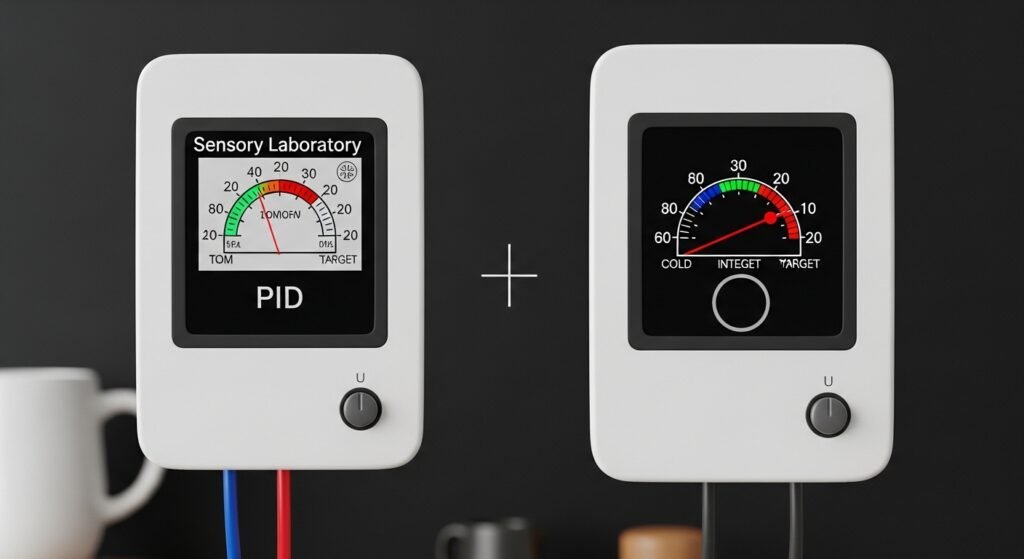
Thermal Stability and Extraction Yield
Why do we obsess over these decimals? Because of Solubility.
-
High Temperature ($>95^\circ C$): Increases the extraction of heavy, bitter compounds. This can be useful for under-developed light roasts but can lead to a harsh aftertaste in darker roasts.
-
Low Temperature ($<90^\circ C$): Reduces the extraction of sugars, often leaving the coffee tasting “thin” or “salty.“
By using a saturated group with PID control, you “lock” the temperature variable. This allows you to focus purely on grind size and dose. If your shot tastes “off,” you can be 99% sure it’s not the water temperature—it’s your technique or the bean.
Maintenance of Thermal Systems: Scaling and Insulation
A common failure in the “Sensory Laboratory” is the neglect of thermal insulation.
-
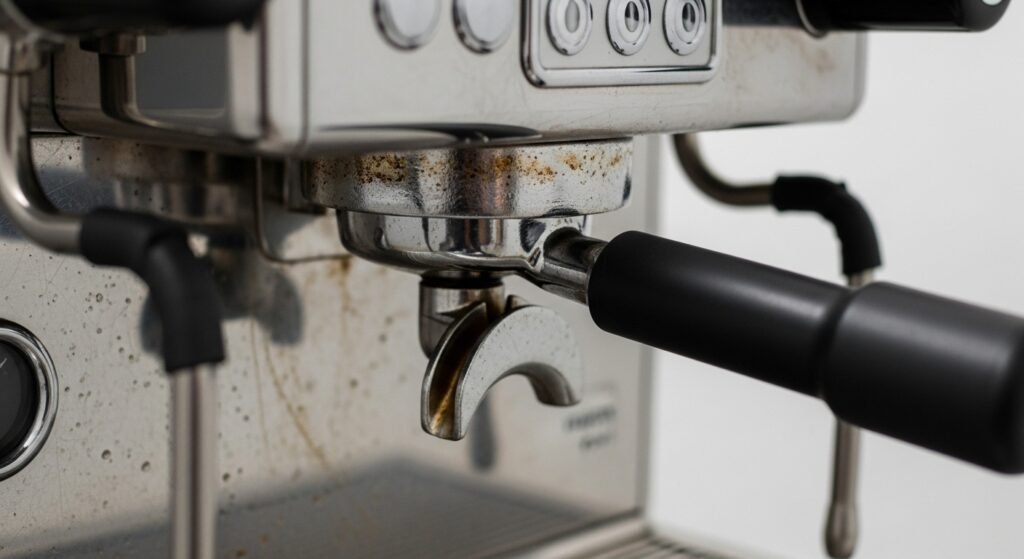
Scaling: As we know from our study of water quality, calcium buildup acts as an insulator. If your group head is scaled up, the heat cannot transfer efficiently from the water to the metal (or vice-versa). This leads to “thermal lag,” where the first shot is cold and the third is hot.
-
Group Gaskets: Even the rubber gasket plays a role. A worn gasket allows heat to leak out of the sides of the portafilter, destabilizing the puck temperature during the extraction process.
Conclusion: The Engineering of Taste
The choice between a saturated and a semi-saturated system often comes down to the volume of the cafe and the style of coffee being served. Saturated groups offer the absolute peak of consistency for high-volume environments, while semi-saturated groups with PID control offer a versatile laboratory for exploring different origin profiles.
In the “Sensory Laboratory,” we respect the engineering that goes into every group head. Whether you are using a classic E61 or a modern saturated beast, the goal is the same: thermal equilibrium. Master your machine’s thermal behavior, maintain your equipment, and use the science of PIDs to protect the aromatic integrity of your coffee. The perfect aftertaste is not just brewed; it is thermally engineered.

Kevin Smith is deeply interested in the craft and culture of coffee, with practical experience exploring specialty beans, brewing techniques, and flavor development. Over the years, he has spent time studying preparation methods, observing extraction processes, and understanding how small details influence the final cup.
Through NovaWeHub, Kevin shares clear, practical, and research-based insights designed to make coffee knowledge approachable for everyone — from beginners to enthusiasts. His focus is on simplifying complex concepts and encouraging readers to explore coffee with curiosity, confidence, and a more refined sensory awareness.