
When we build our home coffee laboratory, we spend weeks researching choosing the right grinder and perfecting our pouring technique. We obsess over finding the best beans from renowned Brazilian coffee regions or exotic African farms. Yet, we often overlook the one ingredient that makes up about 98% of our cup: water. If your water is not chemically balanced, it doesn’t matter how expensive your beans are; the extraction will be flawed.
Water is the solvent that pulls flavor out of the coffee grounds. However, water is not just $H_2O$. It is a complex solution of minerals, gases, and chemicals. Some minerals act as magnets that pull out the sweetness and acidity, while others act as blockers that make the coffee taste dull or unpleasantly bitter. Understanding water chemistry is the “final frontier” for the home barista. In this guide, we will explore why tap water is usually the enemy of good coffee and how you can optimize your water to ensure a perfect acid vs. bitter balance.
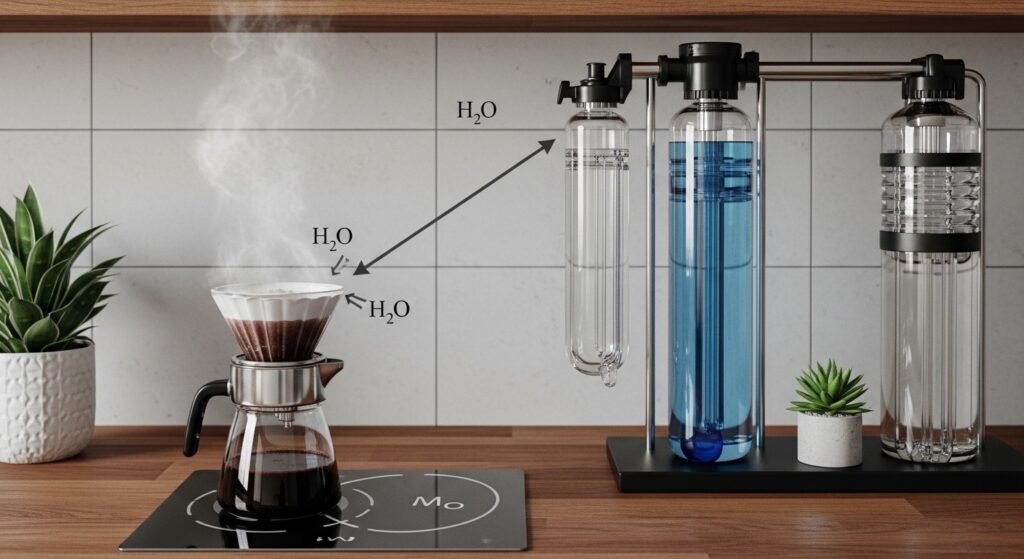
The Chemistry of Extraction: Hardness vs. Alkalinity
In the context of coffee, we look at two main measurements: Total Hardness and Alkalinity. Hardness refers to the concentration of calcium and magnesium ions. These ions are the “workers” of extraction. Magnesium, in particular, is excellent at pulling out sharp, fruity flavors, while calcium helps bring out the heavier, chocolatey notes. If your water is “too soft” (low mineral content), the coffee will often taste weak and sour because there weren’t enough minerals to pull the flavor out.
Alkalinity, or “Buffer,” is the water’s ability to neutralize acid. Think of it as a sponge. A little bit of alkalinity is necessary to prevent the coffee from tasting like vinegar, but too much will soak up all the beautiful citric and malic acidity that we prize in specialty coffee. This is why coffee brewed with very hard tap water often tastes “flat,” “chalky,” or “dull.” The alkalinity has essentially “muted” the coffee’s personality.
The Problem with Tap Water and Chlorine
Most municipal tap water is treated with chlorine or chloramine to make it safe to drink. While this is great for health, it is a disaster for coffee flavor. Even a tiny amount of chlorine can react with the phenols in coffee to create “chlorophenols,” which have a distinct medicinal or plastic-like taste. Furthermore, tap water is designed to be “scale-neutral” to protect city pipes, which often means it is far from the ideal mineral range for brewing.
If you are following the golden ratio perfectly but your coffee still has a chemical aftertaste, your tap water is likely the culprit. Filtering your water through a simple carbon block filter (like a Brita pitcher) is a good first step because it removes chlorine, but it often doesn’t change the mineral composition enough to optimize the body and mouthfeel of your brew.
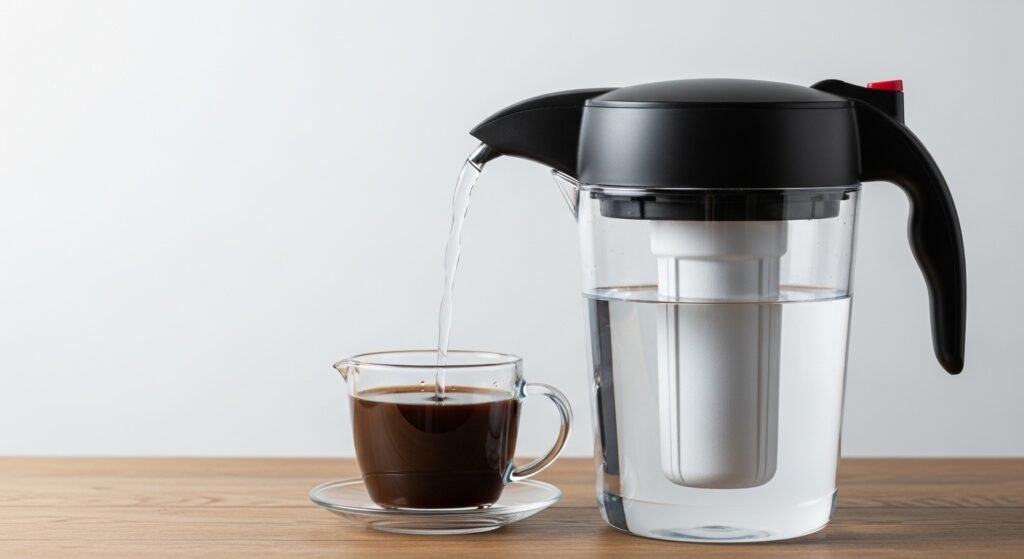
Exploring Solutions: Bottled, Filtered, or Custom Water?
For the dedicated enthusiast, there are three main ways to improve water quality. The first is finding a specific brand of bottled spring water that has a mineral content close to the Specialty Coffee Association (SCA) standards (ideally 50-150 ppm of total dissolved solids). However, this is both expensive and environmentally unfriendly.
The second option is specialized filtration systems like “Zero Water” or Reverse Osmosis (RO). These systems strip everything out of the water, leaving you with a blank slate. But beware: brewing with pure 100% distilled water is just as bad as using hard tap water. Without any minerals, the water becomes aggressive and extracts too much of the bitter compounds. If you use an RO system, you must “re-mineralize” the water.
The third, and most “laboratory-style” approach, is using distilled water and adding specific mineral packets (like Third Wave Water). These packets contain a precise ratio of magnesium, calcium, and potassium. This ensures that whether you are in London, New York, or São Paulo, your water is identical, allowing you to taste the true journey of the bean without local interference.
Water Temperature: The Catalyst
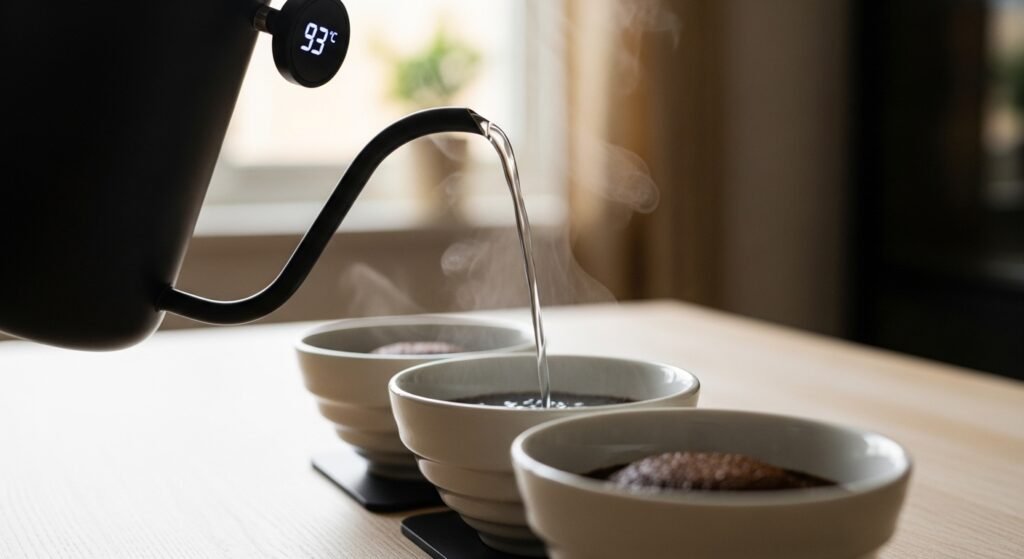
Once you have the right chemical composition, you must control the temperature. Water temperature determines the speed of extraction. Hotter water (92°C–96°C) extracts faster and is better for light roasts, while slightly cooler water (88°C–90°C) is better for darker roasts to prevent over-extraction.
In the coffee cupping ritual, temperature is kept strictly consistent to allow for a fair comparison. At home, using a temperature-controlled gooseneck kettle is one of the best investments you can make. It ensures that the water you’ve worked so hard to balance is delivered to the grounds at the exact moment it can do the most good.
Conclusion: Respect the Solvent
We often say that coffee is an art, but it is deeply rooted in chemistry. Respecting the water you use is a sign of a mature barista. By moving away from tap water and toward a filtered or mineral-balanced solution, you are essentially “cleaning the window” through which you see the coffee’s flavor.
The next time your coffee doesn’t taste quite right, don’t immediately blame your grinder or your beans. Look at your water. Is it too hard? Does it smell like chlorine? By optimizing the invisible 98% of your cup, you unlock the full potential of the remaining 2%. The laboratory of the senses starts with a clean, balanced foundation. Take care of your water, and your water will take care of your coffee.

Kevin Smith is deeply interested in the craft and culture of coffee, with practical experience exploring specialty beans, brewing techniques, and flavor development. Over the years, he has spent time studying preparation methods, observing extraction processes, and understanding how small details influence the final cup.
Through NovaWeHub, Kevin shares clear, practical, and research-based insights designed to make coffee knowledge approachable for everyone — from beginners to enthusiasts. His focus is on simplifying complex concepts and encouraging readers to explore coffee with curiosity, confidence, and a more refined sensory awareness.