
In the world of fine wine, the word “terroir” has been a cornerstone of quality for centuries. Recently, this French term has migrated into the specialty coffee industry, becoming one of the most important concepts for enthusiasts to understand. At its simplest, terroir is the “sense of place.” It is the holistic environment in which a coffee cherry grows, encompassing everything from the chemical composition of the soil to the angle of the sun on the hillside. When you taste a coffee that has distinct notes of jasmine, tomato, or chocolate, you aren’t just tasting the bean; you are tasting the geography of a specific coordinate on Earth.
Understanding terroir is what allows us to distinguish a high-altitude Ethiopian coffee from a low-altitude Brazilian one without even looking at the label. It is the biological blueprint that determines a coffee’s potential for acidity, body, and sweetness. For the home barista and the specialty coffee explorer, recognizing the impact of geography is the first step in moving beyond “dark” or “light” roasts and into the fascinating world of regional flavor profiles. In this deep dive, we will explore the four pillars of coffee terroir: altitude, soil, climate, and topography.
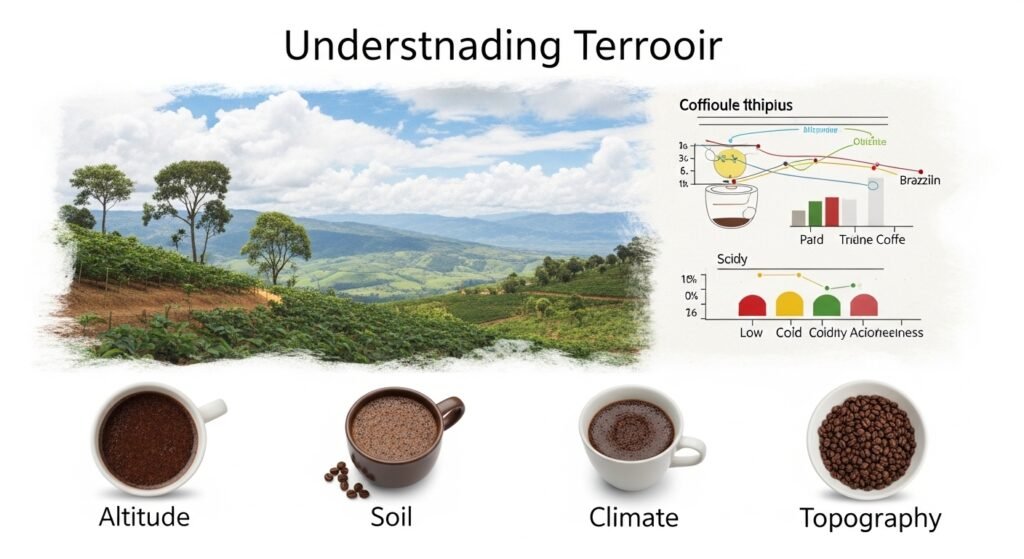
The Pillar of Altitude: The Magic of Thin Air
Perhaps the most discussed aspect of coffee terroir is altitude. Why do coffee bags proudly display “1,800 MASL” (Meters Above Sea Level)? The reason is rooted in plant physiology. At higher altitudes, the air is thinner, and temperatures are significantly cooler, especially at night. This environment forces the coffee tree to work harder to survive. Because the temperatures are lower, the coffee cherries ripen much more slowly than they would in a hot, humid valley.
This slow maturation process is crucial for flavor development. As the cherry takes longer to develop, it has more time to synthesize complex sugars and organic acids. This results in a bean that is physically denser—often referred to as Strictly Hard Bean (SHB). When these dense beans are roasted, they offer a much more vibrant acidity and a complex array of flavors, such as citrus, bergamot, and stone fruits. Conversely, coffee grown at lower altitudes matures quickly, leading to softer beans with more earthy, nutty, and chocolatey profiles, but with less acidity and complexity. Altitude is the primary reason why mountainous regions like Huila in Colombia or the Sidamo region in Ethiopia are world-renowned for their “bright” and “sparkling” cups.
The Chemistry of the Soil: Volcanic Ash and Nutrient Density
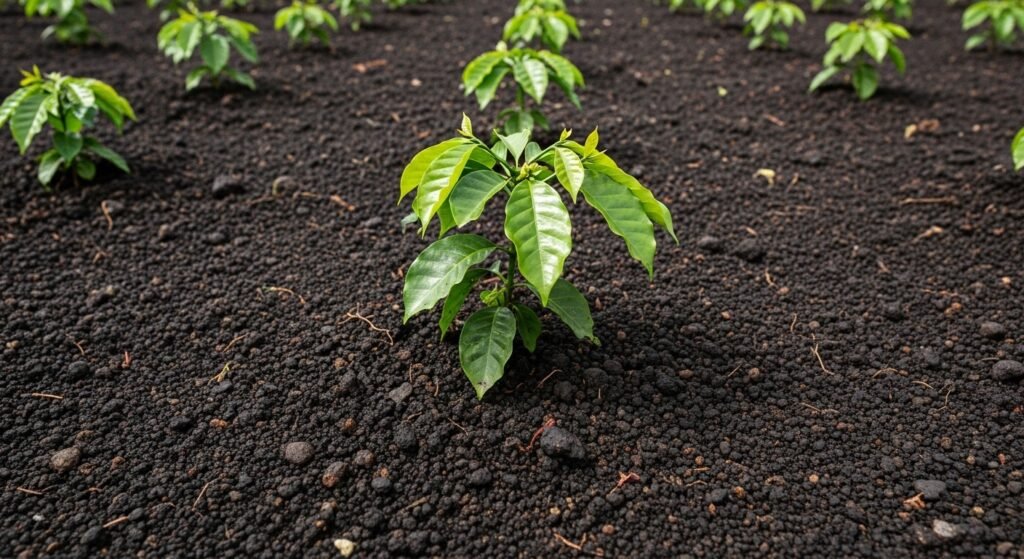
While altitude determines the pace of growth, the soil determines the flavor’s “ingredients.” Coffee is a hungry plant; it extracts an incredible amount of nutrients from the earth to produce its seeds. The most prized soil in the coffee world is volcanic. Regions like Central America, Hawaii, and parts of East Africa sit on volcanic belts where the soil is rich in minerals like potassium, magnesium, and phosphorus.
Volcanic soil is often porous and provides excellent drainage, which prevents the roots from becoming waterlogged while retaining enough moisture to sustain the plant during dry spells. Beyond minerals, the pH level of the soil also plays a silent but powerful role in the cup. More acidic soils tend to produce coffees with higher perceived acidity. When we talk about “minerality” in a coffee—a certain crispness or “clean” feeling on the palate—we are directly experiencing the geological history of that specific farm. This is why a Geisha variety planted in Panama tastes radically different from the same Geisha variety planted in Brazil; the soil “rewrites” the flavor profile of the genetics.
Climate and Microclimates: The Rhythm of the Harvest
Climate is the heartbeat of terroir. Coffee requires a specific balance of rainfall and sunshine to flourish. Ideally, a coffee region needs a distinct wet season to trigger flowering and a dry season to allow for harvesting and drying. However, within a single country or even a single farm, there are “microclimates.” A microclimate is a small area where the weather differs from the surrounding region due to specific factors like proximity to a forest, a river, or a mountain peak that blocks the wind.
For example, a farm located near a tropical rainforest might experience frequent afternoon mists. This mist acts as a natural temperature regulator, shielding the trees from the intense midday sun and further slowing down the maturation of the cherries. This creates a specific “sweetness” that a neighboring farm in a sunnier, drier spot might lack. Wind patterns also matter; cool breezes can prevent pests and diseases like coffee leaf rust (Roya), while harsh winds can stress the trees. The climate is the most unpredictable part of terroir, especially with the current challenges of global warming, which is forcing farmers to move to even higher altitudes to find the “perfect” climate.
Topography and Shade: The Landscape’s Architecture
The final pillar of terroir is topography—the physical layout of the land. The slope of the mountain determines how much sunlight the trees receive. North-facing slopes in the southern hemisphere receive different light intensity than south-facing ones, affecting the sugar concentration in the fruit. Furthermore, the presence of “shade trees” is a critical human-managed part of the terroir.
In shade-grown coffee systems, farmers plant taller trees (like bananas or leguminous trees) over the coffee shrubs. These taller trees do more than just block the sun; they provide a habitat for birds that eat pests, their fallen leaves act as natural mulch and fertilizer, and they create a stable “envelope” of humidity. This “forest terroir” often produces coffee with more delicate and nuanced floral notes compared to “sun-grown” coffee, which tends to be more robust but less complex. The topography also dictates how the coffee is harvested; on steep volcanic slopes, mechanical harvesting is impossible, meaning the terroir itself demands the high-quality human touch of selective hand-picking.

Conclusion: The Soul of the Cup
When we talk about terroir, we are acknowledging that coffee is more than just a commodity; it is a product of the Earth’s diverse landscapes. Geography is the silent architect of every flavor note we enjoy. It is the reason why a morning cup can transport our senses to the misty hills of Rwanda or the sunny plateaus of Minas Gerais.
For the consumer, understanding terroir changes how you shop for coffee. You start looking for specific regions, altitudes, and farm names because you know that those coordinates are a guarantee of a certain sensory experience. It also fosters a deeper respect for the farmers who manage these landscapes. They aren’t just growers; they are stewards of the terroir. The next time you take a sip of a truly exceptional coffee, take a moment to think about the soil, the thin mountain air, and the tropical rains that made that moment possible. You aren’t just drinking a beverage—you are drinking a piece of the world.

Kevin Smith is deeply interested in the craft and culture of coffee, with practical experience exploring specialty beans, brewing techniques, and flavor development. Over the years, he has spent time studying preparation methods, observing extraction processes, and understanding how small details influence the final cup.
Through NovaWeHub, Kevin shares clear, practical, and research-based insights designed to make coffee knowledge approachable for everyone — from beginners to enthusiasts. His focus is on simplifying complex concepts and encouraging readers to explore coffee with curiosity, confidence, and a more refined sensory awareness.